Few cities in the world have been portrayed as often, or as dramatically, as Las Vegas. In movies, television, music, video games, and advertising, Vegas rarely exists simply as a place where a story happens. It influences the story. Its lights, casinos, wedding chapels, luxury suites, crowded sidewalks, and desert surroundings create a mood before a character even speaks.
That is what makes Vegas unusual. New York can represent ambition, Paris can suggest romance, and Los Angeles is often connected with fame, but Las Vegas seems capable of becoming almost anything a storyteller needs. It can be glamorous, dangerous, funny, romantic, lonely, or completely absurd.
Over decades, that flexibility has helped turn the city into one of pop culture’s most recognizable settings — and, in many stories, a character in its own right.
A City Built to Put on a Show
Las Vegas understood spectacle long before spectacle became an everyday part of entertainment culture.
The casinos were always important, but the experience surrounding them mattered just as much. Neon signs, extravagant hotel entrances, live performances, enormous swimming pools, themed resorts, and restaurants designed to impress all helped create a city where ordinary rules appeared to have been temporarily suspended.
The history documented by UNLV Special Collections and Archives shows how closely the development of Las Vegas became connected with entertainment, tourism, gaming, and the constantly changing visual identity of the Strip.
By the middle of the 20th century, the city was already building the mythology that filmmakers would later use. The Rat Pack era added another layer. Frank Sinatra, Dean Martin, Sammy Davis Jr., and other performers helped establish an image of Vegas as a place of tuxedos, cocktails, late nights, and effortless cool.
Hollywood did not have to invent Las Vegas. It simply had to point a camera at it.
Hollywood’s Perfect Playground
The relationship between Hollywood and Las Vegas has produced some of cinema’s most memorable versions of the city.
Elvis Presley gave audiences an energetic, colorful Vegas in Viva Las Vegas. Diamonds Are Forever used the city as a suitably extravagant setting for James Bond. Martin Scorsese’s Casino showed something much darker, exploring power, corruption, violence, and the people attempting to control an industry built around risk.
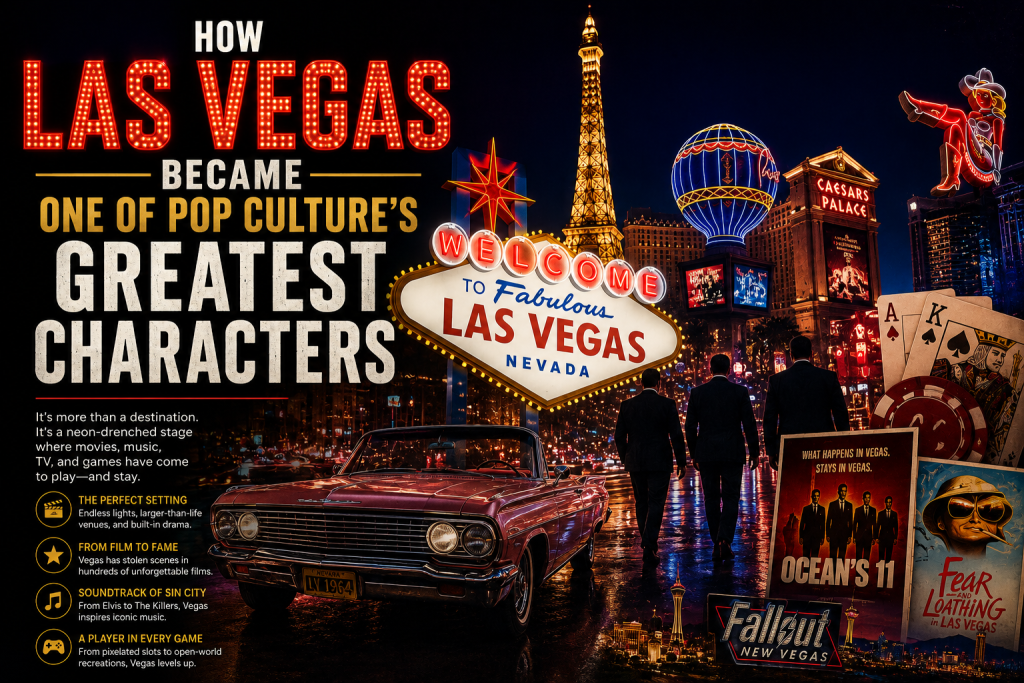
Then there is Ocean’s Eleven, which transformed the modern Strip into an impossibly stylish playground for a group of thieves. A few years later, The Hangover used many of the same ingredients — hotels, casinos, excess, impulsive decisions — and turned them into comedy.
The remarkable thing is that all of these versions feel believable.
That is because Vegas contains contradiction naturally. The same casino floor can represent luxury to one character and desperation to another. A hotel suite can be a celebration in one movie and the scene of a disaster in the next.
Casino imagery has become such a familiar part of entertainment that even audiences who have never visited Nevada instantly understand its visual language. Cards, chips, roulette wheels, and jackpots communicate risk and possibility within seconds. The same fascination now follows audiences online, where searches for the best gambling sites reflect how much casino culture has expanded beyond the physical gaming floor.
More Than a Movie Location
Las Vegas did not become famous through cinema alone. Television has repeatedly used it whenever writers need a destination where characters can behave differently from their normal selves.
The city has also become inseparable from music and live entertainment. A Vegas residency once carried a very specific old-school image, but modern performers have completely redefined the concept. Major artists now treat Vegas residencies as prestige events capable of attracting international audiences.
Video games have built their own versions of the mythology.
Fallout: New Vegas reimagined the region as a post-apocalyptic world while keeping enough casino imagery to remain unmistakably Vegas. Grand Theft Auto: San Andreas created Las Venturas, a fictional city that exaggerated the casinos, lights, and excess audiences already associated with Nevada.
By this point, Las Vegas has developed a kind of visual shorthand. Show a glowing casino sign, a limousine arriving at night, and a character making an impulsive decision, and audiences already know what sort of story they have entered.
That mythology has travelled into digital entertainment as well. Even conversations about the UK’s best gambling sites for real money casinos exist within a broader culture shaped partly by decades of films, games, advertising, and television presenting casino gaming as a distinctive world of its own.
The City That Keeps Recasting Itself
One of the strangest things about Las Vegas is how comfortable it is with destroying its own history.
Famous casinos close. Hotels are demolished. Signs disappear. New billion-dollar resorts appear where earlier landmarks once stood.
In another major city, this might threaten its cultural identity. In Vegas, constant change has become part of that identity.
Its greatest talent may be reinvention.
Each generation receives a slightly different Las Vegas. Older audiences might picture Sinatra, showgirls, and classic neon. Others think of Casino or Ocean’s Eleven. A younger generation might associate Vegas with electronic music, Formula 1, enormous sports venues, viral social media clips, or immersive entertainment.
Yet the basic fantasy remains recognizable.
Technology has also allowed pieces of the Vegas experience to exist far away from Nevada. Someone comparing the best gambling sites may be engaging with casinos in a completely different form, but many of the symbols surrounding that experience — glamour, suspense, chance, and instant transformation — were popularized by the same entertainment mythology Vegas has spent decades building.
A Character That Refuses to Fade Away
What ultimately makes the Las Vegas Strip so valuable to pop culture is that it can play almost any role.
It can be where a character goes to become someone new. It can be where someone loses control. It can represent success, temptation, escape, excess, or the consequences of believing that luck will solve everything.
Most famous cities appear in stories.
Vegas performs in them.
Its skyline changes, its casinos change, and the entertainment surrounding it changes, but its personality remains unmistakable. Loud, artificial, seductive, funny, unpredictable, and completely comfortable with being too much, Las Vegas has spent decades becoming something greater than a location.
It has become one of popular culture’s greatest characters.