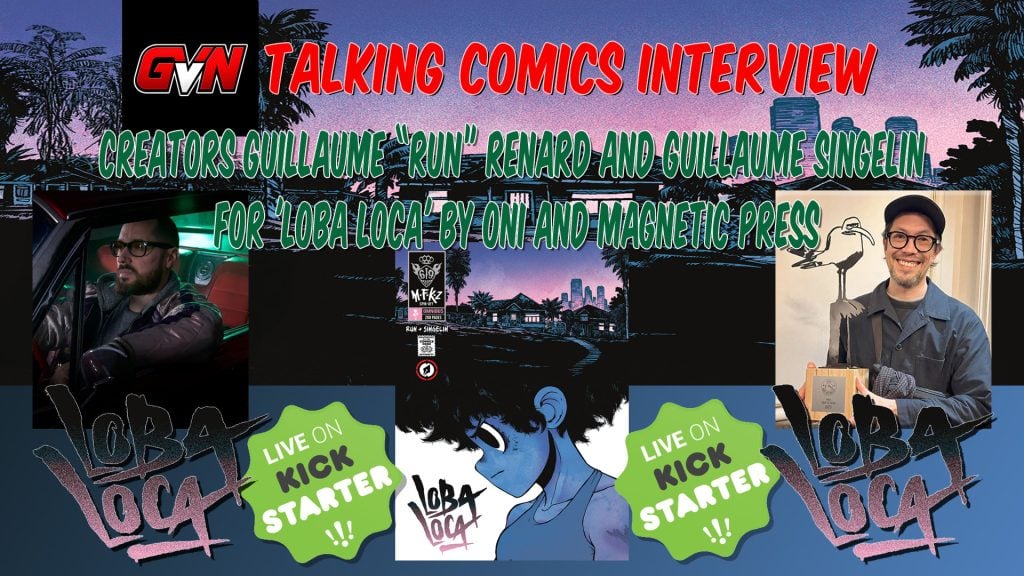
From its inception, Guillaume “Run” Renard’s MFKZ Universe has never been afraid to get loud, weird, and beautifully unhinged. With LOBA LOCA, creators Guillaume “Run” Renard and Guillaume Singelin push that world into a fresh, character‑driven corner. Blending street‑level grit with emotional punch, the duo builds a story that feels unmistakably MFKZ while carving out its own identity. As the graphic novel prepares to launch on Kickstarter through Magnetic Press and Oni Press, we catch up with Run and Singelin to discuss how Loba Loca emerged from the shadows to claim her own spotlight.
Creative Beginnings
GVN: I want to thank you both for sharing just a bit of your time today. Since this is our first opportunity to chat, I want to start with both of your creative beginnings. For each of you, “Run” and Guillaume, when did you first take an interest in art and cartoons specifically, and whose work inspired you to pursue that possibility?
RUN: France is a unique country in that it’s a true cultural crossroads. From a very young age, we had access to works from all over the world. To start, Franco-Belgian comics are extremely popular, and we grew up with their classics. American superheroes were present in newsstands with magazines like Strange, a French magazine that reprinted American Marvel and DC titles between 1970 and 1998.
Manga arrived very early with works like Akira, and then my entire generation grew up watching Japanese anime in the 90s before finding them in bookstores in the 2000s.
We weren’t shaped by a single school of comics. We grew up with Franco-Belgian comics, American comics, and Japanese manga all at the same time.
The authors who have influenced me the most are undoubtedly Katsuhiro Otomo, Frank Miller, Mike Mignola, and Bill Sienkiewicz. But ultimately, it wasn’t so much their graphic style that influenced me as their freedom. Each of them had managed to construct a visual language that was uniquely their own. That’s probably what most inspired me to create comics: understanding that there wasn’t just one way to tell a story.
SINGELIN: Hello, I was lucky enough to grow up in a family with a strong appreciation for culture in general. Although my parents didn’t work in the arts, they were avid readers, watched a lot of films, and we often went to art exhibitions. My older brother was a major influence on me; together we discovered manga like Dragon Ball and Akira, as well as comics like Hellboy and Sin City.
So we always drew, and we continued into our teens. When my brother went to art school, I followed him. That’s how I entered the professional art world.
As I mentioned, I was fortunate to have access to a lot of culture. In France, we’re quite lucky; we had a lot of manga, comics, and Franco-Belgian comics, of course. That’s why it’s difficult to pinpoint a specific influence.
But Otomo (and therefore Akira) was definitely a strong catalyst.
The Inspiration for “Loba Loca”
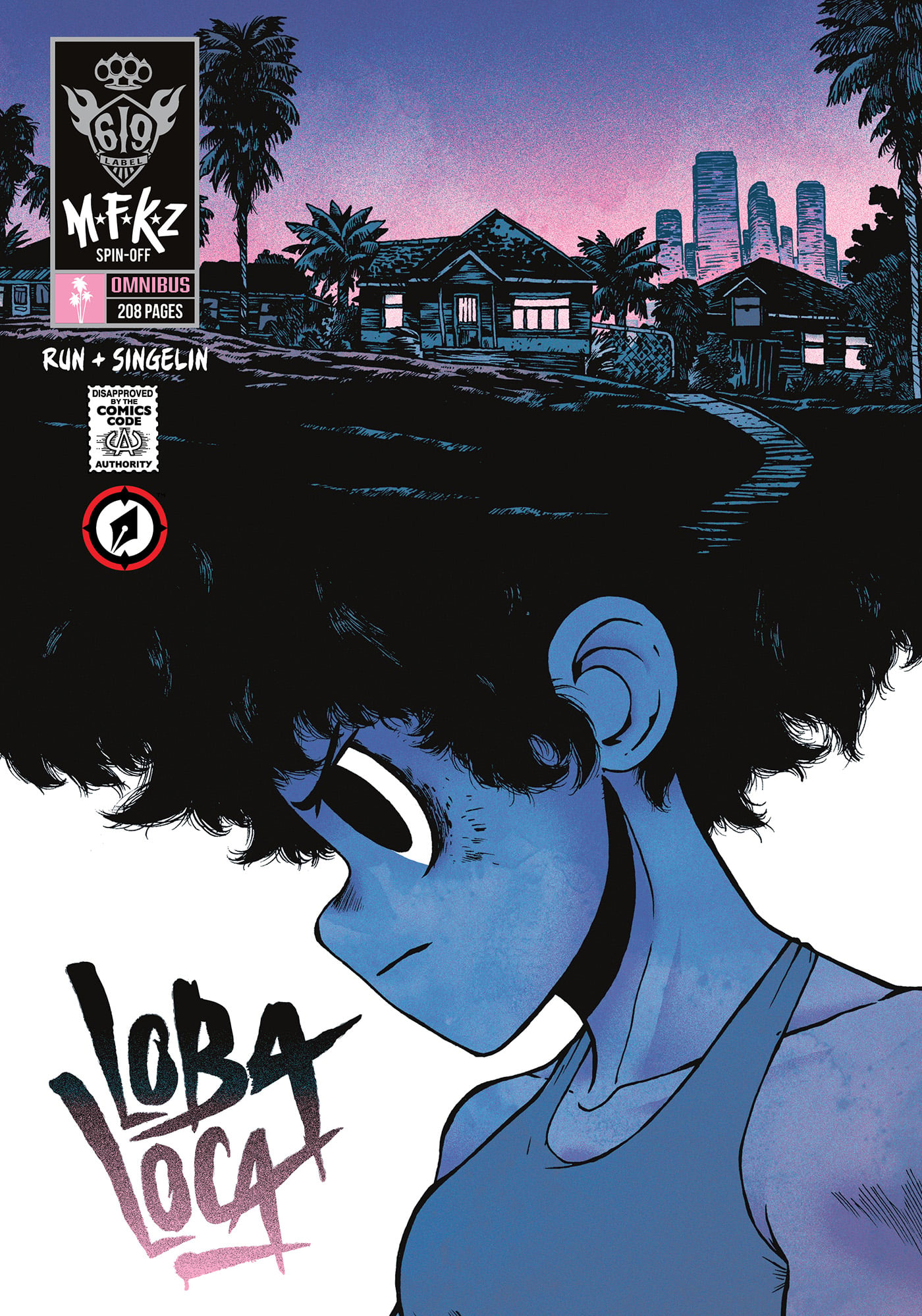
GVN: MFKZ has always been a fascinating collection of distinct characters, and “Loba Loca” expands one of MFKZ’s most intriguing corners. What inspired the creation of a full graphic novel centered on this character and her role in the universe?
RUN : The world of Mutafukaz wasn’t built around a single character. From the start, I wanted to create a world vast enough that each of its inhabitants could become the main character of their own story. Vinz and Angelino are simply a gateway (in MFKZ).
With Loba Loca, we explore territories that the main series could only touch upon superficially: the search for identity, depression…
I also wanted to work with Guillaume Singelin on a spin-off because he knows Mutafukaz very well, having worked with me on the film’s pre-production in Japan. Loba Loca was written specifically for him, as he’s very good at directing intimate narratives. I also wanted to explore another facet of my personality, having become a father myself.
Ultimately, Loba Loca reflects how I conceive fictional worlds. I don’t see them as stories fixed around one or more main characters, but as living worlds that can continue to develop through different points of view, other genres and types of narrative, and other authors.
SINGELIN: I think RUN will be able to talk about this idea better, since it was really him who approached me with it.
However, I can say that MUTAFUKAZ was also one of my major influences. I discovered the first short film and the comic book when I was still a student. When I had the chance to meet RUN, it was incredible to see his way of working, of creating a universe. He quickly offered me the opportunity to participate in the Mutafukaz animated film, so in a way, I was quickly immersed in this world professionally.
At one point, RUN proposed a spin-off focusing on a MUTAFUKAZ wrestler set in Japan. Because of my job, and also the artistic pressure, I had to put this project aside. A few years later, he suggested this road movie idea and this heroine to me. I had gone on holiday to California some time before, and that was the turning point – I finally felt ready to participate in the Mutafukaz universe.
Expanding the MFKZ World
GVN: The MFKZ world keeps growing in unexpected directions (much to your fans’ delight). How did you approach adding new mythology while keeping the tone and attitude fans love?
RUN : I didn’t necessarily try to maintain the tone of the original series, which is more outrageous in my opinion. This story is more measured, more intimate; we take the time to delve into the personality of each of the protagonists. I’m still the writer of the original series, so it’s logical that we find the same kind of humor, the same crazy obsessions. It’s just that focusing on a story with fewer stakes allows us to take our time. In France, Loba Loca was released right after another spin-off, called “Puta Madre,” and the two projects are closely linked (I won’t say more to avoid spoilers).
SINGELIN: I was a Mutafukaz fan, but I think that with a universe like this, it can be approached in many different ways. RUN knows me well, and his idea for Loba Loca resonated with me. I think that if we approach the project sincerely and with passion, the fans will be receptive. We don’t want to give them the same thing, but rather explore the universe with them.
And it also allows us, with different spin-offs, to open the universe to new readers. We created the project primarily for ourselves, but also with the idea that longtime fans would be happy to discover a new part of the story, and for newcomers, it would be a gateway.
Melding Unique Creative Styles
GVN: You both have unique creative styles. How did working together influence Loba Loca’s identity, and what did each of you contribute that helped the project grow?
RUN : For Loba Loca, Guillaume took ownership of the characters’ designs, which are exactly what I wanted. I laid out the general pitch, and Guillaume liked it, so I got to work. In France, the project was released in six monthly installments. While writing, Guillaume and I would call each other and talk about Guadalupe as if she were a mutual friend. It helped us really understand the character, even though she has quite a few contradictions, which we found interesting to explore.
As for the rest, I had sent a lot of reference photos for the backgrounds, and it worked out well because Guillaume had just returned from a trip to California, and I go back there regularly.
SINGELIN: RUN and I already knew each other very well before Loba Loca; we worked together and shared many influences. But we do have slightly different narrative sensibilities. RUN understood this perfectly, which is why I think he shaped Loba Loca with me in mind. He was able to experiment with new narrative approaches, while I felt comfortable with this gentler, more positive story.
Allowing the Artist Their Freedom
GVN: Singelin’s art style has a kinetic, expressive energy that feels perfect for this story. How did that visual approach influence the narrative beats, pacing, or emotional tone of this story?
RUN : When I write for another artist, I never try to impose a layout or staging on them. That would be counterproductive. If I work with an artist like Guillaume, it’s precisely because I want to benefit from his perspective and sensitivity.
I’ve known Guillaume for a very long time. I know how he tells a story, how he paces a scene, how he brings his characters to life. When I was writing Loba Loca, I had Guillaume’s style in mind. I wrote Loba Loca for him. If he hadn’t been available or if he had said no, the project simply wouldn’t have existed.
His artwork brings a very particular energy, but also a great deal of humanity. Guillaume is able to make his characters extremely expressive without ever resorting to caricature, which inevitably influences the rhythm of the story. I could let the story breathe, linger on a silence or an attitude, because I knew he would be able to give them weight.
In the US, I’ve noticed that “big” projects are often segmented into roles like writer/pencil artist/inker/colorist… and each has their place. Loba Loca is more the result of a dialogue between two authors, not just a script illustrated by an artist.
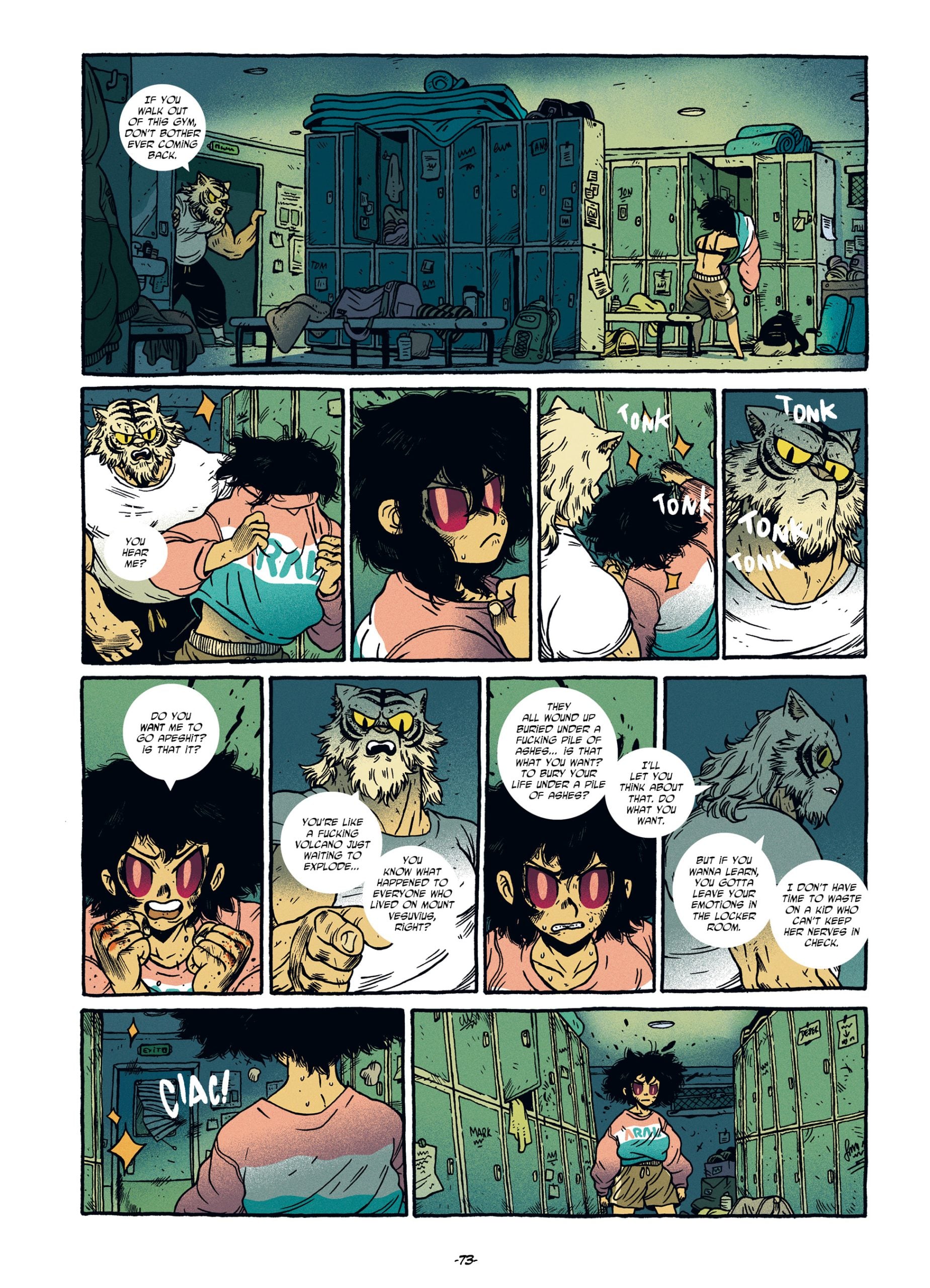
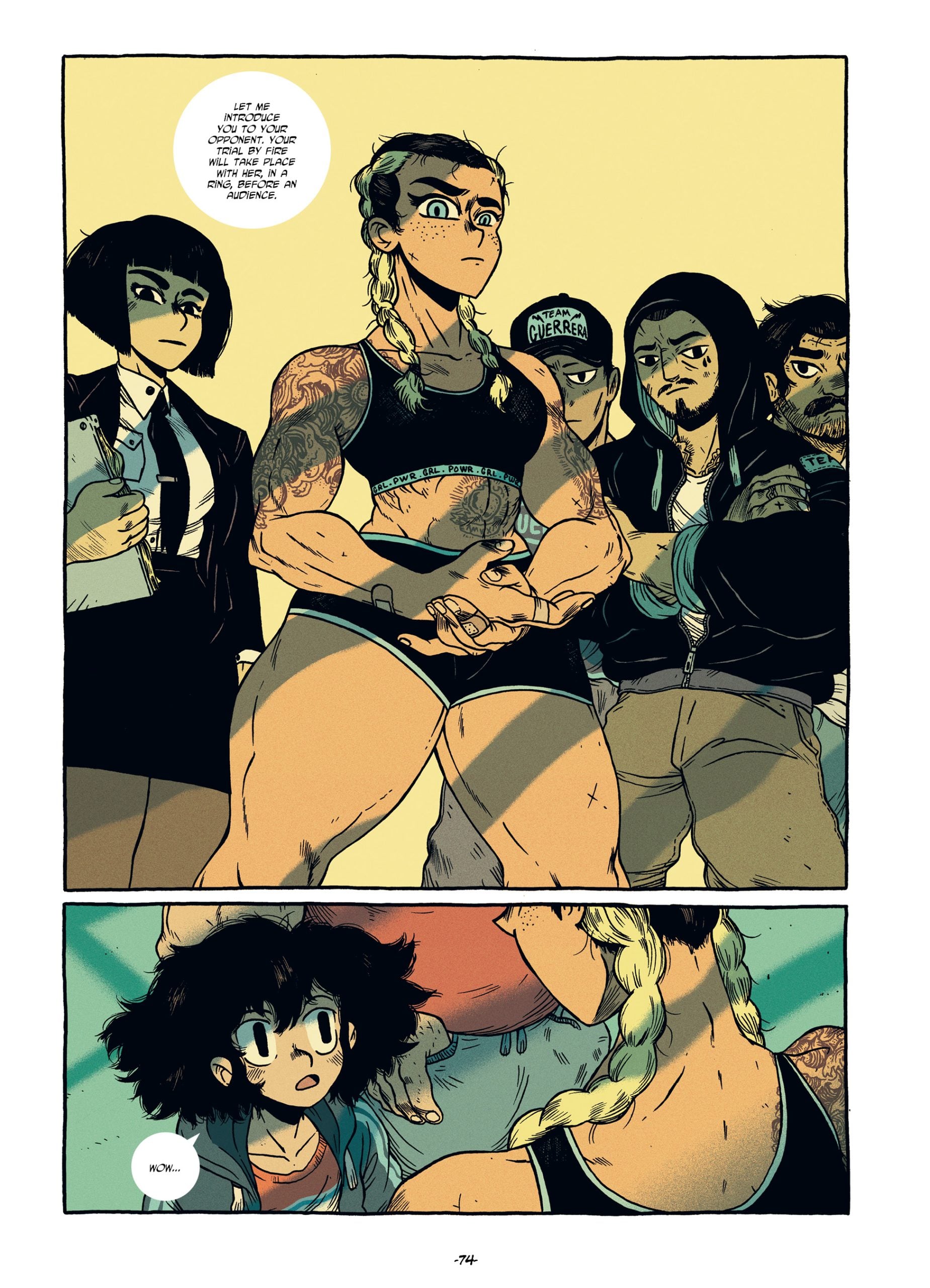
SINGELIN: My idea was to create a feel-good story, so something rounder, more colorful, and very energetic, like Gadalupe. Again, I didn’t really think about it much; as I read the story, my designs adapted to it quickly. Plus, I was lucky enough to already have the entire RUN universe at my fingertips, with its thousands of photos of California.
This story is more intimate than the main work, so the focus was really on giving the two main characters a lot of space, making them as vibrant as possible. They are truly the heart of the story.
The Character of Guadalupe
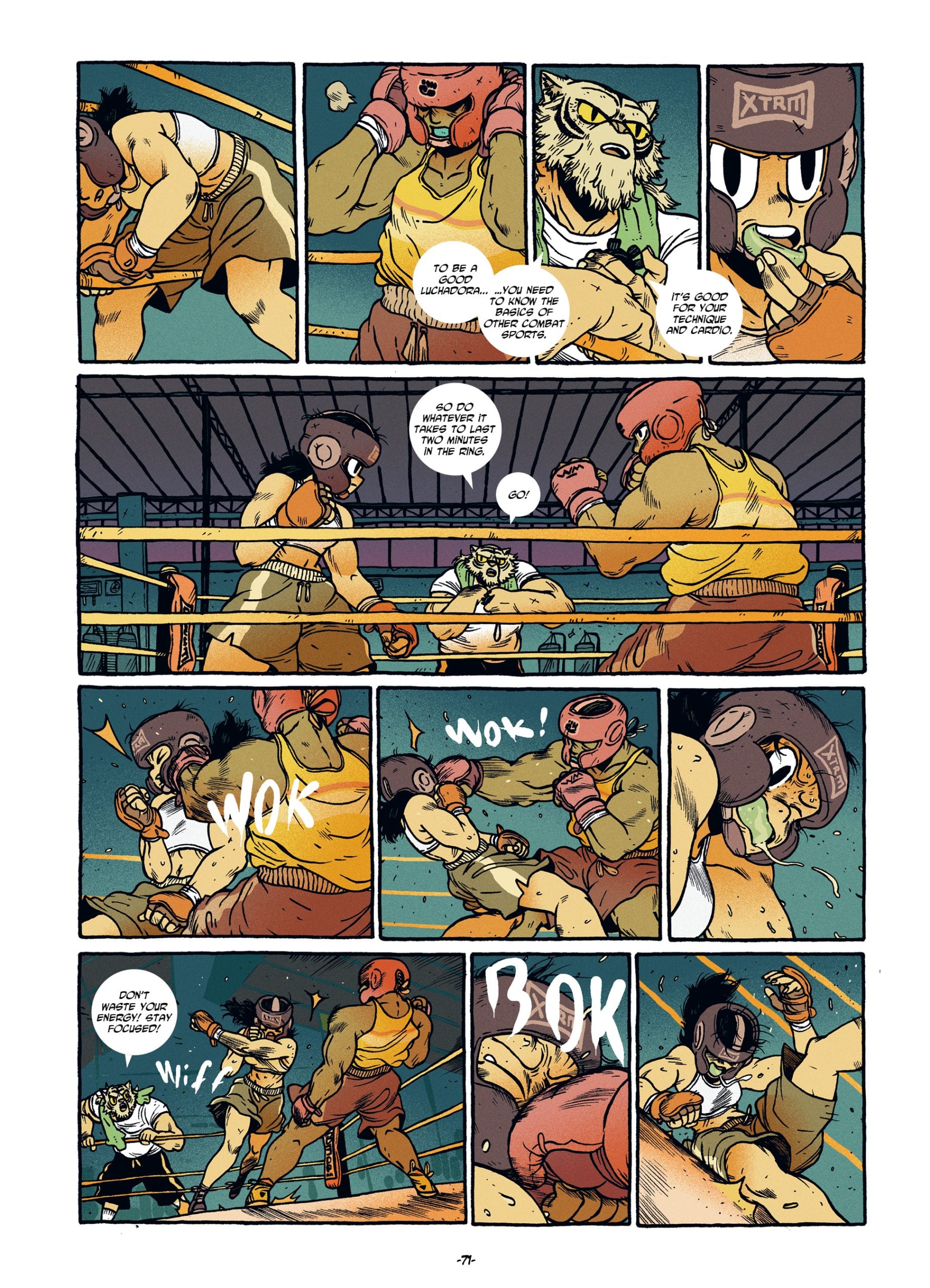
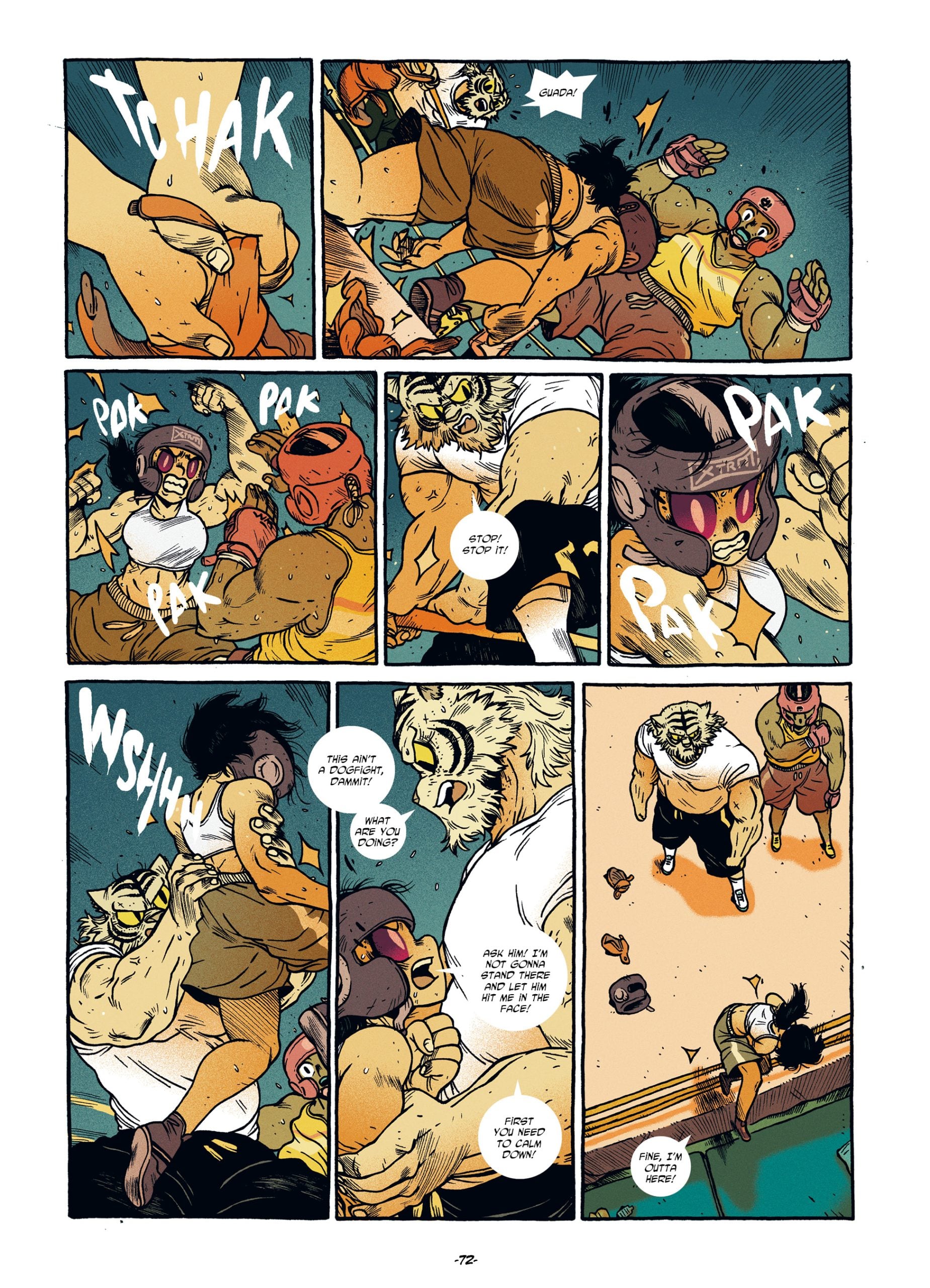
GVN: As the title suggests, Loba Loca takes center stage here. What aspects of her personality, history, or motivations were most thrilling to explore in depth?
RUN : Guadalupe is a character steeped in duality (much like the story itself). The name Guadalupe refers to the Virgin of Guadalupe, a symbol of Latin American identity. Mayflower, on the other hand, evokes the ship of the first Spanish colonists. I found it interesting that her identity was even inscribed in her name: two heritages, two sometimes opposing visions, coexisting within her and fueling her quest for identity. What also interested me was changing perspectives on this world. Through her, we could explore different themes, but also show another facet of Dark Meat City. A city doesn’t change, but depending on the character we follow, it can tell a different story. In this case, a much brighter and more optimistic one. That’s also what I love about fictional worlds. A good character doesn’t just serve to advance the plot: they allow us to reveal aspects of the world that other characters can’t show.
SINGELIN: Guadalupe is the heroine, of course, but what’s also important is her relationship with Tigre, who are complete opposites in terms of character and behavior. So the most interesting aspect was exploring their relationship, how they learn from each other, their disagreements—that’s really what strengthens them throughout the story.
Kickstarter
GVN: Bringing Loba Loca to Kickstarter with Oni and Magnetic Press creates a unique launch path. What opportunities does crowdfunding open for a project like this?
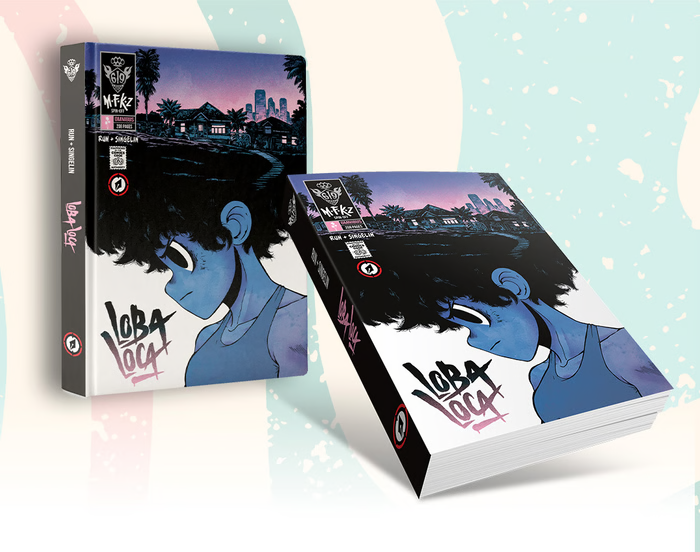
SINGELIN: For me, the most important thing is to make this project accessible in English; it’s always cool to reach a new audience, and on a finished project, we have more time to make goodies, cool objects, which Magnetic Press has done very well!
The MFKZ Universe AFTER “Loba Loca”
GVN: Thank you once again for talking with us. Finally, without spoiling anything, does “Loba Loca” set the stage for new stories, characters, or directions you’re excited to explore next within the MFKZ universe?
SINGELIN: I’ll let RUN answer that, hehe. He’s the architect of this crazy universe!
RUN : In France, several projects related to MFKZ already exist: Puta Madre (of which Loba Loca could be considered a sequel), volume 0 “It Came from the Moon,” a soft reboot “MFKZ 1886,” as well as MFK2, which I’m currently working on… And also a psychedelic reimagining with “Metamuta,” which explores Angelino’s subconscious… I think the universe is a gigantic sandbox, but I may stop after MFK2.
Our thanks to Run and Singelin for taking us deeper into the heart of LOBA LOCA, a story that proves the MFKZ Universe can hit just as hard emotionally as it does visually. Their collaboration brings nuance, grit, and humanity to a character stepping into her own spotlight. As the project heads toward Kickstarter, it’s clear this graphic novel isn’t just an expansion — it’s a statement about where MFKZ can go!
You can check out the Kickstarter campaign.

Senior Writer at GeekVibesNation – I am a 60 something child of the 70’s who admits to being a Star Trek/Star Wars/Comic Book junkie who once dove headfirst over a cliff (Ok, it was a small hill) to try to rescue his Fantastic Four comic from a watery grave. I am married to a lovely woman who is as crazy as I am and the proud parent of a 21-year-old young man with autism. My wife and son are my real heroes.