If you have a binder of Pokémon or Magic cards in a closet, the hardest part of getting back into the hobby is not figuring out what the cards are worth. It is finding a human being nearby who will talk to you about them. There are around 5,700 local game stores operating in the United States right now, in roughly 2,600 cities. About two out of three of them publish nothing online about what they actually have in stock, which is why it feels like they all closed. They did not. They just went quiet on the internet.
There is a specific feeling that hits somewhere in your late thirties, usually while cleaning out a closet.
You find the binder. The cheap one with the warped plastic sleeves. Inside is a holographic card you remember trading a friend three lunches for, and a stack of commons you kept because you liked the art.
And the thought arrives fully formed: I wonder if this is worth anything.
That thought is almost never really about money. It is about the fact that you were eleven, and this mattered enormously, and you want to know if the thing you cared about still exists somewhere out in the world.
It does. It is just harder to find than it should be, and the reason is genuinely strange.
What Is The Old Collection Actually Worth?
Let us handle this part quickly and honestly, because it is the question that got you here and the answer is usually disappointing.
Most of it is worth very little. The overwhelming majority of cards ever printed are commons and uncommons that were printed in enormous quantities, and a warped binder in a humid closet has not been kind to them.
Value in this hobby concentrates brutally. It sits in a small number of specific cards, in genuinely good condition, from specific print runs. A card that looks identical to you can be worth two dollars or two hundred depending on a set symbol in the corner and whether the edges are clean.
So the honest version is this: your binder probably contains a handful of cards worth real money and a great deal of cardboard worth keeping for sentimental reasons only. That is not a sad outcome. It is just the actual shape of the thing.
The part nobody tells you is that finding out which is which is a social problem, not a technical one. There are apps that will scan a card and show you a price. What they cannot tell you is whether the crease you are squinting at matters, or whether the version you have is the one people want. For that you need a person who handles a few hundred of these a week.
Those people work at local game stores. Which brings us to the strange part.
Why Does It Feel Like Every Card Shop Closed?
Because you looked for them the way you look for everything else.
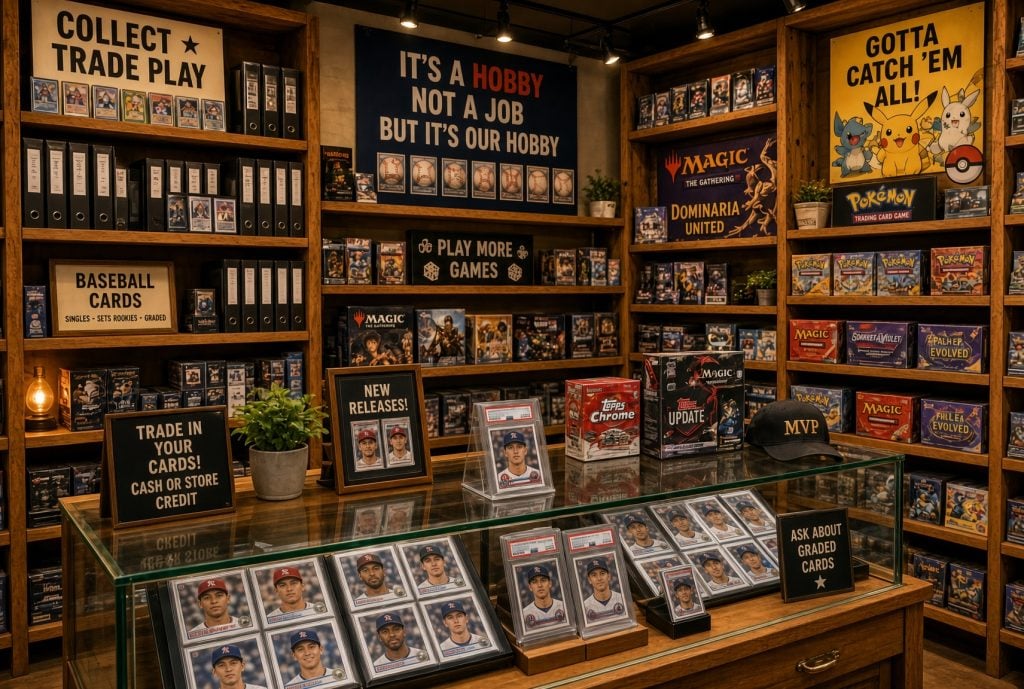
We build a live index of what independent card shops have on the shelf. As of the end of August 2026, that index covers around 5,700 stores across roughly 2,600 American cities. These are not warehouses. They are small businesses with a counter, a play space in the back, and someone behind the register who knows the difference between a first edition and a reprint.
Two out of three of those shops publish no inventory online at all.
Not a bad website. Not an out-of-date website. Nothing online whatsoever. They have an address, a phone number, usually a Facebook page that gets updated when there is a tournament, and a glass case full of exactly the cards you are curious about. None of which shows up when you search.
So when you type a card name into a search engine and get nothing but national marketplaces, you are not learning that local shops do not have it. You are learning that local shops do not have websites. Those are extremely different facts, and almost everyone confuses them.
Why Would A Store Choose To Be Invisible?
This is where the reflex is to call the shops backwards, but the economics are what I find interesting.
Keeping a live singles catalog current is genuinely brutal work. A shop might handle tens of thousands of distinct cards, each in multiple printings and conditions, with prices that move weekly and stock that changes every time someone walks in. Keeping that inventory accurate is a full-time job, at a business that often runs on two or three people.
Some owners have decided, not unreasonably, that their advantage is the counter, the play space, and the conversation, and that putting the inventory online mostly invites hassles they did not ask for.
The result is a retail category that is one of the last genuinely unsearchable spaces left in American life. Almost everything else got indexed. This did not.
Whether that is charming or maddening depends entirely on whether you are trying to find something.
Where Do You Actually Start?
The practical answer has three steps, and the first one is the one people skip.
Find out what is actually near you. Most people dramatically underestimate this. Card shops cluster in strip malls and second-floor units and do not advertise, so the mental map you have of your own town is usually wrong. You can look up the game stores in your city and state to see what is genuinely within driving distance, which is often several more than you expected.
Then call. I realize this is unfashionable advice in an article on the internet. But given that two out of three shops publish nothing, the phone remains the highest-yield tool in this entire hobby, and it will stay that way for years. Five minutes on the phone beats an hour of searching, because you are querying the one database that is actually complete: the person standing in front of the case.
Then go on a weeknight. Most shops run league or tournament nights, and that is when the people who can actually answer your questions are in the building and in a good mood about it.
If you are hunting one specific card and nobody nearby has it today, that is a normal outcome rather than a dead end. Shops restock constantly, and you can get an email when a nearby shop puts one back on the shelf rather than driving the loop again next weekend. (There is a paid tier for people watching a lot of cards at once; the basic version costs nothing.)
What Should You Know Before You Walk In?
A few things that make the first visit better, learned the hard way.
Bring the cards in something rigid. A shoebox is fine. A grocery bag is how corners get dinged on the drive over, and corners are a meaningful part of what you are about to be told.
Ask what they are looking for rather than what your cards are worth. Shops buy what they can sell locally, which depends on what people in your specific town play. The same card can be an easy sale in one city and dead stock in another.
And be clear about what you actually want. “I want cash for these” and “I want to get back into this” lead to completely different and equally good conversations, but only if you say which one you mean.
Frequently Asked Questions
Are my old cards from the 90s automatically valuable because they are old? No, and this is the single most common misconception. Age is not scarcity. Many 90s sets were printed in vast quantities precisely because the hobby was booming. Condition and the specific card matter far more than the year.
Should I get my cards graded before selling them? Usually not, at least not first. Grading costs money per card and only pays off on cards that are both genuinely valuable and in excellent condition. Find out what you have before spending anything on slabbing it.
Is a local shop or an online marketplace better for selling? They solve different problems. A marketplace reaches more buyers and takes longer, with fees and shipping. A shop is one conversation and cash or store credit the same day, usually at a lower number because they have to resell it. Neither is a rip-off; they are different trades.
How do I know if a shop is trustworthy? Go on a league night and watch how the staff talk to regulars. A shop that runs events for the same people every week has strong reasons to treat a walk-in fairly. Reputation is extremely local in this hobby.
Do card shops still exist in smaller towns? More than most people think. The distribution is genuinely national rather than clustered in big cities, though density varies a lot. It is worth actually checking your area rather than assuming.
Is it too late to get back into it as an adult? Adults are a large share of who these shops serve. The people running the counter were also eleven once, and got the same feeling from the same binder. That is generally why they opened a store.

Hi! I’m Bryan, and I’m a passionate & expert writer with more than five years of experience. I have written about various topics such as product descriptions, travel, cryptocurrencies, and online gaming in my writing journey.