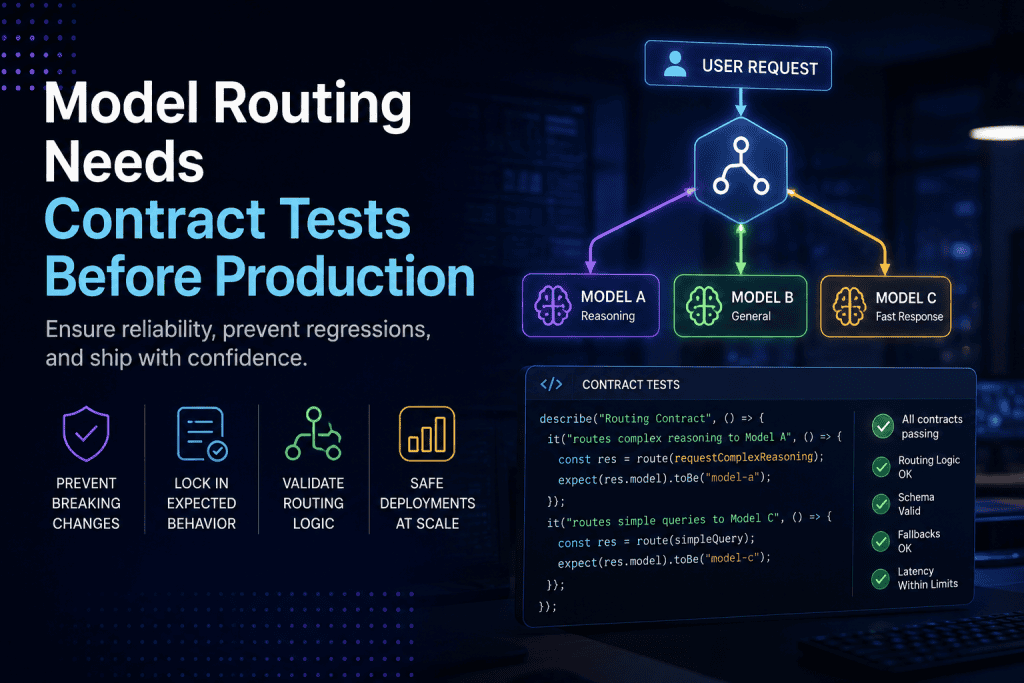
A pull request that changes only a model name can look too small to deserve a release plan. The client stays in place, authentication is unchanged, and the diff may be one line. A developer using Router Base can avoid rebuilding an integration for every provider. The hidden risk sits beyond the request: wire-compatible models can still return results the application cannot use.
Take a support-summary feature as a bounded example. One model returns valid JSON but leaves the answer field blank. Another streams a sentence before the application finishes its checks. A fallback returns a useful answer that is too long for the card. RouterBase can carry chat, image, video, and audio calls through a common API surface. It cannot decide what this product is willing to display, save, or reject.

OpenAI Compatibility Stops at the Transport Layer
OpenAI compatibility tells developers how to send a request and parse the outer response. It saves adapter work, especially when several providers sit behind the same client. The product contract begins one layer later: which fields may be empty, what can reach the interface, and which result forces a retry or a visible failure.
Define What Your Application Actually Accepts
Write the acceptance rule before adding a second route. For a summary card, that rule might require a non-empty answer, an allowed status value, and a maximum display length. Validate the result at the server boundary before storing it or sending it into a stream that the interface will render.
An HTTP success code records a transport fact. If the parser silently substitutes defaults for a missing field, the bad result can travel several services before anyone notices. Reject it where it enters the application, attach a reason the logs can search, and return the known UI state chosen for that feature.
Handle Synchronous Calls and Asynchronous Jobs Separately
RouterBase documents chat and image generation as synchronous calls. Video and audio work differently: the initial request returns a task ID, and the client checks the task later by polling or by receiving a callback. Treating both patterns as one generic completion event produces brittle code.
For a synchronous call, the client needs a timeout and a validator before it hands the result to downstream code. An asynchronous job needs durable states such as pending, completed, and failed. Its task ID must survive a worker restart, and a repeated callback must not create a second final record. Submitting a video task is not the same event as receiving usable media.
Build a Small Evaluation Set Before Routing
Start with roughly ten redacted requests drawn from QA cases, support tickets, and known parser failures. Keep one simple control, several ordinary examples, and a few inputs that previously produced awkward UI states or manual cleanup. This is not a public model ranking. It is a repeatable check against the software the team is shipping.
| Contract surface | Representative check | Pass signal | Record to keep |
| Structured response | Required fields and allowed values | Validator accepts the result | Model, route, schema version |
| Streaming chat | Partial output and final event | UI never exposes an unusable state | First usable event and final status |
| Async media | Submit, poll or callback, download | One job reaches one final state | Task ID, status history, owned file |
| Rate limit | Controlled HTTP 429 response | Backend delays or sheds work safely | Retry decision and request count |
Ten cases fit into continuous integration and remain quick enough to run for every route change. When one fails, keep the model, route, schema version, and rejected output together. Add a fixture only when it exposes a distinct product failure; near-duplicate prompts make the suite slower without giving the release decision new evidence.

Freeze One Fixture Before Changing a Route
Remove private data from each fixture, not the constraint that made it useful. Preserve the long instruction, required output shape, tool request, or rejection condition that stressed the original feature. A sanitized prompt that becomes easier than the real task creates a comforting test and a poor release gate.
A team evaluating RouterBase can reuse the fixture across different models without rebuilding each provider connection. Keep the prompt, validator, and timeout fixed for the comparison. If all three change with the route, a green result cannot tell the reviewer which edit repaired the failure.
Make 429 and Duplicate Callbacks Boring
Run the error paths in CI or staging, where they can be repeated without harming live work. A documented 429 should enter one server-side retry policy, not send every browser or worker into its own loop. A local timeout should end in a named UI state. For asynchronous jobs, deliver the same callback twice and confirm that both deliveries point to one final record.
The gateway reports the condition. Product code still chooses the retry delay, the message a user sees, and the idempotency key that prevents duplicate work. Leaving those choices implicit is how a routine capacity response turns into a retry storm or a second billable job.
Fallback Changes Behavior Even When Requests Succeed
RouterBase presents routing by price, latency, or availability and automatic fallback after an upstream error or timeout. Suppose that fallback returns HTTP 200 but renames a JSON field the parser requires. The provider call recovered; the feature still broke. Every fallback result therefore belongs behind the same application validator as the primary route.
Approve Fallbacks With the Same Contract Suite
An untested model does not belong in a production fallback list simply because it accepts the same endpoint. Run the stable fixture against it and inspect the rejected cases, not only the average score. A candidate that drops a required field or changes a tool request may still suit another workload, but it is not a safe fallback for this one.
After the candidate passes, enable it for one feature or workload and keep the previous route configuration ready. Watch the validator failures that reach application logs. A provider-wide switch trades a small configuration diff for a large debugging surface; feature-level release history makes the first bad result much easier to trace and roll back.
Keep Product Decisions Beside Gateway Logs
RouterBase logs can show the model, request parameters, task status, credits, result, and error details. That answers what the gateway saw. The deployment record must answer a different question: which contract version approved this route, and what evidence would cause the team to remove it?
Keep the contract-suite version, approved models, fallback order, application timeout, and rollback owner in the same change record. For generated media, copy accepted files into storage controlled by the product team; the documented platform retention window for generated video and image files is 14 days. The task log can prove delivery without serving as the product archive.
Merge Route Changes Only After Contract Checks
A route change is ready to merge when three artifacts exist: a green contract run, an approved fallback list, and a named rollback owner. That is enough for a small team. It does not require a governance deck, but it does prevent a one-line model edit from bypassing the checks applied to every other production dependency.
A team calling one stable model may decide that a gateway adds little. The calculation changes when models, providers, or modalities move often enough to create repeated adapter work. A common API can remove that chore. Keep the acceptance gate inside the application, where the team can decide exactly what reaches its users.

Caroline is doing her graduation in IT from the University of South California but keens to work as a freelance blogger. She loves to write on the latest information about IoT, technology, and business. She has innovative ideas and shares her experience with her readers.