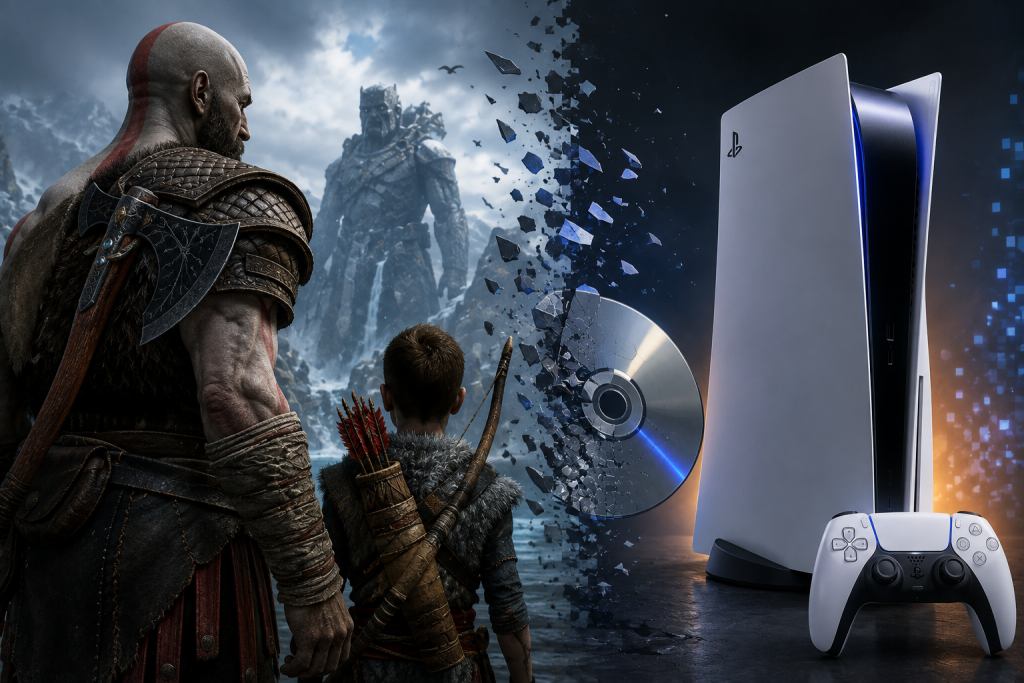
Sony’s decision to stop producing physical discs for new PlayStation games has been met with anger, disappointment and concern from players who still value owning something they can place on a shelf.
David Jaffe, the creator of the original God of War, understands why those players are upset. He also believes the uncomfortable explanation behind Sony’s decision may be relatively simple: most PlayStation customers have already moved toward digital games.
Responding to the ongoing debate, Jaffe argued that the familiar idea of the customer always being right becomes more complicated when different groups of customers want completely different things.
“The needs of the many customers outweigh the needs of the fewer customers.”
Jaffe was not claiming to possess inside information about Sony’s planning. He is no longer employed by the company and was offering his own interpretation of the decision.
His argument is that Sony may be choosing to serve the larger number of players who purchase games digitally, even if that means abandoning a smaller but deeply committed physical-media audience.
That may explain the business logic. It does not make the consequences any less significant.
Sony Will Stop Producing Discs For New Games In 2028
Sony announced on July 1 that physical disc production for all new games released on PlayStation consoles will end beginning in January 2028.
The policy will apply to first-party PlayStation games and releases from outside publishers. After the cutoff, new titles will be distributed through the PlayStation Store and sold by retailers in digital formats rather than on playable discs.
The announcement does not mean existing PlayStation discs will suddenly stop working.
Games released physically before January 2028 are not affected by the change. Retailers may also continue selling remaining inventory, and players will still be able to use compatible discs they already own.
The decision is instead about future releases. A game launching after the policy takes effect will no longer receive a traditional PlayStation disc, even if it is sold through a physical retailer.
A store could potentially sell a download code or packaged digital edition, but customers would not receive a disc they could install, lend, trade or resell.
David Jaffe Believes Sony Is Following Its Customers
Jaffe’s position begins with the growing difference between physical and digital sales.
Digital purchases now account for the overwhelming majority of full-game sales across PlayStation consoles. Players can buy a title from home, begin downloading it immediately and access it without placing a disc into the console each time they want to play.
That convenience has gradually changed customer behavior.
Many players also build libraries around one PlayStation account, making digital purchases feel like the natural option when upgrading to another console or switching between devices.
Jaffe believes Sony is looking at that behavior rather than the intensity of the reaction online.
Physical-media supporters may be passionate, vocal and highly engaged, but Sony’s internal sales data likely shows that they represent a shrinking percentage of the company’s overall software business.
From that perspective, maintaining disc production means continuing to support manufacturing, packaging, shipping and retail systems for the smaller of two customer groups.
Jaffe’s argument is not necessarily that ending discs is good for every player. It is that companies tend to make decisions around the behavior of the largest portion of their audience.
The Majority Can Be Larger Without Being More Important
The phrase “the needs of the many” makes Sony’s decision sound like a simple calculation. If more people purchase games digitally, then digital distribution should receive the company’s attention and resources.
The problem is that physical and digital customers do not place the same demands on Sony.
A digital customer is not harmed because another player has the option to purchase a disc. Both formats can exist beside one another, as they have throughout the PlayStation 5 generation.
Physical customers will lose an option under Sony’s new policy, while digital customers will continue buying games in essentially the same manner they do today.
That distinction is why the announcement has created such a strong response. Sony is not merely prioritizing digital distribution or releasing fewer physical editions. It is removing discs from every new PlayStation release after the cutoff.
The number of customers affected may be smaller, but the effect on those customers will be considerably greater.
Physical Games Offer More Than A Different Installation Method
For some players, the debate is about the satisfaction of owning a case, disc and piece of artwork. Collectors enjoy building libraries that physically represent the games they have played over the years.
However, the value of physical media extends beyond collecting.
A disc can be lent to a friend, shared within a family or sold when its owner has finished playing. Customers can purchase used games from local stores, online marketplaces and other players without waiting for a digital sale.
Retailers also compete with one another on price. One store may discount a new release, another may offer a trade-in promotion and a third may lower the price to clear remaining inventory.
Digital distribution changes that relationship.
Once discs disappear, the PlayStation Store becomes the primary marketplace for playable copies of new PlayStation games. Retailers may sell digital codes, but they cannot create a second-hand market around those purchases.
A player cannot finish a downloaded game and sell the license to someone else. The purchase remains connected to an account and subject to the platform’s access rules.
For people who regularly trade games to help pay for their next purchase, the end of physical media represents a meaningful increase in the long-term cost of gaming.
Digital Sales Are More Profitable For Sony And Publishers
Customer preference is only one reason companies favor digital games.
Digital distribution removes many of the costs and risks associated with physical products. There are no discs to manufacture, cases to print or copies to ship around the world.
Publishers do not need to estimate how many units each retailer will sell, manage unsold inventory or replace defective products. A digital copy can remain available without occupying warehouse or shelf space.
More importantly, the platform and publisher receive revenue from each new digital transaction. Used physical sales allow the same copy to pass between several people without creating another sale for Sony or the game’s publisher.
Former Square Enix business development director Jacob Navok has argued that players who strongly value physical media should be prepared to pay more for it because physical copies cost companies more to produce and distribute.
That argument raises another question: Were customers ever given a meaningful opportunity to make that choice?
Publishers generally decide whether a game receives a physical edition and what that edition costs. Consumers cannot voluntarily pay more for an option that a company has decided not to manufacture.
Limited-edition companies have shown that portions of the gaming audience will pay a premium for smaller physical production runs. Sony’s policy removes even that possibility for new PlayStation releases unless some form of exception is introduced later.
Sony Says Digital Preferences Significantly Outpace Discs
Sony’s public explanation closely resembles Jaffe’s interpretation.
The company said consumer preferences and the wider entertainment industry have continued moving away from discs. It described the transition as a natural response to the way most members of the PlayStation community now access games.
Recent sales data supports the conclusion that digital games are dominant.
Roughly four out of every five full PlayStation game purchases have been digital during recent reporting periods. That ratio does not include every type of gaming transaction, but it demonstrates how dramatically the market has changed since the beginning of the PlayStation 4 generation.
Sony has also said it does not expect ending discs to create a significant negative effect on its business.
That confidence may be the strongest indication that the company does not expect the physical-media backlash to translate into enough lost customers or revenue to reverse the decision.
Hundreds of thousands of physical copies can still be sold while representing a relatively small part of a platform used by more than 100 million active accounts.
Both facts can be true. Physical games can remain commercially meaningful while no longer being large enough to influence Sony’s overall strategy.
Digital Popularity Does Not Eliminate Preservation Concerns
Sales figures measure what customers are buying now. They do not fully address what happens to games decades later.
A physical disc creates an independent object that can survive after a storefront changes, a publishing agreement expires or a title is removed from sale. That disc may not always contain a completely updated version of the game, but it can preserve at least some form of the original release.
Digital games depend on accounts, servers, licenses and continued platform support.
Sony can allow previously purchased games to remain downloadable after they leave the store, and that is commonly what happens. However, access still depends on the company maintaining the necessary systems and recognizing the customer’s license.
Preservation becomes especially complicated when a game disappears before someone has purchased it. Once a digital-only title is delisted, there may be no legal way for a new player to obtain it.
A physical copy can remain in circulation through used stores and collectors long after official production ends.
The loss of that backup does not matter only to people who prefer decorated shelves. It affects historians, preservation groups and future players attempting to understand how the medium developed.
Digital Games Can Be More Convenient Without Being Permanent
The popularity of digital purchases is not difficult to understand.
Players do not need to travel to a store or wait for a delivery. Games can be preloaded before release, launched without changing discs and downloaded again after being removed from a console’s storage.
Digital libraries are particularly useful for handheld devices, remote play and households that frequently move between more than one system.
Those conveniences are real. Physical-media supporters do not need to deny them to make a case for preserving both options.
The concern is that convenience at the time of purchase is not the same as control after the purchase.
Customers who buy digitally cannot resell the product, lend it in the traditional sense or move it freely to a different platform. Their access exists within the rules of the PlayStation ecosystem.
Most users may never encounter a problem. Their libraries could remain available throughout every console generation they use.
The debate is about what they are legally and practically able to do if those conditions change.
Retailers Will Need To Adapt To A PlayStation Without Discs
Sony says retailers will continue participating in the sale of new PlayStation games after physical disc production ends.
That may involve download codes, gift cards or packaged products containing digital access rather than playable media.
Those products can preserve some retail presence, particularly for customers who use cash or purchase games as gifts. They do not replace the economic system created by physical software.
Game stores generate revenue from trade-ins and used sales. A single physical copy can return to a retailer several times, creating more opportunities for customers to buy, sell and exchange products.
Digital codes are generally sold once. After redemption, they have no second-hand value.
Large retailers can shift shelf space toward accessories, gift cards and collectibles. Independent game stores may have a more difficult time replacing the used PlayStation business as newer physical releases gradually disappear.
The change will not happen all at once in January 2028. Older games will remain in circulation for years.
However, every new digital-only release will make the physical PlayStation market slightly more dependent on an aging catalog.
Jaffe Is Explaining The Decision, Not Celebrating Every Consequence
Jaffe’s comments are likely to frustrate players who believe Sony is ignoring them.
His position can sound like a dismissal of physical customers as an insignificant minority whose preferences no longer matter.
A more generous reading is that he is separating what customers want from what a corporation is likely to do.
Sony may genuinely understand the emotional, financial and preservation arguments surrounding physical media. That does not mean the company will continue supporting a format if it believes digital distribution better serves its larger strategy.
Jaffe’s point is fundamentally about business incentives.
Companies often say they listen to customers, but no company can satisfy every customer when their preferences conflict. Management eventually decides which group represents the strongest source of future growth.
In Sony’s case, that group appears to be customers who already purchase nearly everything through the PlayStation Store.
Calling Physical Players A Minority Does Not Settle The Debate
The strongest part of Jaffe’s argument is that Sony’s decision did not emerge without evidence.
Digital sales dominate the PlayStation business, and the company has watched that percentage increase for years. Ending discs is not a random attempt to force customers toward a format they have completely rejected.
The weaker part is the assumption that serving the majority automatically justifies removing a choice from everyone else.
Digital customers do not need physical games to disappear for digital distribution to remain convenient and profitable. Sony is choosing complete standardization over maintaining two methods of sale.
That choice may reduce costs, increase control and reflect current buying habits. It also removes competition and flexibility from the market.
The issue is therefore larger than whether more people buy digitally.
It is about whether a dominant platform holder should maintain a less popular format because that format provides forms of ownership, access and resale that its more popular replacement cannot offer.
The End Of PlayStation Discs Is A Business Decision With Cultural Consequences
Jaffe may be correct about the calculation taking place inside Sony.
If the company sees a large digital audience and a steadily declining physical one, ending discs may appear to be an efficient use of resources. The majority of customers may continue buying games without significantly changing their habits.
Physical-media supporters are concerned precisely because they know they may no longer possess enough market power to stop the transition.
Their argument is not always that discs remain the most popular format. It is that popularity should not be the only measurement used when deciding whether something deserves to survive.
Physical games preserve consumer choice in ways that digital licenses do not. They support lending, resale, collecting, retail competition and long-term access outside a single storefront.
Sony has decided those benefits are no longer enough to justify producing discs for new games after January 2028.
Jaffe’s “many versus the few” explanation captures the likely business reasoning behind that choice. It also reveals why the decision feels so final.
The PlayStation customers fighting to save physical releases do not need to prove that they are the majority. They need to convince Sony that the options discs provide remain valuable even when most people choose not to use them.

DC Fanboy! Superman is the greatest comic book character of all time. Favorite movies are Man of Steel, Goonies, Back To the Future