

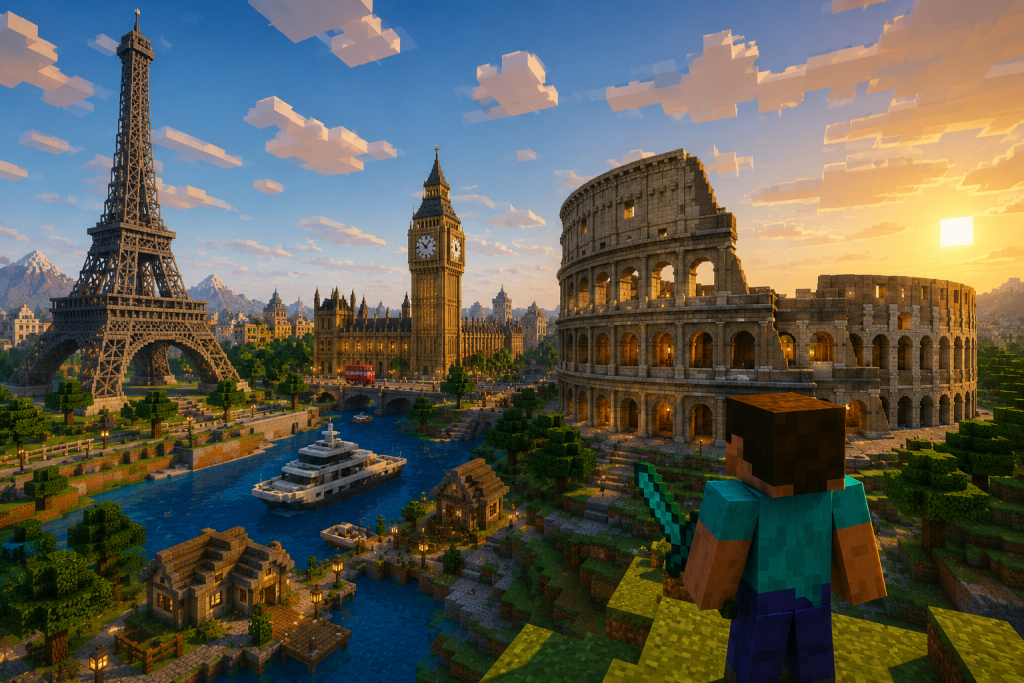
Minecraft is often described as a sandbox for building, but it is just as powerful as a way to explore places that players may never visit in person. A well-made real-place map can turn a famous landmark, historic district, or natural wonder into a playable environment where scale, atmosphere, and discovery matter as much as construction. For players who enjoy exploration, architecture, history, or simply finding a new world to share with friends, real-world Minecraft maps offer a different kind of gaming experience.
MapMC is a collection focused on downloadable real-place Minecraft Java maps. Instead of presenting a map as a static image or a quick screenshot, the project gives players a way to see the location in game, review map details, and choose a Java world that fits their interests. The collection includes recognizable places such as the Colosseum in Rome, Tokyo Tower, and the Old Town of Prague, along with other landmarks and historic sites. That range makes the maps useful for several kinds of players: builders can study architecture, educators can use a familiar setting to start a conversation, and casual players can simply wander through a digital recreation at their own pace.
The best part of this format is the sense of scale. A photograph can show what a landmark looks like, but walking through a Minecraft version changes the relationship between the player and the place. You can approach a building from different directions, compare nearby streets and open spaces, and notice how the surrounding environment shapes the landmark. In multiplayer, the same map becomes a shared destination for screenshots, role-play, tours, or a relaxed evening of exploration.
A practical map collection also needs to make downloading straightforward. MapMC presents Java ZIP downloads alongside gameplay footage, screenshots, and clear details, so players can make an informed choice before importing a world. That is especially helpful for anyone who has downloaded a map before and wondered which Minecraft version it needs, how large the file is, or whether the world has actually been tested. Seeing real gameplay before downloading reduces uncertainty and makes the experience more welcoming for people who are curious about custom maps but do not usually browse large modding communities.
Real-place maps also encourage a healthier kind of discovery. A player may arrive because they recognize one landmark, then find another city, palace, bridge, or historic site that they did not know was available as a Minecraft world. The collection becomes a starting point for comparing architecture and geography through play rather than through a long list of facts.
For anyone looking for a fresh Minecraft Java project, MapMC is worth exploring. It offers a simple path from recognizing a real place, to watching it in game, to downloading a tested world and beginning an adventure of your own.
Another advantage is that these maps can become a bridge between different kinds of Minecraft players. Someone interested in history can focus on the landmark itself, while a builder can study materials, proportions, and surrounding streets. A family or classroom can use the world as a starting point for questions about where a place is and why it matters. Even when the session is short, the map gives the group a clear destination instead of an empty seed and an open-ended plan. That combination of recognizable locations and familiar Minecraft freedom is what makes real-place maps easy to revisit: each visit can be a tour, a building challenge, a photo session, or simply a quiet walk through a world inspired by somewhere real.
Explore the full collection at MapMC
More details are available in the Rome Colosseum map

Heather Neves is working as a freelance content writer. She likes blogging on topics related to parenting, golf, and fitness, gaming . She graduated with honors from Columbia University with a dual degree in Accountancy and Creative Writing.


1 Comment
An important point is that the gameplay preview changes the decision from guessing to verifying. Seeing the scale and navigation in-game before downloading should be especially useful for players comparing real landmarks, and the Java version and file-size details make these maps much easier to try.