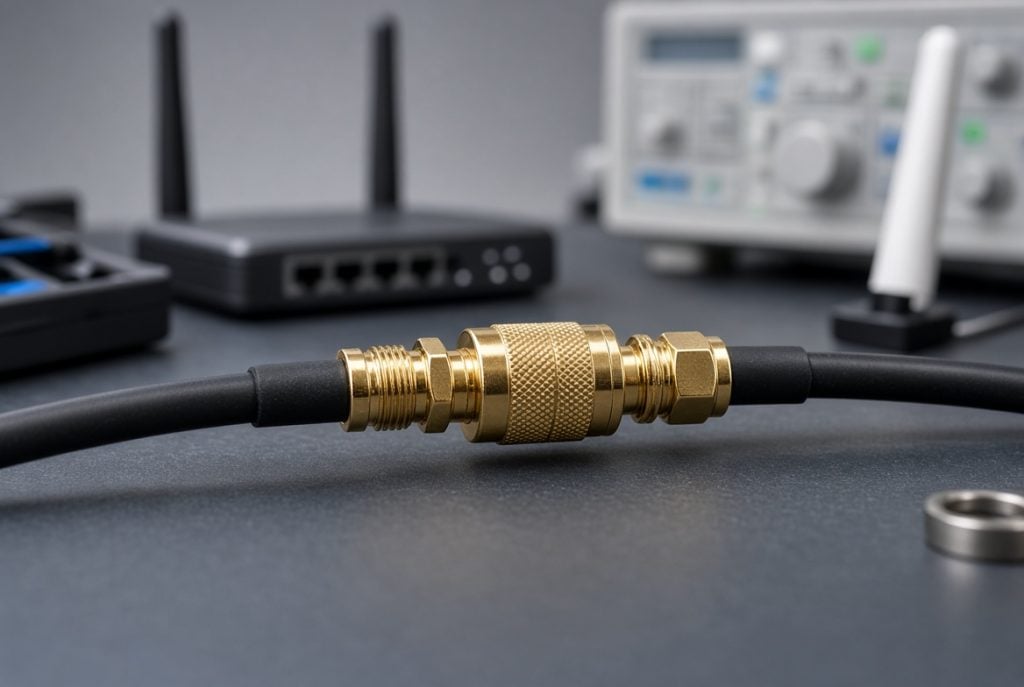
RF and microwave engineers rarely work with a setup that stays the same for long. Test benches change, prototypes evolve, and field installations almost never match the connector layout shown on the datasheet. This is why a small, simple part earns a place in every lab drawer: the SMA to SMA adapter.
Why This Simple Part Solves So Many Problems
An sma to sma adapter does one job, but it helps in many different situations. It lets two SMA-terminated parts, such as cables, connectors, or test equipment ports, join together without needing a custom cable or a full connector rebuild. For engineers working on bench testing, prototyping, and field setups, this saves time and cuts down on how many spare parts need to be kept on hand.
1. Connecting Different Devices
Most RF systems are built using equipment from more than one manufacturer. A signal generator from one company, a spectrum analyzer from another, and a custom circuit board with its own SMA connector all need to link together during testing. Mismatched connector types between these devices are common, and an adapter solves this right away instead of forcing a cable swap or a full connector replacement.
This is especially useful in busy labs where several instruments share limited bench space. Adapters let engineers change a test setup in seconds, connecting a device to a new signal path, adding a different attenuator, or sending a signal to a second analyzer, all without shutting the system down or being locked into one fixed cable layout.
2. Extending, Repairing, and Simplifying Cable Maintenance
The second common use is less exciting but just as useful day to day: keeping existing cables working. When a cable is a bit too short for a new equipment layout, or when a connector on an otherwise good cable gets worn out, replacing the whole cable is often unnecessary and costly.
An adapter lets a technician join two existing cables together, fixing a length shortage without cutting into the cable or replacing the connector by hand. This is especially helpful for field repairs and maintenance work, where a technician may not have a full connector kit but does carry a small case of adapters.
Beyond quick fixes, adapters also make regular maintenance easier. If a maintenance team keeps a small set of adapter types on hand, they can carry fewer specialized cables and instead use adapters to handle mismatched connector types as needed. This cuts down on the need to stock many different cable types for connection needs that only come up occasionally.
When Space Is Tight: Right-Angle and Gender-Specific Adapters
Straight adapters solve connector-type mismatches, but real setups often add another problem: limited space. Equipment mounted in racks, crowded circuit boards, and tight enclosures often can’t fit a straight connector without bending the cable too much or blocking a nearby port.
This is where a right-angle adapter becomes useful. A sma female to sma male adapter built in a right-angle shape lets engineers turn a cable ninety degrees, which often makes the difference between a connection that fits neatly inside an enclosure and one that forces the cable into a tight, unsupported bend. Sharp bends near a connector often lead to loose connections and cable wear over time, so a right-angle adapter is not just a convenience. It also helps protect the connection over the long run.
Stainless steel construction and a wide frequency range (often rated up to 26.5 GHz for this type of adapter) also matter for engineers working across different frequency ranges on the same bench, since it removes the need to swap adapters when moving between different types of tests.
Simple Tips for Choosing an Adapter
A few things to keep in mind when picking an adapter for connecting devices or extending cables:
- Match the frequency rating to your needs. Using an adapter rated for a lower frequency than what you’re working with can cause signal loss and other performance problems.
- Check connector type carefully before ordering. SMA connectors come in male and female versions, and sometimes reversed versions, so mixing these up is a common ordering mistake.
- Choose sturdy materials for parts used often. Adapters used in testing get connected and disconnected far more often than ones used in the field, so it helps to check how many times a connector can be reused before it wears out.
- Keep a small stock on hand. A few straight and right-angle adapters, in both connector types, cover most connection and extension needs without having to order custom cables.
Conclusion
Adapters don’t get talked about much, but they are some of the most used parts in an RF engineer’s toolkit. Whether the job is connecting mismatched test equipment, extending a cable without fully rebuilding it, or fitting a connection into a tight space using a right-angle part, the right SMA adapter turns a time-consuming fix into a quick one. Keeping a small, organized set of adapters, including both straight and right-angle, male and female types, is a small investment that pays off during setup, repair, and maintenance work.

Sandra Larson is a writer with the personal blog at ElizabethanAuthor and an academic coach for students. Her main sphere of professional interest is the connection between AI and modern study techniques. Sandra believes that digital tools are a way to a better future in the education system.