Smart watches can monitor heart rate, count steps, and record dozens of workout types. Smart glasses promise cameras, voice assistants, and navigation within the wearer’s field of view. Yet most consumer technology becomes far less useful the moment someone enters a swimming pool.
A sports watch can record a swim, but its screen is awkward to check during a length. A phone remains in the locker or on the pool deck. Consequently, swimmers often receive useful training information only after reaching the wall.
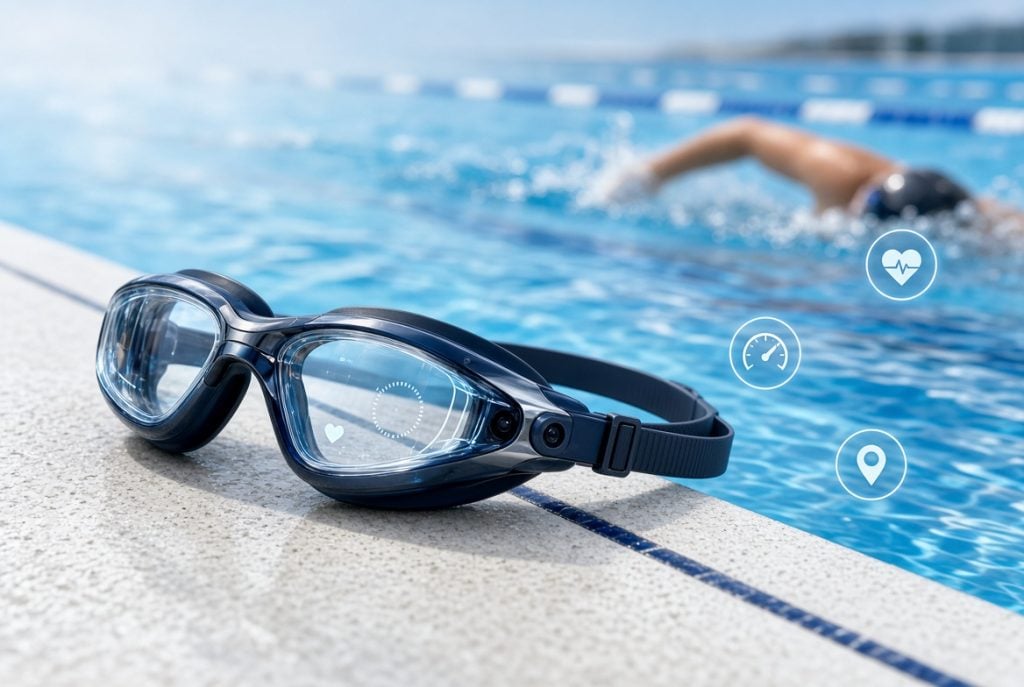
Smart swim goggles address that problem by placing selected data inside the lens. Swimmers can check pace, distance, or lap information without turning a wrist or waiting until the set is over.
The idea resembles a video game HUD, but its value rests on a less glamorous question: Can the display support the session without competing for the swimmer’s attention?
Why Conventional Wearables Struggle in the Pool
Glancing at a sports watch while running is relatively easy. The arms are already moving, and a quick pace check rarely alters the athlete’s form.
Swimming is different.
Turning the wrist during freestyle can disturb body position and stroke rhythm. Raising the head to check a pool clock creates an even greater interruption. Most swimmers therefore wait until they reach the wall before confirming their time, pace, or completed laps.
During a structured workout, that delay reduces the value of the feedback.
Consider a swimmer trying to hold an even pace across a set of 200-meter repeats. The first repeat is controlled, but the second begins to fade. A watch will record the change, although the swimmer may not see it until stopping. By then, the opportunity to correct the pace during that repeat has gone.
Then there is the familiar problem of losing count. Deep into a long set, even an experienced swimmer can forget whether the current length is the seventh or the ninth.
A lap tracker can preserve the final record. The harder problem is making that information available without interrupting the movement being measured.
Smart Swim Goggles Change When Feedback Arrives
The most meaningful feature of smart goggles for swimming is not their ability to collect data. Sports watches have done that for years. Their advantage lies in where and when selected information appears.
The HoloSwim 3 Pro smart swim goggles, for example, use an in-lens display to place chosen swim metrics within the wearer’s field of view.
During pool training, swimmers can view distance, lap count, elapsed time, average pace, stroke count, rest time, and average SWOLF. After leaving the water, they can examine the recorded session in the HoloSport app.
This creates two distinct stages for using the data.
The in-lens display provides brief references during the swim. The app supports a slower and more detailed review afterward. That distinction matters because swimmers do not need a complete analytics dashboard in front of their eyes.
During a length, one or two numbers that inform the next decision are usually enough.
A Real-World HUD Must Know When to Stay Quiet

The comparison between heads-up display swim goggles and a video game interface is difficult to avoid.
In a game, a HUD displays health, direction, or mission status without forcing the player to leave the main screen. A well-designed interface keeps essential information available while allowing everything else to recede into the background.
Smart swimming goggles face the same design test.
Too many figures in the lens can quickly become a distraction. A swimmer must still manage breathing, body position, lane traffic, turns, and the approaching wall. In open water, the list also includes other swimmers, weather, surface conditions, and physical landmarks.
Enabling every available metric is therefore rarely the best choice.
Average pace and lap count may be sufficient for a controlled pace set. Distance and elapsed time may be more useful during a continuous swim. Stroke count and SWOLF are often better reviewed across comparable repeats after the workout.
The best swim goggles with real-time display should not demand constant attention. They should provide a small amount of purposeful information whenever the swimmer chooses to look.
What Can Real-Time Data Correct?
Live metrics can help swimmers address measurable training problems.
If someone starts a repeat too quickly, a pace reading can reveal the mistake before the final wall. If a swimmer regularly loses count during longer sets, an in-lens lap counter reduces the need to rely on memory. Distance information can also help manage a continuous workout without stopping to consult a watch.
The limitations are equally important.
A display cannot see a dropped elbow, a mistimed breath, or a hand crossing the body’s centerline. It may show that pace has declined or stroke count has increased, but it cannot always explain why.
AI-supported training analysis has the same boundary.
Software can organize data from multiple workouts and identify recurring patterns in pace, stroke count, or efficiency-related measurements. It might reveal, for instance, that a swimmer consistently slows during the final third of each set. Determining the cause could still require video review, a coach’s observation, or a closer examination of how the workout was structured.
Smart swim goggles provide evidence. They do not provide a complete diagnosis.
Are Smart Swim Goggles Worth Buying?
Smart swim goggles are most useful for people who can identify a specific training problem and explain how real-time feedback might help solve it.
A masters swimmer training alone may want pace information without depending on a coach to call out splits. A triathlete may want to review pool and open-water sessions within the same training system. Someone who regularly completes structured workouts may simply need a more dependable way to track laps.
Beginners should be more selective.
A swimmer who is still learning breathing, balance, and basic comfort in the water may gain more from one clear instruction than from several live metrics. Extra information easily becomes noise when the swimmer does not yet have the experience to interpret it.
Before buying, ask one question:
What will I do differently after seeing this number?
If the answer is specific, a real-time display has a defined purpose. If the main attraction is simply seeing numbers in the lens, conventional goggles and a pool clock may already be sufficient.
Swimmers weighing display, training-tracking, and audio features can compare HoloSport smart swim goggles before choosing the model that best fits their usual training environment.
Pool and Open-Water Swimming Require Different Tools
No single feature set works equally well in every swimming environment.
A pool provides measured distances, lane markings, and predictable walls. Pool swimmers are more likely to prioritize lap counting, pace management, rest intervals, and consistency between repeats.
Open water creates a different set of demands. Visibility, stability, changing light, route awareness, and normal sighting technique become more important. GPS route recording and compass information can support training, but they cannot replace direct observation of the surroundings.
Smart swim goggles for pool and open-water swimming should therefore be judged by more than the number of sensors they contain. Swimmers need to consider which information is useful in each setting and whether the display remains readable without becoming intrusive.
No electronic display can guarantee open-water safety. Swimmers must still locate buoys and shoreline landmarks, observe surface conditions, watch for boats and other swimmers, and follow a safety plan appropriate to the location.
Wearables Are Moving From Recording to Timely Feedback
The first generation of fitness wearables concentrated on counting. Devices recorded steps, distance, duration, and estimated calorie expenditure, then presented the results after the activity.
The next stage may be defined less by the amount of data collected and more by whether information arrives at the right time.
Data becomes more valuable when it appears early enough to influence a decision. For swimmers, that could mean noticing a pace change before the repeat ends. It might mean confirming the lap count without interrupting stroke rhythm.
This is where smart swim goggles make a credible case for themselves. They adapt the interface to the swimming environment instead of asking an athlete to keep using a wrist-based screen underwater.
The technology must still prove itself in regular use.
Fit remains more important than software. The display must be legible without taking over the swimmer’s vision. Its measurements need to be consistent enough to support training decisions. Charging, cleaning, and post-workout maintenance also become part of the ownership experience.
Only when those basic requirements are met does the in-lens display move beyond novelty.
Smart swim goggles should not be judged by how futuristic they appear in a product demonstration. The more useful questions are whether a swimmer loses count less often, corrects a pacing error sooner, or leaves the pool with a clearer understanding of the session.
Compared with the sweeping claims often attached to wearable technology, that is a restrained standard.
It is also much closer to what a sports technology product should actually accomplish.

Caroline is doing her graduation in IT from the University of South California but keens to work as a freelance blogger. She loves to write on the latest information about IoT, technology, and business. She has innovative ideas and shares her experience with her readers.