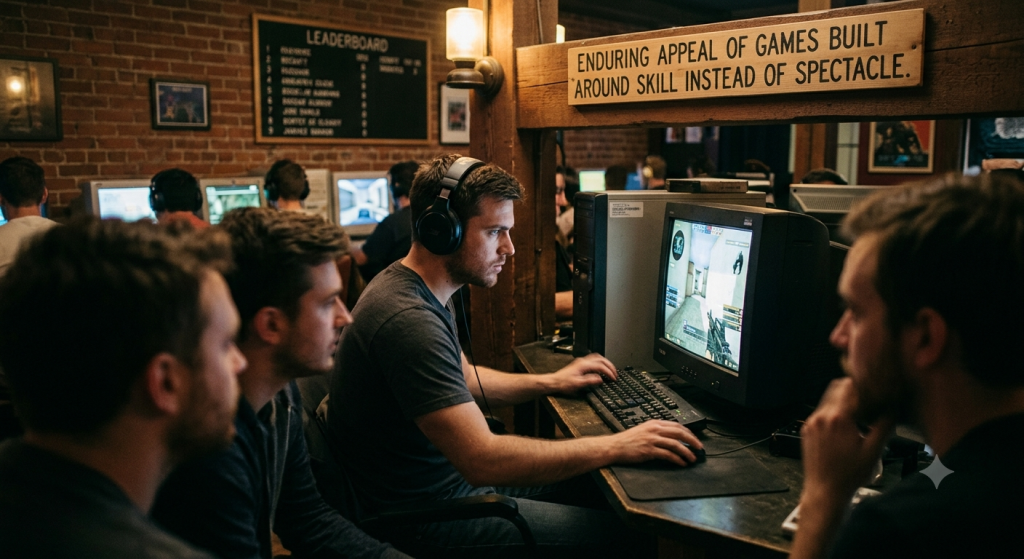
My buddy Marcus still plays chess on the same app he downloaded back in 2014. I asked him once why he never bothered switching to something newer, and he just shrugged. Said there was nothing to fix. A board’s a board, a clock’s a clock, and whoever he gets paired against that night is whoever he gets paired against.
That answer bugged me for a while, honestly, because it cuts against how the industry usually talks about what keeps people around. Everyone’s chasing bigger budgets and shinier engines, yet half the games people keep coming back to were never built to wow anyone in a trailer.
That matters more now, mostly because everything is fighting for the same sliver of your evening. Games built around skill hold their ground in that fight in a weird way. Nobody’s rebuilding chess with ray tracing, and nobody needs to. What they’re selling is quieter, more like the slow satisfaction of getting a little sharper every time you sit down, and there’s a lesson in that for an industry that keeps assuming innovation means a bigger budget.
Impressive Isn’t the Same Thing as Engaging
A good-looking game grabs you fast. That part isn’t in question, especially now when half of what sells a game happens before you’ve even touched it, in some trailer or livestream clip.
Holding onto that attention is a completely different problem, though.
People show up because something looks incredible. They stay because whatever’s underneath keeps giving them a reason to think. A clever read on an opponent, a comeback you didn’t see coming, finally not making the same dumb mistake for the tenth time – none of that comes from a graphics card. It’s probably why some rough-looking games are still running strong a decade later while titles that looked stunning at launch quietly disappeared within a year.
Looking good gets someone to click play once. It’s the part underneath that decides whether they come back.
Getting Better Feels Like Something
There’s a kind of satisfaction skill-based games offer that most modern entertainment has quietly stopped bothering with: you can actually feel yourself getting better.
Your first few sessions are usually a mess. You’re slow, you miss things, and you lose more than feels fair. Then at some point you start seeing openings before they close, reading the other player a beat faster. None of that came from a new item drop. It came from doing the thing enough times that your brain caught up.
Compare that to a game where progress mostly means bigger numbers on a screen. That kind of improvement lives in a spreadsheet, and it isn’t really yours. What you build in a skill-based game belongs to you, and I think that’s the real reason these things hold onto people for years instead of months.
Rules You Can Learn Fast, Games You Can’t Fully Finish
A handful of the oldest games around share this odd quality. You could teach someone the whole rulebook in five minutes flat. Then they could spend the rest of their life chasing mastery and still come up short.
That gap between how quickly you can learn something and how long it takes to get good at it might be the single most reliable sign a game will last. More rules don’t automatically mean more depth. A lot of the time it works the other way, where a simpler system leaves more room for real strategic thought because nobody’s wasting brainpower fighting the interface.
Every move matters here. Every decision leaves a trail you can look back on and learn from, win or lose. That’s what lets beginners fumble around and still have fun, while letting veterans separate themselves through actual understanding rather than whatever a wiki page told them to memorize. A lot of developers still build around this idea, card games and competitive shooters alike, even when nobody names it out loud.
The Community Sticks Around Even When the Game Doesn’t Change
A game rarely stays alive because of its code. It stays alive because people keep showing up for each other.
Strategies get passed around in comment threads and Discord servers that never really close down. Somebody argues a tactic for years without anyone fully winning the point. A confused newcomer shows up one week and ends up explaining the rules to someone else a year later. All of it adds up to something that would probably survive even if the servers went dark tomorrow.
The communities that last were rarely chasing whatever was popular that season. They formed around something that stayed fun no matter which console generation happened to be current. Give it long enough and the people become almost as big a draw as the game itself. That’s a decent chunk of why old titles keep pulling in new players well past their commercial peak.
Tech Cleared the Path. It Didn’t Build the Destination
People love talking about gaming purely through the lens of technological progress, and fair enough. Processing power, rendering, network infrastructure – all of it has jumped forward over the last twenty years in ways that are hard to picture if you weren’t paying attention.
But the more interesting shift happened quieter than that. Technology spent the last several years clearing obstacles rather than reinventing what a game even is. Faster browsers, better phone chips, cloud saves that actually work without you thinking about them – none of it changes the core experience, it just stops getting in the way of someone who already wanted to play. When the tech fades into the background like that, people spend less energy wrestling with a platform and more time actually inside the game. That might be one of the more underappreciated wins the industry has quietly pulled off.
Browser Games Grew Up While Nobody Noticed
There was a stretch where calling something “a browser game” basically meant you were insulting it, shorthand for clunky and forgettable. That reputation stuck around way longer than it deserved to.
These days, browsers handle responsive layouts, efficient rendering, and low-latency connections at a level that would’ve sounded made up a decade ago. Plenty of developers stopped treating browsers as the fallback for people without decent hardware. For a lot of projects, it’s genuinely the preferred way to build, since it strips out installs and specialized equipment while barely giving anything up.
That shift opened the door wider than people expected. Somebody can stumble onto a sharp little card game in seconds, no download, no excuse about their laptop being too old. Convenience used to be an afterthought. Now it’s closer to the whole pitch.
Skill Doesn’t Go Out of Style the Way Trends Do
Trends in this industry move fast, sometimes uncomfortably so. One year it’s survival mechanics everywhere. Then extraction shooters take over, then live-service seasons, then whatever comes next.
Through all of it, games built around actual decision-making keep pulling a crowd that never really left. Reading a situation, adjusting your plan halfway through, following a strategy to the end – none of that depends on which genre happens to be fashionable, because those are human abilities. That gives skill-first design a staying power the trend-chasers rarely get to enjoy.
Phones Changed Where People Play More Than They Changed What People Wanted
Smartphones shifted the location of gaming more than the appeal of it. People stopped assuming a session had to happen on a couch after dinner with a console humming under the TV.
Now a commute is enough time to finish a match, and a lunch break becomes a few rounds instead of another scroll through your phone. Strategy-heavy games slid into this shift easily, mostly because they never leaned on expensive visuals, and thinking translates just fine to a smaller screen. The rise of mobile gameplay such as bolatangkas let older, skill-first experiences reach people who never would’ve found them otherwise, without losing whatever made them worth playing.
Old Games Finding New Homes
One of the better trends in the industry lately is the push to keep traditional games alive through modern platforms instead of gutting them into something unrecognizable. Plenty of platforms are choosing to protect whatever made the original good while making it easier to get to, which respects both the history behind a game and the people still actually playing it.
Communities get to keep the rules they already know while picking up better connections and compatibility across whatever device is nearby. Platforms like Tangkasnet show this pattern well, keeping a traditional, skill-based card game accessible without gutting the strategic depth that made it worth playing this long.
What Gaming Quietly Teaches Everyone Else
The success of skill-based games carries lessons that reach a lot further than entertainment.
Anyone working on user retention eventually runs into the same wall: how do you get someone to keep coming back without burning them out? Skill-based games have been answering that quietly for decades. They reward showing up consistently without dumping too much on a newcomer’s first day, teach through doing rather than some tutorial nobody sits through, and still leave room for veterans to keep pushing further. None of that happened by accident, and plenty of software built for daily use borrows from the same playbook.
Depth Might Win Out Over More
AI, cloud computing, and mobile hardware that keeps getting stronger will keep pushing what games can technically pull off. Safe bet.
Even so, raw technical horsepower has never been what made people stick around. Players keep drifting toward things that respect their time and give them something worth improving at. A flashy trailer earns a first look, but what keeps a community alive for years is something else entirely, and that pattern has survived every technological shift the industry has thrown at it.
The games that stick around usually aren’t the most technically ambitious ones on the shelf. They’re the ones that stumbled onto whatever makes a person want to come back tomorrow.
The Ones That Last Don’t Need to Shout
Gaming’s history is packed with real technical achievements, from clunky early 3D engines to hardware jumps that changed what was possible. All of that deserves credit, and none of this is a knock against progress.
But the games that actually stay with people tend to do something quieter. They ask you to get better instead of just watching something happen. They build communities around shared knowledge instead of a launch-week hype cycle that fades within a month, and they’re still fun long after whatever visual trend defined their release year has been forgotten.
Good design was never about how impressive the tech underneath it looked. It’s about whether people still want to sit back down once the hype’s worn off, and games built around skill keep answering that better than almost anything else this industry makes.

Hi! I’m Bryan, and I’m a passionate & expert writer with more than five years of experience. I have written about various topics such as product descriptions, travel, cryptocurrencies, and online gaming in my writing journey.