TL;DR
- Odysseus finally returns to Ithaca disguised as a beggar and secretly reunites with Telemachus.
- Penelope’s bow contest gives Odysseus the opportunity to reveal himself and confront the suitors occupying his home.
- The film reveals that Odysseus and the Greeks have effectively become the feared “people from the sea” described throughout the story.
- Odysseus survives the final battle but chooses not to reclaim the throne.
- Telemachus becomes king while Odysseus and Penelope leave Ithaca together and sail west.
- Christopher Nolan significantly changes Homer’s original ending to focus on guilt, responsibility and breaking a cycle of violence that began at Troy.
Warning: Major spoilers for Christopher Nolan’s The Odyssey follow.
For most of The Odyssey, Odysseus has one seemingly simple goal: get home.
Christopher Nolan spends nearly the entire movie making that goal increasingly difficult. Matt Damon’s Odysseus survives the Trojan War, monsters, shipwrecks, starvation, Circe, Calypso and the deaths of the men who followed him across the sea. Yet when he finally reaches Ithaca, the movie reveals that coming home was never really the end of his journey.
Odysseus has to decide whether the man who left Ithaca decades earlier can simply reclaim the life, family and kingdom he abandoned.
Nolan’s answer is considerably different from Homer’s.
Odysseus Finally Returns To Ithaca
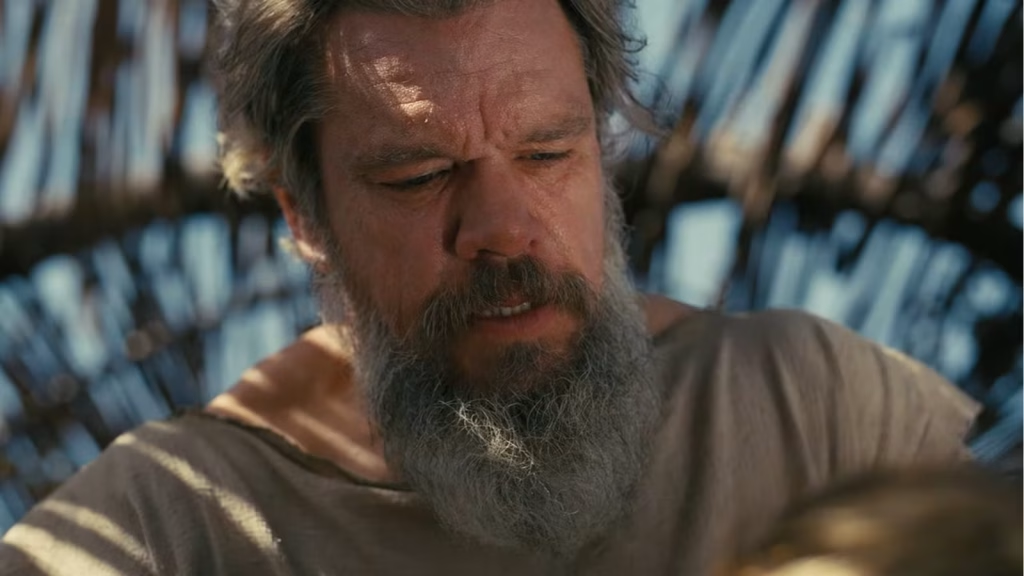
After surviving the final stage of his voyage, Odysseus eventually reaches Ithaca. He does not immediately walk into his palace and announce that the king has returned.
Instead, he disguises himself as an old beggar.
The disguise allows Odysseus to observe what has happened during his absence without immediately revealing himself. His palace has become overrun with men competing to marry Penelope. They consume his food, occupy his home and behave as though the king who disappeared after the Trojan War is never coming back.
Robert Pattinson’s Antinous is the most dangerous among them, and his ambitions appear to stretch beyond simply marrying Penelope. Whoever controls Penelope could also control the future of Ithaca.
Odysseus has spent years imagining his homecoming. What he discovers is a home that has been forced to continue without him.
How Does Telemachus Discover Odysseus Is His Father?
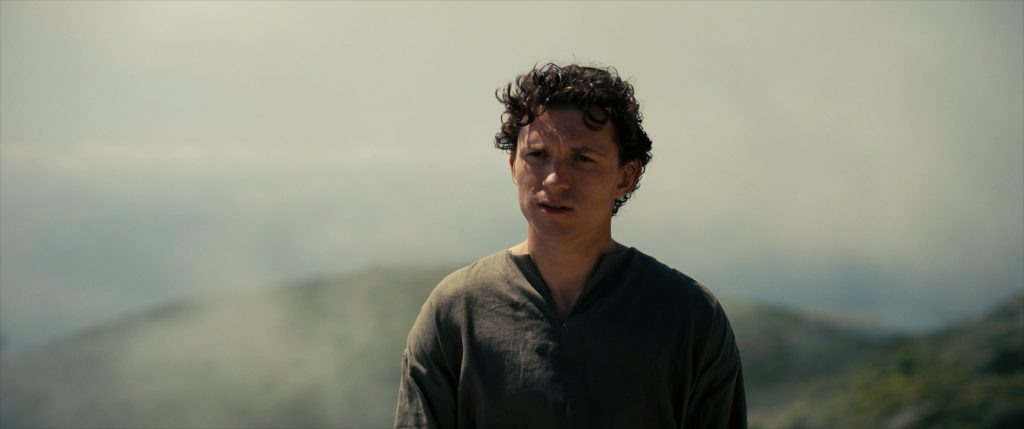
Nolan changes the reunion between Odysseus and Telemachus from the version presented in Homer’s poem.
Antinous has arranged an attempt on Telemachus’ life, and the disguised Odysseus intervenes to protect him. Telemachus gradually realizes that the mysterious older man standing beside him is actually the father he has spent his entire life hearing stories about.
That reunion carries enormous emotional weight because Telemachus barely knows Odysseus beyond the legend.
Odysseus left for Troy when Telemachus was still an infant. The brilliant warrior, strategist and king that his son has imagined was largely constructed from stories told by other people. The man who finally comes home is considerably more damaged than the legend.
Father and son agree to keep Odysseus’ return secret long enough to confront the men threatening their family.
Why Doesn’t Odysseus Immediately Tell Penelope Who He Is?
Penelope is the person Odysseus has supposedly spent his entire journey trying to reach, yet he still approaches her while pretending to be someone else.
The conversation becomes one of the most important parts of Nolan’s ending because Odysseus begins talking about Troy without presenting himself as the great hero responsible for winning the war.
The Trojan Horse may have been his greatest strategic achievement, but the movie gradually reframes it as one of his greatest moral failures.
The Greeks entered Troy by exploiting trust. What appeared to be a gift became the means through which soldiers secretly entered the city and destroyed it from within.
Odysseus finally begins to understand that winning the war required becoming something he may never be able to forgive.
Who Are The “People From The Sea”?
This is one of Nolan’s biggest additions to the traditional story.
Throughout the film, characters speak about mysterious “people from the sea” who represent an approaching danger. They are described almost like an unstoppable force arriving from across the water to destroy communities and leave civilizations behind in ruins.
Eventually, Penelope forces Odysseus to confront an uncomfortable truth.
Odysseus and the Greeks are the people from the sea.
The terrifying invaders everyone fears do not necessarily need to come from some unknown civilization in the future. The Greeks have already crossed the sea, invaded another kingdom and destroyed a city whose people saw themselves as the ones being attacked.
Odysseus remembers Troy as a Greek victory. The Trojans would have remembered the Greeks as invaders.
Nolan loosely connects that idea to the mysterious Sea Peoples associated with the collapse of several Late Bronze Age civilizations. The movie is not presenting a literal historical solution to their identity. Instead, the idea becomes a way of forcing Odysseus to recognize how history changes depending on which side survives to tell it.
Why Is Odysseus So Haunted By Troy?
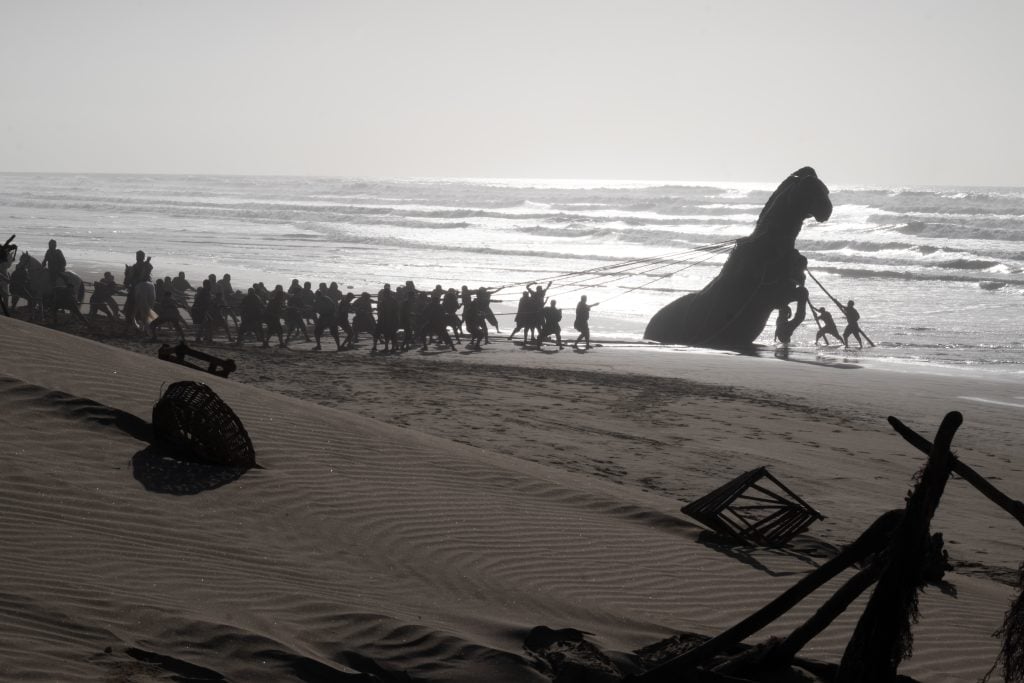
Nolan turns much of Odysseus’ journey into an extended confrontation with trauma.
His adventures are physically dangerous, but the memory he cannot truly escape is Troy.
The realm of the dead makes that especially clear. Odysseus encounters fallen figures connected to the war, including Agamemnon and Sinon, forcing him to face men whose deaths and suffering are tied to the conflict he helped win.
The movie repeatedly returns to images of Troy’s destruction rather than allowing the Trojan Horse to remain a clever heroic trick.
Odysseus won the war.
That is exactly what haunts him.
What Is Going On With Athena?
Zendaya’s Athena is another area where Nolan deliberately leaves room for interpretation.
Unlike Homer’s poem, the movie does not constantly show gods physically appearing and manipulating human events. Poseidon, Zeus and other gods are invoked, feared and blamed, but many apparently divine events can also be interpreted through the beliefs of the people experiencing them.
Athena is the major exception.
Even her appearances become complicated by the film’s connection between the goddess and the trauma Odysseus carries from Troy. Nolan leaves open the possibility that at least some of Odysseus’ encounters with Athena represent his conscience, guilt or memories rather than straightforward divine visitation.
The film never needs to definitively answer the question.
To Odysseus, Athena is real. Whether audiences see her as a literal goddess, a manifestation of his guilt or a combination of both becomes part of the movie’s ambiguity.
How Does Penelope’s Bow Contest Work?
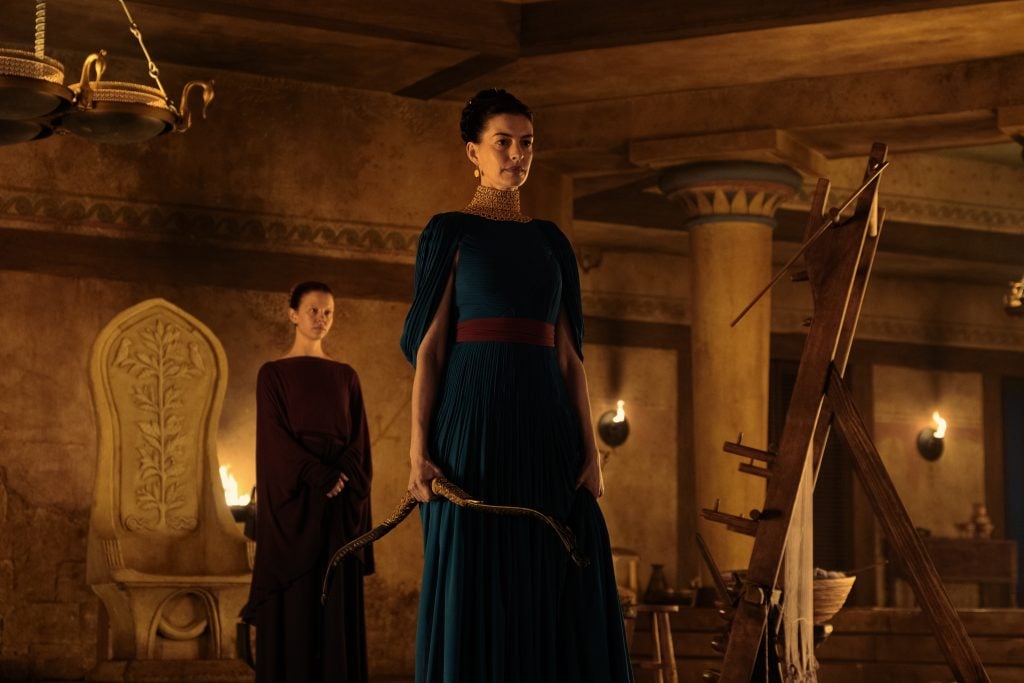
With pressure building for Penelope to select a new husband, she announces a test.
The suitors must string Odysseus’ bow and successfully fire an arrow through twelve axes.
One after another, they fail.
Then the mysterious beggar asks for his opportunity.
Odysseus strings the bow and completes the shot nobody else can accomplish.
The contest therefore becomes more than a test of strength. It reveals that the true master of the house has returned before Odysseus completely drops the disguise.
How Does Penelope Know It Is Really Odysseus?
Nolan changes one of the most famous pieces of Homer’s ending.
In the poem, Penelope tests Odysseus by suggesting that their marriage bed be moved. Odysseus immediately reacts because he knows moving it should be impossible. He personally constructed the bed around a living olive tree.
Only the real Odysseus could know that secret.
Nolan replaces the bed test with the golden Athena pin Penelope gave Odysseus before he departed for Troy.
When he shows it to her, Penelope finally has the personal evidence she needs.
After years of uncertainty, stories and disguises, she knows her husband has truly come home.
What Happens To Antinous And The Suitors?
The bow contest quickly turns into war inside Odysseus’ own palace.
Odysseus and Telemachus fight the suitors, including Antinous, as the struggle for Ithaca becomes brutally physical. Nolan stages the confrontation less like an effortless execution and more like a final battle in which the suitors fight back.
Penelope is also given an active role rather than simply waiting for the men to determine the future around her. Her confrontation with Melantho ends with Penelope pushing her into the chaos consuming the palace.
Odysseus and Telemachus ultimately defeat the suitors.
But Nolan does not present the bloodshed as a triumphant return to heroic form.
The violence inside Ithaca is intercut with memories of Troy.
Odysseus has once again entered a place and solved conflict by leaving bodies behind.
Does Odysseus Die At The End?
No.
Odysseus is badly wounded during the battle, and the movie briefly makes his survival uncertain.
He eventually ends up with his head resting in Penelope’s lap, finally reunited with the woman he spent years trying to reach.
Nolan does not kill him.
Instead, Odysseus survives long enough to make a far more important decision.
He gives up the throne.
Why Does Telemachus Become King?
Once the suitors are defeated, Odysseus could theoretically reclaim his position as king of Ithaca.
He chooses not to.
Telemachus becomes king instead.
The decision represents more than Odysseus simply retiring after years away. He recognizes that the world created by his generation cannot continue being ruled by the same men responsible for its wars.
Telemachus belongs to the generation that grew up living with the consequences of choices made by their fathers.
Leaving Ithaca to him gives the kingdom the opportunity to move forward rather than rebuilding everything around the return of a warrior who has spent decades trapped inside the past.
Where Do Odysseus And Penelope Go?
The movie ends with Odysseus and Penelope leaving Ithaca together.
They sail west.
The direction carries a personal meaning for both characters.
Earlier in their lives, Penelope wanted Odysseus to avoid the war and sail away with her toward the setting sun.
He chose Troy instead.
Decades later, they finally make that journey.
It is romantic, but it is not simply a happy retirement. Their departure also feels like a form of self-imposed exile.
Odysseus cannot rebuild Troy. He cannot resurrect the men lost during the war or erase the years Penelope and Telemachus spent without him.
What he can do is refuse to continue ruling as though none of it happened.
What Does The Final Scene Mean?
The closing image is hopeful without pretending everything has been repaired.
Odysseus believes another dawn can eventually follow the darkness created by his generation, but the film also warns that humanity has a habit of forgetting the mistakes responsible for previous disasters.
That idea connects directly to the movie’s fascination with storytelling and memory.
The deeds of men like Odysseus survive because people tell stories about them. Over generations, stories become legends. Legends simplify complicated people into heroes and villains.
Once the uglier parts disappear, future generations may repeat exactly what those heroes once did.
Nolan’s Odysseus finally understands that being remembered as a great warrior does not necessarily mean he was a good man.
How Is Nolan’s Ending Different From Homer’s?
The difference is substantial.
Homer does not end with Odysseus voluntarily abandoning Ithaca and handing the kingdom to Telemachus.
After the suitors are killed, the poem continues with Odysseus reuniting with his father, Laertes. The families of the dead suitors then seek revenge, threatening to create another cycle of bloodshed.
Athena ultimately intervenes and forces peace.
Odysseus remains king.
Nolan removes that resolution.
His Odysseus does not need a goddess to command everyone to stop fighting. Instead, he gradually recognizes for himself that another victory followed by another retaliation will simply continue the cycle that began long before he returned home.
The Real Ending Is Odysseus Giving Up Victory
That is what separates Nolan’s conclusion from a conventional homecoming story.
Odysseus reaches Ithaca. He finds Penelope. He meets the son he barely knew. He defeats the men trying to take his kingdom.
By every traditional measure, the hero has won.
Then he walks away from the reward.
The man who once believed intelligence could solve any problem finally understands that cleverness without morality helped destroy an entire civilization. He cannot undo Troy or recover the years his family lost waiting for him.
What he can control is what happens next.
Telemachus inherits Ithaca. Odysseus and Penelope sail west.
The legendary king who spent decades trying to get home finally realizes that returning home and returning to the person he used to be are not the same thing.

DC Fanboy! Superman is the greatest comic book character of all time. Favorite movies are Man of Steel, Goonies, Back To the Future