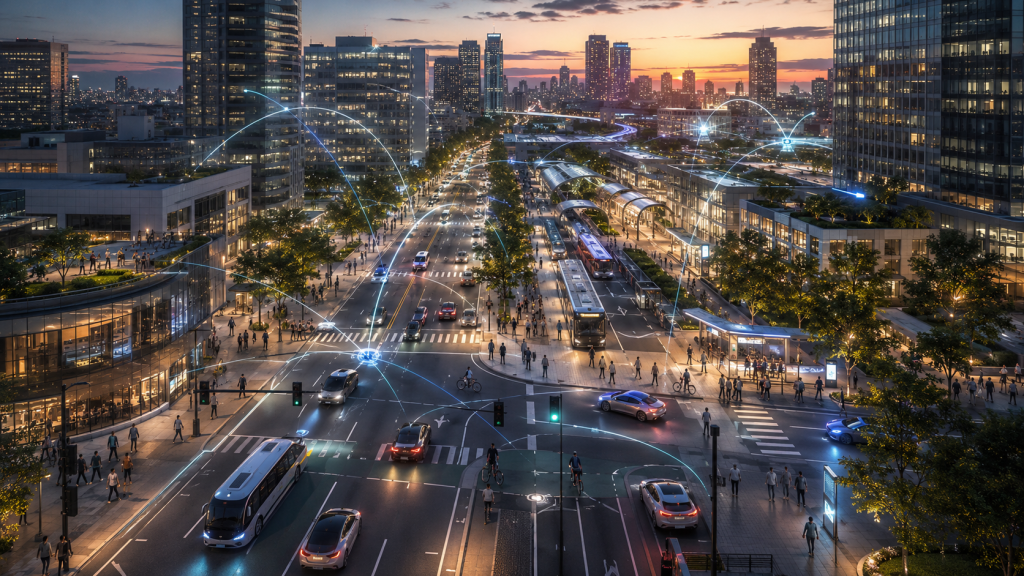
Urban transport is undergoing a transformation that is easy to miss at street level. There are no dramatic visual changes, no single breakthrough moment, and no obvious shift in how cities look from the outside.
Instead, mobility is becoming “invisible”—optimised, predicted, and coordinated by artificial intelligence systems working behind the scenes.
From traffic signals that adapt in real time to ride-sharing platforms that anticipate demand before it happens, AI is reshaping how people move through cities without requiring them to think about the systems enabling it.
Traffic That Organises Itself
One of the most immediate impacts of AI in urban transport is adaptive traffic management.
Traditional traffic systems rely on fixed timing cycles that change only occasionally. AI-powered systems, by contrast, continuously analyse vehicle flow, congestion levels, pedestrian movement, and even weather conditions to adjust signals dynamically.
This means intersections can respond in real time to shifting demand. If one corridor becomes congested, signal priority can be redistributed within seconds rather than minutes or hours.
At scale, this creates a more fluid network where traffic is not strictly controlled by static rules but guided by constant data feedback loops.
Predicting Movement Before It Happens
AI is increasingly capable of forecasting transport demand rather than simply reacting to it.
By analysing historical patterns, event schedules, weather data, and real-time mobility signals, systems can predict where congestion is likely to form before it actually occurs.
This predictive capability allows ride-sharing platforms and transport networks to reposition vehicles proactively. In some cases, cars are moved to high-demand areas before users even request them.
The result is a shift from reactive transport systems to anticipatory ones—where the system behaves almost as if it understands future movement.
The Quiet Integration of Ride-Sharing Networks
Ride-sharing platforms have become one of the most visible examples of AI-driven mobility, but their deeper impact lies in integration rather than presence.
Behind the scenes, these platforms are increasingly connected to broader urban transport systems, including public transit scheduling, mapping services, and traffic management infrastructure.
This creates a layered mobility ecosystem where different transport modes are coordinated through shared data rather than operating independently.
In practical terms, a commuter’s journey may now involve a seamless transition between walking, shared vehicles, and public transport—all orchestrated through AI-driven routing decisions.
Dynamic Routing and the Redistribution of Congestion
Navigation systems powered by AI do more than simply find the fastest route. They actively redistribute traffic across the urban network.
When congestion builds on major roads, routing algorithms divert vehicles onto alternative paths. While this improves individual travel times, it also spreads traffic pressure across a wider area.
This has led to a more complex urban mobility landscape where congestion is no longer concentrated in predictable corridors but distributed dynamically across multiple layers of the road network.
The city effectively becomes a constantly rebalancing system, with AI acting as the stabilising force.
Invisible Infrastructure and the New Urban Layer
One of the most significant changes brought by AI is the emergence of invisible infrastructure.
Unlike roads, bridges, or rail lines, this infrastructure does not physically exist in the same way. It is composed of data flows, predictive models, and algorithmic decision-making systems that shape how physical infrastructure is used.
Traffic lights, navigation apps, ride-sharing platforms, and logistics systems are all part of this hidden layer.
From the perspective of the user, mobility feels increasingly frictionless. But underneath, a complex network of computational systems is constantly negotiating how space and time are allocated across the city.
Data as the New Transport Currency
In this environment, data has become as important as physical infrastructure.
Every journey contributes to a growing dataset that refines future predictions. Acceleration patterns, route choices, stopping behaviour, and congestion responses all feed back into the system.
This creates a continuous feedback loop where urban mobility is constantly learning from itself.
The more data is collected, the more accurate predictions become, and the more efficient the system becomes at directing movement.
However, this also introduces questions about transparency, ownership, and control of mobility data within urban environments.
The Human Experience of Invisible Systems
Despite the increasing complexity behind the scenes, the user experience of mobility is becoming simpler.
Many drivers and passengers are no longer aware of the systems optimising their journeys. Routes are suggested automatically, congestion is avoided pre-emptively, and transport options are dynamically assembled based on demand.
The result is a paradox: transport systems are becoming more complex in design, but simpler in experience.
This raises an interesting question about agency. As systems become more predictive, the line between personal choice and algorithmic suggestion becomes less distinct.
AI and the Redefinition of Urban Efficiency
Traditional transport planning focused on physical efficiency—moving the maximum number of people with the least infrastructure cost.
AI introduces a different kind of efficiency: behavioural efficiency. Instead of optimising roads alone, systems now optimise human decisions.
This includes predicting when people will travel, how they will travel, and what trade-offs they are willing to make between time, cost, and convenience.
In this sense, AI does not just manage traffic. It influences behaviour patterns that generate traffic in the first place.
Broader Cultural Impact on Mobility Identity
As mobility becomes more automated and data-driven, the relationship between individuals and transport is also shifting.
Driving is no longer the only interface with mobility systems. Many users now experience transport as a service layer rather than a physical activity.
Even within this increasingly abstracted environment, vehicle identity and presentation remain part of the broader automotive landscape. In contexts where mobility is becoming more standardised and algorithmically managed, elements of personal expression continue to play a role in how vehicles are perceived and distinguished. Within that ecosystem, companies such as Plates Express sit alongside wider automotive culture where identity, design, and regulation still intersect.
Conclusion
The rise of invisible mobility marks a fundamental shift in how cities move.
Artificial intelligence is no longer just a tool for navigation or traffic management. It is becoming the underlying structure that coordinates urban transport in real time, shaping how people move before they even begin their journeys.
This creates a system that is more efficient, more responsive, and more adaptive than traditional models of transport planning.
Yet it also introduces a new reality: mobility is increasingly governed by systems that are not visible to the people who depend on them.
In this emerging landscape, the future of transportation is not defined by roads or vehicles alone, but by the intelligence that quietly connects them all.

Sandra Larson is a writer with the personal blog at ElizabethanAuthor and an academic coach for students. Her main sphere of professional interest is the connection between AI and modern study techniques. Sandra believes that digital tools are a way to a better future in the education system.