Union County begins in adult recovery court, not at a moment of crisis or collapse, but in the middle of routine. People speak about their progress in plain language, describing clean days, setbacks, and the uneasy in-between space that defines most attempts at recovery. Adam Meeks opens his debut feature by grounding the viewer in process, and that decision shapes the entire film. Addiction, in Union County, is not a single turning point but an ongoing condition, one that resists neat structure and emotional release.
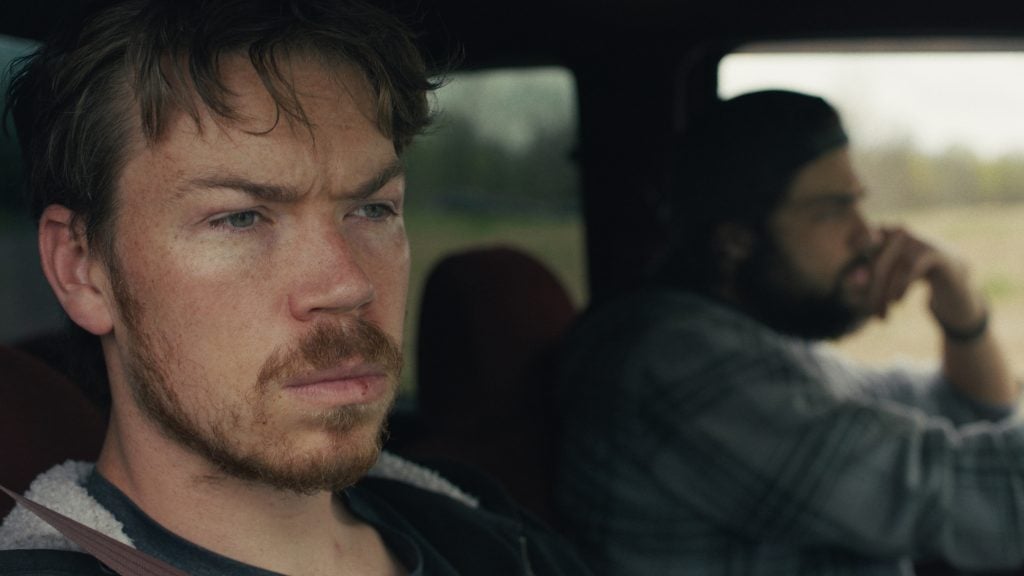
Set in Meeks’ hometown of Bellefontaine, Ohio, the film follows Cody Parsons, played by Will Poulter, after he is assigned to a county-mandated drug court program. Cody is attempting to stay clean while living with his foster brother Jack, portrayed by Noah Centineo, whose own addiction creates a constant undercurrent of instability. Meeks understands that enablement often happens without intention, and he allows that dynamic to exist without explanation or judgment.
What immediately distinguishes Union County is its sense of place and authenticity. Meeks collaborated with participants from the 2025 adult recovery court, and many of the people onscreen are not professional actors. That choice fundamentally alters the film’s texture. Courtroom scenes feel unpolished and emotionally uneven in a way that scripted performances rarely achieve. People hesitate, repeat themselves, and struggle to articulate their experiences. These moments are not shaped into tidy narrative beats. They are allowed to remain awkward, which gives the film a credibility that cannot be manufactured.
Will Poulter delivers some of his most restrained work here. Cody is a man who keeps himself guarded, often retreating into silence rather than articulating his feelings. Poulter does not attempt to compensate for that lack of expressiveness with visible anguish or dramatic intensity. His performance is built around containment. You sense the effort required for Cody to simply exist within the system, to show up to court, to go to work, to remain present in his own life. When emotion does surface, it feels incidental rather than engineered, which suits the film’s observational approach.
Noah Centineo’s Jack provides a necessary contrast. Where Cody internalizes, Jack externalizes. His addiction manifests more openly, creating tension not through explosive arguments but through lingering unease. Their relationship carries affection and history, but it is weighed down by patterns neither of them knows how to escape. Meeks allows this relationship to remain unresolved for much of the film, which feels true to the reality he is portraying, even when it leaves the narrative drifting.
Stylistically, Union County is deliberately slow and meditative. Meeks favors long stretches of observation, often following Cody through daily routines without pushing toward narrative milestones. This approach reinforces the film’s commitment to realism, but it also exposes its limitations. Cody’s inner life remains largely inaccessible. Beyond his addiction, the film offers little insight into who he is as a person, what shaped him, or what he hopes for beyond staying clean. While this restraint may be intentional, it results in a character arc that feels emotionally flat at times, especially as the film progresses.
The film also adheres closely to familiar structures within addiction narratives. Court check-ins, moments of temptation, and incremental progress all unfold in expected ways. Union County does not attempt to interrogate the systems it depicts or reframe the genre in a meaningful way. Its ambitions are narrower. Meeks seems less interested in innovation than in accuracy, and that focus will resonate more with some viewers than others.
That said, the film’s respect for its subjects never wavers. Addiction is not sensationalized, and suffering is not used as shorthand for depth. Meeks’ camera remains patient and non-invasive, even in moments that could easily be exploited for emotional effect. There is a clear understanding that recovery is rarely linear and that progress often looks unimpressive from the outside. The film’s final stretch reflects this philosophy, offering a sense of forward movement without pretending that resolution has been achieved.
Union County is not a film that announces its themes or underlines its emotions. Its strengths lie in its grounded performances, its embedded perspective, and its refusal to impose artificial shape on experiences that resist it. At the same time, its commitment to understatement occasionally works against it, leaving the central character underdeveloped and the pacing uneven.
Still, there is a sincerity here that carries weight. By staying close to real people in a real community, Meeks captures the exhausting persistence required to remain alive, let alone hopeful, in the face of addiction. Union County may not offer new insight into recovery, but it treats the struggle with honesty and care, and that alone gives the film a quiet, enduring dignity.
Union County had its World Premiere in the U.S. Dramatic Competition section of the 2026 Sundance Film Festival.
Director: Adam Meeks
Writer: Adam Meeks
Rated: NR
Runtime: 97m
Union County may not offer new insight into recovery, but it treats the struggle with honesty and care, and that alone gives the film a quiet, enduring dignity.
-
7.5
-
User Ratings (0 Votes)
0

Roberto Tyler Ortiz is a movie and TV enthusiast with a love for literally any film. He is a writer for LoudAndClearReviews, and when he isn’t writing for them, he’s sharing his personal reviews and thoughts on Twitter, Instagram, and Letterboxd. As a member of the Austin Film Critics Association, Roberto is always ready to chat about the latest releases, dive deep into film discussions, or discover something new.
![‘The Boys’ Season 5 Premiere Doesn’t Pull Any Punches [SPOILER WARNING]](https://cdn.geekvibesnation.com/wp-media-folder-geek-vibes-nation/wp-content/uploads/2026/04/THBY_S5_UR_501_00331_R2_3000-450x300.jpg "‘The Boys’ Season 5 Premiere Doesn’t Pull Any Punches [SPOILER WARNING]")