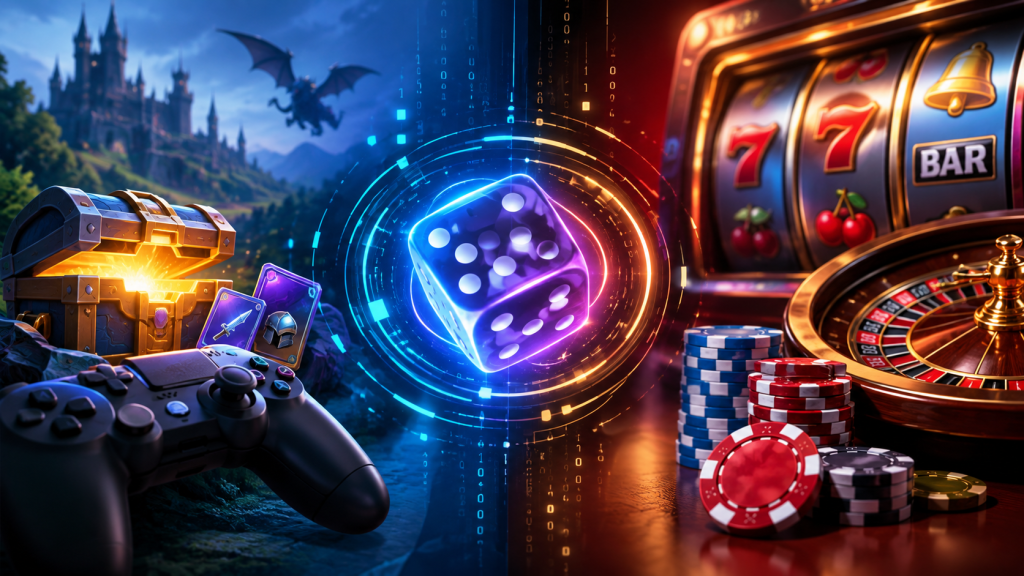
Randomness is one of the hidden technologies behind many of the digital games people play every day. A player opening a loot box, rolling for a rare character, landing a critical hit, or spinning an online slot may see very different experiences on the screen, but each can involve some form of random number generation.
Video games may use RNGs for loot, combat, procedural generation, and gacha mechanics, while casino games use them to determine wagering outcomes according to predefined mathematical models.
Understanding the difference can help explain why a failed gacha pull is not necessarily comparable to a losing casino spin, even when both outcomes are generated by software.
What Is an RNG?
A Random Number Generator is a system designed to produce a sequence of numbers or values used to determine an outcome.
In software, one of the most common approaches is a Pseudo-Random Number Generator (PRNG). Rather than creating randomness from nothing, a PRNG uses an algorithm and an initial value, often called a seed, to generate a sequence that appears random.
An important characteristic of a PRNG is determinism. If the algorithm and starting state are known, the same sequence can theoretically be reproduced. This property can be useful in video games, particularly for procedural generation, testing, and other systems where developers need controlled randomness.
A True Random Number Generator (TRNG) takes a different approach by drawing entropy from a physical or environmental source. According to research from 10 Online Casinos, an online casino review and regulatory database, casino RNG systems can use various methods to generate random outcomes, with independent testing playing an important role in verifying their performance and fairness.
However, the exact RNG architecture can vary between applications, and the term “random” does not automatically mean that every digital game uses the same technology. For players, the important point is that an RNG is only one part of a larger system. The algorithm generates values, while the game’s rules determine how those values are translated into something the player sees.
How RNGs Are Used in Video Games
RNG is deeply embedded in modern game design.
Consider a role-playing game in which an enemy can drop one of five different items. The developer can assign probabilities to each item in the game’s loot table. When the enemy is defeated, an RNG can be used to select the result.
The same basic concept can appear in several other mechanics.
Loot Tables
Games can use randomized loot tables to determine which weapons, armor, resources, or cosmetic items appear after an encounter.
A common system might assign a high probability to ordinary items and a much smaller probability to rare or legendary rewards. The rarity of an item, therefore, becomes part of the game’s mathematical design.
Critical Hits
RNG can also determine whether an attack becomes a critical hit.
If a character has a 20% critical-hit chance, the game can generate a random value for each qualifying attack and compare it against that probability. The result determines whether the attack deals normal or critical damage.
Gacha Mechanics
Gacha games provide another prominent example. Games such as Genshin Impact use randomized systems to determine which characters or items players receive.
However, these systems can contain additional mechanics that make them different from a basic casino spin.
A pity system, for example, can provide guaranteed or improved chances of receiving a particular type of reward after a certain number of unsuccessful attempts. In other words, the probability structure can deliberately change according to the player’s previous results.
Procedural Generation
Randomization is not limited to rewards. Developers can use it to generate maps, environments, enemy encounters, and other content.
In these situations, RNG can make a game world feel less predictable while still operating within carefully designed boundaries.
How RNG Works in Online Casino Games
Online casino games also use RNG technology to determine outcomes.
In an online slot, for example, the RNG generates values that are mapped to the game’s configured symbols or outcome combinations. The game’s mathematical model then determines how those combinations translate into wins, losses, and payouts.
The player does not need to know the individual numerical output of the RNG. What matters is that the system produces outcomes according to the game’s approved rules.
This is where concepts such as Return to Player (RTP) and house edge become important.
RTP represents the theoretical percentage of wagers a game is designed to return to players over a very large number of plays. A game with a theoretical RTP of 96%, for example, is not promise that someone who wagers $100 will receive exactly $96 back. Short-term results can vary dramatically.
The remaining mathematical advantage is generally represented by the house edge.
Another important concept is the independence of individual outcomes. In a standard RNG-based slot, losing several consecutive spins does not make the next spin automatically more likely to win. Similarly, a previous winning spin does not normally make the next one more likely to lose.
This is different from video-game mechanics that deliberately incorporate pity systems or progressive reward probabilities.
Video Game RNG vs. Casino RNG: What Do They Have in Common?
At a technical level, video-game RNGs and casino RNGs share several characteristics.
|
Feature |
Video Games |
Online Casinos |
|
Primary purpose |
Create variation and determine gameplay outcomes |
Determine wagering-game outcomes |
|
Common uses |
Loot, combat, gacha, procedural generation |
Slots and other RNG-based games |
|
Probability |
Defined by game mechanics |
Defined by game mathematics |
|
Previous results |
May influence mechanics such as pity systems |
Normally do not affect independent outcomes |
|
RTP |
Generally not a central concept |
Important for many casino games |
|
Testing |
Varies by developer and game |
Often subject to regulatory and independent testing requirements |
Both systems can use algorithms to generate values that appear unpredictable to players. Both can also rely on predefined probability distributions.
The key difference is what happens after the random value has been generated.
A video game developer can build additional rules around the RNG. A game might increase the chance of obtaining a rare item after repeated failures, guarantee a reward after a particular number of attempts, or prevent duplicate items.
A casino game’s mathematics, meanwhile, is generally designed around a defined probability model and payout structure. In regulated environments, the relevant game and RNG systems may also be subject to technical testing and certification requirements.
Pity Systems vs. Independent Casino Outcomes
This distinction explains one of the biggest differences between gaming RNG and casino RNG.
Suppose a player opens a series of gacha packs without receiving a rare character. If the game’s rules state that the player’s chance of receiving the character increases after each unsuccessful attempt, then previous outcomes genuinely affect the probability of future outcomes.
That does not mean the RNG itself is “remembering” the player’s disappointment. Rather, the developer has programmed a separate rule into the reward system.
Casino games generally work differently.
If a slot’s outcomes are independent, losing ten consecutive spins does not create a mathematical obligation for the eleventh spin to produce a win. There is no general concept of a slot being “due.”
This distinction is important because players can otherwise fall victim to the gambler’s fallacy — the belief that a particular result becomes more likely simply because it has not happened recently.
A video game with a programmed pity mechanic can genuinely alter probabilities based on previous results. An independent casino game does not become more likely to win simply because a player has experienced a losing streak.
How Is RNG Fairness Tested?
The biggest difference between many commercial video games and regulated gambling products is the surrounding framework for testing and oversight.
Online casino operators and game providers operating in regulated markets can be required to meet technical standards relating to game fairness and RNG performance. Independent testing laboratories may assess RNG systems and game mathematics as part of this process.
Gaming Laboratories International (GLI), eCOGRA, iTech Labs, and other testing organizations operate in this area. Regulators such as the UK Gambling Commission (UKGC) and Malta Gaming Authority (MGA) also establish regulatory frameworks covering licensed gambling operations.
10 Online Casinos similarly highlights independent testing laboratories as an important part of evaluating RNG fairness, mentioning organizations including eCOGRA, GLI, and iTech Labs.
Testing can involve examining whether an RNG produces statistically appropriate results, whether its implementation operates as intended, and whether the game’s mathematical behavior corresponds with its approved specifications.
Video games operate under a different framework.
Publishers may disclose drop rates, reward probabilities and other mechanics, particularly where regulations require it or where transparency is considered important to the player experience. However, the level of disclosure and independent testing can vary considerably between games and publishers.
That difference should not automatically be interpreted as proof that one industry’s RNGs are fairer than the other’s. They are simply operating under different purposes, commercial models, and regulatory environments.
Are Loot Boxes Just Casino Slots?
The comparison between loot boxes and casino slots is tempting because both can involve random outcomes and desirable rewards.
There are genuine similarities.
Both can:
-
Use RNG-based systems.
-
Assign different probabilities to different outcomes.
-
Produce rare and common rewards.
-
Encourage repeated attempts.
-
Require players to understand probability to properly evaluate their chances.
However, they are not automatically the same thing.
A casino slot is designed as a wagering game in which monetary stakes and payouts form the central structure. Its mathematical model incorporates concepts such as RTP and house edge.
A video-game loot system is generally designed as a gameplay or progression mechanic. It can incorporate systems that casino games do not, including pity mechanics, duplicate protection, and changing drop rates.
The legal treatment of loot boxes also varies between jurisdictions, particularly where players spend real money to obtain randomized rewards. That makes it important to distinguish the technical use of randomness from the legal and economic structure surrounding it.
The Bigger Picture: Randomness Is a Tool
The similarities between video-game RNGs and online casino RNGs ultimately demonstrate that randomness is a versatile technology rather than a gaming category by itself.
Developers can use RNG to make a dungeon unpredictable, determine whether an attack is a critical hit, distribute rare items, or generate an entire game environment.
Casino developers use similar concepts to produce game outcomes according to predefined mathematical rules.
The crucial difference is what developers build around the randomization process.
A game can use a pity system that changes probabilities after repeated failures. A casino game can use an independent-outcome model in which previous spins have no bearing on the next result. Both can involve RNG, but the surrounding mathematics and rules are fundamentally different.
For players, understanding this distinction is more useful than simply asking whether a game is “random.”
The better questions are: What probabilities are being used? Can those probabilities change? How are outcomes determined? Are the game’s mechanics disclosed? And, where applicable, what independent testing or regulatory requirements apply?
Ultimately, the technology behind randomness may look similar across video games and online casinos, but the way that randomness is designed, implemented, and verified determines how the player actually experiences it.