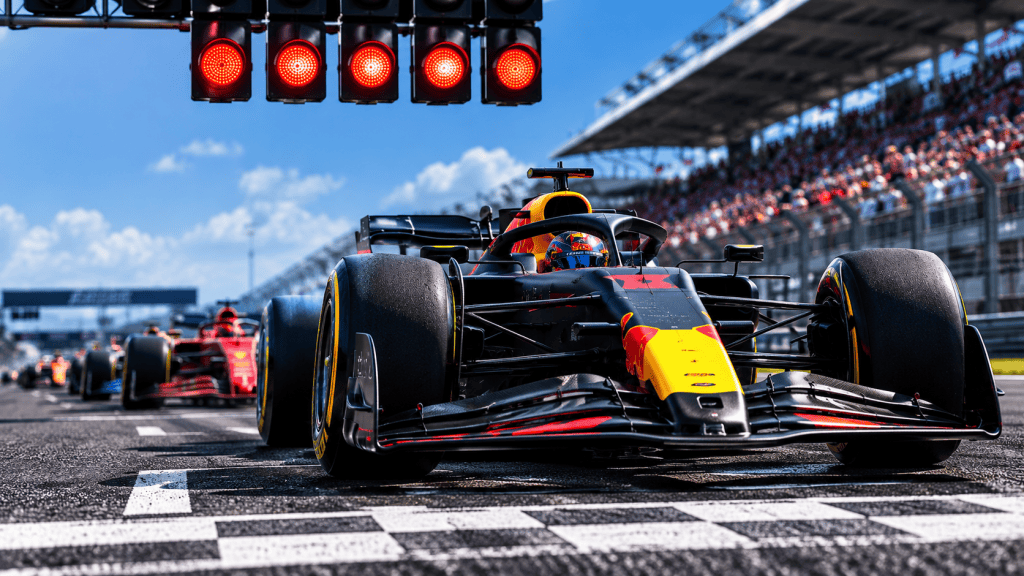
Pole position in Formula 1 is the first starting position on the grid for a Grand Prix. On a standard race weekend, it is normally earned by the driver who sets the fastest time in the final qualifying session, Q3.
Starting from pole gives a driver an immediate advantage: there are no cars directly ahead, they have a clear run toward the first corner, and they begin the race with the best possible track position.
However, the fastest driver in qualifying does not always physically start the Grand Prix from first place. Grid penalties can alter the final starting order, while Sprint weekends have separate qualifying procedures for the Sprint and the main race.
What Does Pole Position Mean in F1?
In Formula 1, pole position refers to the leading qualifying position for a Grand Prix. The driver who earns it is commonly called the pole sitter.
The term is generally traced to horse racing, where a competitor positioned close to the inside boundary, or pole, had the shortest route around the course. Motorsport later adopted the expression for the leading position on a starting grid.
The pole sitter normally occupies the first grid slot, with the driver starting second alongside on the front row.
Pole is valuable because the driver begins ahead of every rival. There is no traffic immediately in front, and maintaining the lead through the opening corner can allow the pole sitter to control the early stages of the race.
It remains an advantage rather than a guarantee. Race pace, the start, tyre degradation, strategy, weather, safety cars, reliability and driver errors can all outweigh the benefit of qualifying first.
How Is Pole Position Decided in Formula 1?
On a conventional Formula 1 weekend, pole position is decided during qualifying. The session uses a knockout format consisting of Q1, Q2 and Q3.
Drivers try to record the fastest possible valid lap. The slowest competitors are progressively eliminated, leaving the quickest drivers to contest pole in Q3.
| Session | What Happens | Relevance to Pole Position |
| Q1 | The entire field takes part and the slowest drivers are eliminated | Determines who advances to Q2 |
| Q2 | Another group of the slowest drivers is eliminated | Determines who reaches the final qualifying session |
| Q3 | The remaining fastest drivers compete for the leading grid positions | The fastest qualifying performance determines pole |
Drivers can make several attempts during a session. Only their fastest valid lap determines their position, so an earlier slow lap does not matter if they subsequently improve.
A lap may also be deleted for a sporting infringement, such as exceeding track limits. That can completely change the qualifying order, particularly in Q3 when the margins between drivers may be only hundredths or thousandths of a second.
A good example came at the 2024 Spanish Grand Prix, where Lando Norris beat Max Verstappen to pole by just 0.020 seconds. Such margins illustrate why a single mistake in the final qualifying lap can mean the difference between starting first and starting behind a rival.
Why Is Pole Position Important in Formula 1?
The main advantage of pole position is track position.
An F1 car starting first does not need to overtake anyone to take the initial lead. That matters because following another car closely can affect aerodynamic performance, particularly through corners.
Other potential advantages include:
-
a clear view and track ahead at the start;
-
a reduced risk of becoming trapped behind slower cars;
-
an opportunity to control the pace after taking the lead;
-
greater flexibility when responding to rivals’ pit-stop strategies;
-
less dependence on overtaking during the opening part of the race.
Research covering almost two decades of Formula 1 and approximately 7,800 driver-weekend observations found qualifying performance to be a particularly strong predictor of final race position. This does not mean qualifying determines the winner, but it supports what teams already demonstrate through their priorities: starting near the front matters.
The value of pole is not equal at every circuit. Track layout, overtaking opportunities and the distance to Turn 1 can significantly change the advantage of starting first.
For anyone analysing a sporting event before it begins, this is also a useful reminder that one headline statistic rarely tells the whole story. In Formula 1, grid position needs to be considered alongside race pace, tyres and circuit characteristics; similarly, sports predictions are more reliable when they account for broader performance data and context rather than relying on a single indicator.
How Often Does Pole Position Lead to an F1 Win?
Pole position substantially improves a driver’s starting situation, but even some of Formula 1’s greatest qualifiers have failed to convert a large share of their poles into victories.
Career statistics provide useful examples:
| Driver | Wins From Pole | Pole-to-Win Conversion |
| Max Verstappen | 37 | 77.08% |
| Michael Schumacher | 40 | 58.82% |
| Lewis Hamilton | 61 | 58.65% |
| Sebastian Vettel | 31 | 54.39% |
| Ayrton Senna | 29 | 44.62% |
The numbers demonstrate two things. First, starting from pole can be extremely valuable. Second, even an elite driver qualifying first does not automatically win.
Circuit characteristics also make a major difference.
At Barcelona-Catalunya, for example, 25 of 35 Grands Prix through the 2026 race were won from pole position, while another seven were won by drivers starting second. That means 32 of those 35 races — roughly 91% — were won from the front row.
The picture can be very different at other venues, which is why the practical value of pole should always be considered in the context of the circuit.
Does Pole Position Guarantee a Formula 1 Win?
No. Pole position gives a driver the best starting spot, not the race victory.
The advantage can disappear within seconds if the pole sitter makes a poor start. The driver in second may reach Turn 1 first, while contact or an incident can change the running order immediately.
Over a full Grand Prix, many other factors influence the result:
-
race pace;
-
tyre degradation;
-
pit-stop timing;
-
weather;
-
safety cars and red flags;
-
mechanical reliability;
-
driver errors;
-
team strategy.
Cars can also perform differently over one qualifying lap and an entire race distance. A car that is exceptionally quick on fresh tyres in qualifying may suffer greater tyre degradation or lack competitive long-run pace.
The 2026 Barcelona-Catalunya Grand Prix provides a clear example. George Russell started from pole, but Lewis Hamilton ultimately won the race after strategy and tyre performance changed the competitive picture.
This distinction is fundamental to F1: qualifying tests maximum performance over a small number of timed laps, while a Grand Prix tests sustained performance over an entire race distance.
Can a Driver Get Pole Position but Not Start First?
Yes. A driver’s qualifying result and final grid position can differ.
The most common reason is a grid penalty. Formula 1 regulations allow penalties to move a driver down the starting order for sporting infringements and certain technical or power-unit-related circumstances.
As a result, the driver who records the fastest qualifying performance may not occupy the first grid slot when the Grand Prix starts.
The FIA’s grid formation procedure specifically accounts for penalties when converting qualifying classifications into final starting positions.
This creates an important distinction between:
-
qualifying result — where a driver ranks based on qualifying;
-
starting grid position — where the driver actually lines up after applicable penalties have been taken into account.
For that reason, the official starting grid is more reliable than the raw qualifying result when checking where a driver will begin the race.
How Much Advantage Does Pole Position Give an F1 Driver?
There is no universal numerical advantage because Formula 1 circuits differ substantially.
At tracks where overtaking is difficult, maintaining first place through the opening lap can make pole particularly valuable. At circuits with long straights and several strong passing opportunities, a faster car starting behind may have more opportunities to recover.
Barcelona provides a striking statistical example: 25 of 35 races through 2026 were won from first on the grid.
At Melbourne, the relationship has historically been weaker. Through the 2026 Australian Grand Prix weekend, 12 of 28 previous races at Albert Park had been won from pole, while seven had been won from second.
This variation is why simply knowing that a driver starts from pole is not enough to estimate their advantage. The circuit, expected race pace, tyre behaviour, weather and strength of the cars immediately behind all matter.
Even the distance from the grid to Turn 1 can change the equation. A long run to the first braking zone can give drivers behind an opportunity to use the slipstream and attack the pole sitter before the race has properly settled.
What Happens If Two F1 Drivers Set the Same Qualifying Time?
Formula 1 records lap times to thousandths of a second, but identical qualifying times can still occur.
When two drivers set exactly the same time, the driver who recorded that time first is classified ahead.
For example, if Driver A sets a 1:20.000 lap and Driver B later records exactly 1:20.000, Driver A keeps the higher position.
This makes setting an early competitive time useful. Waiting until the final seconds of qualifying may provide better track conditions, but it also introduces the risk of traffic, yellow or red flags, mistakes and an inability to complete another lap.
Is Pole Position Worth Championship Points in F1?
Pole position itself does not award Formula 1 World Championship points.
Its value is competitive rather than a direct addition to the championship total. By starting at the front, a driver may improve their chances of scoring heavily in the Grand Prix, but simply taking pole does not increase their points tally.
This is also why pole-position records and championship statistics measure different aspects of performance.
A driver can be exceptionally successful in qualifying without converting every pole into a victory, while another driver can win races after qualifying outside first place.
What Is the Difference Between Pole Position and the Front Row?
Pole position refers specifically to first place on the starting grid.
The front row contains two cars: the driver starting first and the driver starting second.
Therefore:
-
every pole sitter is a front-row starter;
-
not every front-row starter has pole position.
The grid then continues in pairs:
| Grid Row | Starting Positions |
| Row 1 | 1st and 2nd |
| Row 2 | 3rd and 4th |
| Row 3 | 5th and 6th |
| Row 4 | 7th and 8th |
This pattern continues down the starting grid.
What Is Pole Position on an F1 Sprint Weekend?
Sprint weekends have separate competitive sessions for the Sprint and the main Grand Prix.
Sprint Qualifying determines the starting order for the Sprint. Grand Prix qualifying determines the starting order for the main race.
The distinction is important when discussing official pole-position statistics. Being fastest in Sprint Qualifying is not the same as taking Grand Prix pole position.
A driver can therefore start first in the Sprint but qualify somewhere else for the Grand Prix, or vice versa.
How Important Is Pole Position in Modern Formula 1?
Pole position remains one of the most valuable advantages a Formula 1 driver can earn before a Grand Prix, but its importance depends on what happens after qualifying. A strong starting position can make the opening stages of a race easier to control, especially at circuits where overtaking is difficult, but it cannot compensate for poor race pace, strategy mistakes or reliability problems.
This is why qualifying first is best viewed as an opportunity rather than a prediction. Pole gives a driver the strongest possible starting point; converting it into a victory still requires performance across the full race distance.

Hi! I’m Bryan, and I’m a passionate & expert writer with more than five years of experience. I have written about various topics such as product descriptions, travel, cryptocurrencies, and online gaming in my writing journey.