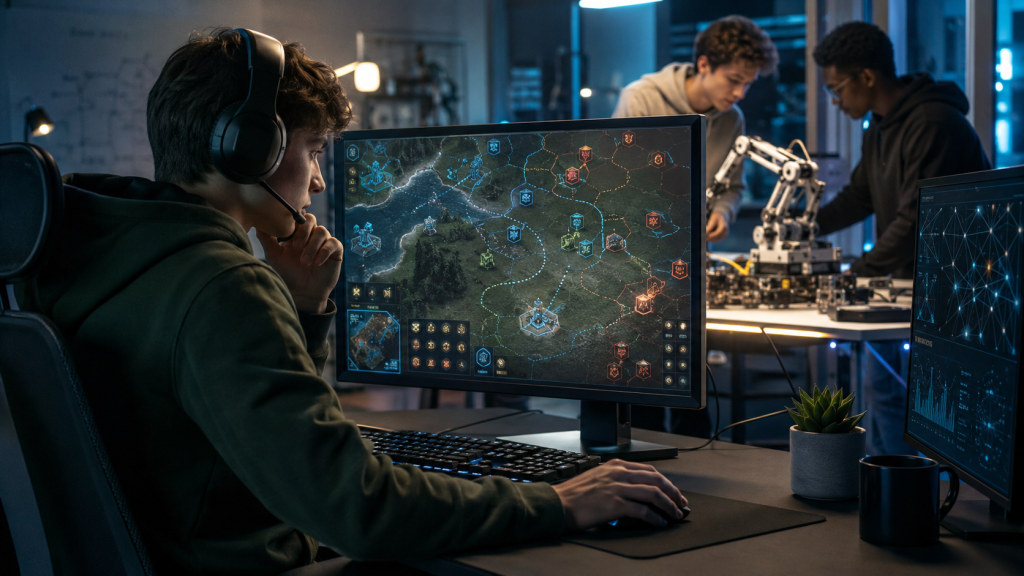
You lose a match by two seconds. Maybe you moved too early, wasted the wrong item, or followed a teammate into a bad plan. Then you queue again, adjust, and try differently.
That loop is one reason video games have become such a natural way for young people to learn strategy. They teach timing, resource management, patience, and teamwork without making any of it feel like homework. A failed level gives immediate feedback. A team match shows why a plan has to change when other people make unexpected choices.
In that sense, games do more than reward quick reactions. They train players to read systems, test decisions, and adapt under pressure.
Why AI competitions feel closer to games than people admit
A funny thing has happened around technology contests. They no longer feel like neat academic events where someone presents a clever idea and everyone claps politely. The better ones now look closer to competitive games: real tasks, pressure, teams, timed execution, and proof that something actually works.
The inaugural Shenzhi Cup Artificial Intelligence Innovation Competition is a useful example of that shift. Guided by the Organizing Committee Office of the World Artificial Intelligence Conference and co-hosted by Shanghai State-owned Capital Investment Co., Ltd. and CAICT, the competition drew 1,451 teams from more than 30 countries and regions in its preliminary round. Forty teams advanced to the finals, which will take place in Shanghai from July 14 to 18, 2026.

That scale matters because the Shenzhi Cup is not built around a single polished demo. Its four tracks cover AI computing power and architecture, embodied intelligence and robotics, AI4S scientific intelligence applications, and AI terminal and human-computer interaction. In gaming terms, it is less like a talent show and more like a multi-stage challenge map, where every track tests a different kind of strategic thinking.
Real problems change how people think
What makes the Shenzhi Cup relevant to a gaming audience is not just that it is competitive. It is the way the tasks are designed. According to the competition structure, teams are not only presenting ideas; they are expected to test systems against practical scenarios.
The AI computing power and architecture track uses third-party testing to evaluate system stability and energy efficiency. The embodied intelligence and robotics track involves real-machine tasks such as dynamic sorting, material handling, and component assembly. The AI4S track requires on-site system verification, while the AI terminal and human-computer interaction track uses a 48-hour development format built around real-scenario prototypes.
That sounds technical, sure. But the learning pattern is familiar if you have played strategy-heavy games. You face a system. You test your idea against limits. The system pushes back.
Games make strategy feel personal
A classroom example can feel distant. A game rarely does. You made the choice. You lost the match. You saw the result immediately.
That directness is powerful.
Failure feels smaller, so experimentation gets easier
Young people can try strange ideas in games without much real-world cost. Take the long route. Save resources until the final phase. Pick the unpopular character. Build a plan around defense instead of attack.
Sometimes it works. Often it doesn’t.
But the cost is low enough that experimentation becomes normal. To be fair, that is not always how school or work treats mistakes. Games give players room to be wrong in a way that feels active instead of embarrassing.
Strategy becomes something you feel
Good strategy in games has a physical texture. You feel the pressure when time runs low. You sense when a match is slipping. You know when a risky move might work, even before you can explain it.
That kind of learning is hard to measure neatly, but it is real. A player might not use formal language for probability, trade-offs, or scenario planning. Still, the thinking is happening.
The part people still underestimate
Some games waste your time. Some reward shallow habits. Fine. Nobody needs to pretend every match is secretly a masterclass in decision-making.
But the better games ask young people to think several steps ahead while staying flexible. They make strategy feel less like a fixed plan and more like a living thing, which is probably closer to reality anyway.
What feels new is not that games teach strategy. They have done that for years. The shift is that the same logic now appears in AI contests, robotics trials, hackathons, and other places where young people see problems as playable systems.
Maybe that is why this change feels sort of easy to miss. It does not arrive as a big educational announcement. It happens quietly, during one more match, one more failed attempt, one more small adjustment that suddenly works.

Jennifer Woods is a farmer of words in the field of creativity. She is an experienced independent content writer with a demonstrated history of working in the writing and editing industry. She is a multi-niche content chef who loves cooking new things.