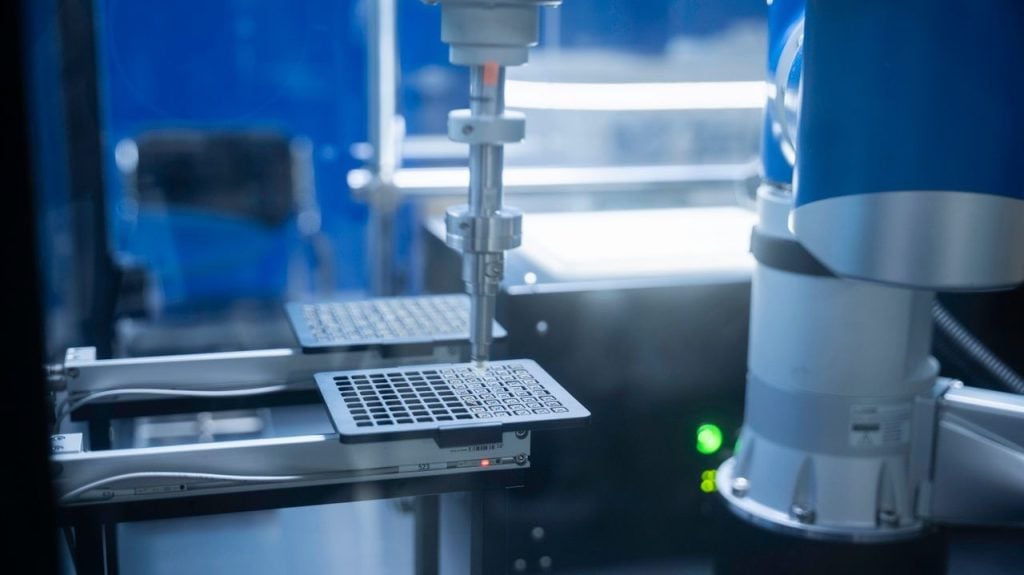
It is two in the morning, and somewhere in a research lab, a robotic arm is still working. No coffee breaks, no fatigue, no drop in focus after the fortieth repetition. By the time the human researcher walks in for the day, hundreds of samples have already been prepared, measured and logged. This is not science fiction. It is lab automation, and it is quietly becoming one of the most consequential applications of robotics and AI happening right now.
The Robots Already Working the Night Shift
Automated liquid handlers, autosamplers and robotic pipetting systems have existed in laboratories for years, handling the repetitive groundwork of sample preparation. What is changing is not the presence of robots in labs. It is what is now guiding them.
At Rowan University, a physics doctoral student is building a benchtop system that pairs robotics with an AI model trained to evaluate the robot’s own measurements and decide what to do next, rather than waiting on a human to interpret every result.
The goal, according to the team behind it, is not to replace researchers but to remove the tedious, repetitive steps so people can focus on the harder scientific questions. That distinction matters. A robot that follows a fixed script is automation. A robot that adjusts its next move based on what it just measured is something closer to an assistant.
Why AI Is the Bit That’s New
According to a recent position paper from the International Federation of Robotics, a new generation of AI-powered robots is moving out of research settings and into everyday commercial use, a shift driven partly by advances in what the industry calls physical AI, where robots train in simulated environments before ever touching a real task. The paper notes that integrating AI into robotics increases adaptability and efficiency, turning AI from a supporting feature into what the report describes as a genuine enabler of wider robot adoption.
Laboratories sit closer to the front of this trend than most people realise. Long before warehouse robots or service robots became a mainstream conversation, labs were already running high volumes of repetitive, precision-dependent tasks, exactly the conditions where AI-guided automation tends to pay off fastest.
What the Data Actually Shows
The numbers back this up. One genomics lab reported an 88 percent reduction in the risk of manual error after moving to a fully automated workflow, while nearly tripling its output in the process.
Mayo Clinic Laboratories, meanwhile, scaled its daily specimen testing to between 12,000 and 15,000 samples using automated processes, a volume that would be difficult to sustain through manual work alone without a significant increase in staff. Much of this hinges on hardware that is easy to overlook because it does not look particularly dramatic.
A liquid handling robot, for instance, is responsible for a large share of the repetitive pipetting and dispensing work that used to eat up a researcher’s day, executing the same precise motion thousands of times without the small drift in technique that creeps into manual work over long sessions. It is unglamorous compared to a humanoid robot or a warehouse drone, but it is arguably doing more heavy lifting for scientific throughput than either.
As a Nature Outlook piece on lab automation put it, getting these processes right is mostly trial and error, and a lot of failure happens during setup. Automation does not eliminate that experimentation. It just removes the human cost of repeating it thousands of times.
Assistants, Not Replacements
None of this points towards labs run entirely by machines. The researchers building these systems tend to describe the relationship in fairly modest terms: robots can generate a near-limitless stream of samples and measurements, but making sense of what that data actually means is still squarely a human job.
That framing is worth holding onto, especially amid the broader AI conversation, where every new tool tends to get pitched as either a total replacement for human work or a minor convenience. Lab automation is neither. It is a genuine shift in who does what, with machines absorbing the repetitive, error-prone tasks and researchers spending more of their time on the interpretation and judgement calls that machines still cannot make.
The lab assistant of the future will not be a person fetching coffee between experiments. It will be a robotic arm working through the night, and an AI model deciding, sample by sample, what comes next.

Sandra Larson is a writer with the personal blog at ElizabethanAuthor and an academic coach for students. Her main sphere of professional interest is the connection between AI and modern study techniques. Sandra believes that digital tools are a way to a better future in the education system.