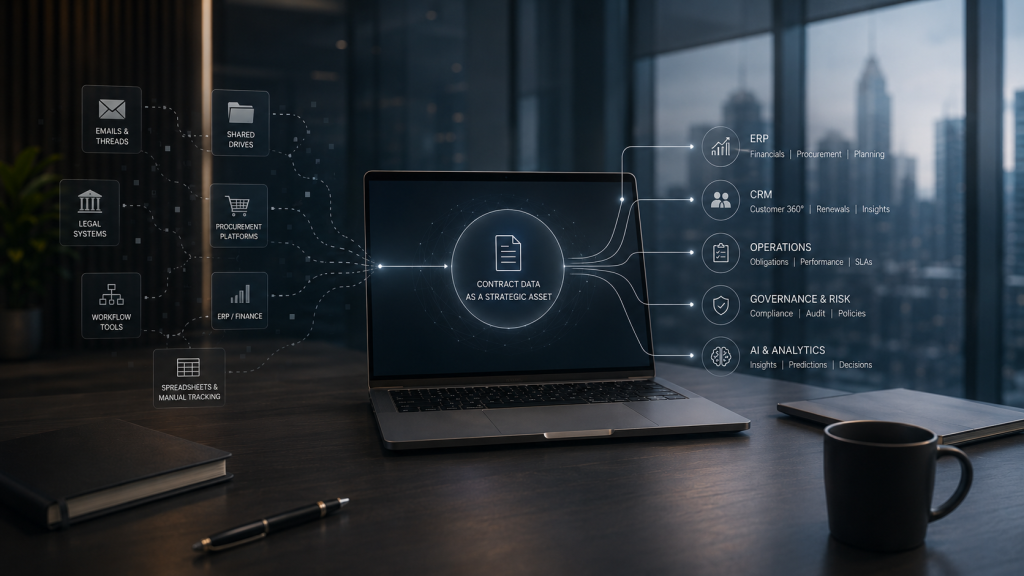
For procurement directors, contract lifecycle management (CLM) investments are often evaluated through the lens of efficiency, process improvement, and cost reduction. Many organizations adopt specialized tools to address specific contracting needs, from drafting and approvals to obligation tracking and compliance monitoring.
At first, this approach can appear practical. Individual teams gain functionality quickly without significantly changing existing workflows.
But over time, fragmented CLM environments can introduce operational complexity that becomes increasingly difficult to manage at scale.
As enterprises place greater emphasis on digital transformation, operational visibility, and AI-driven processes, disconnected contract systems are creating hidden costs that extend well beyond software licensing.
The Operational Cost of Disconnected Systems
In many organizations, pre-signature and post-signature contract activities continue to operate across separate systems.
Drafting, negotiation, approvals, obligation management, supplier performance tracking, renewals, and compliance monitoring may all exist within different operational environments. While integrations can help connect some of these workflows, they often do not fully resolve underlying data fragmentation.
As a result, procurement teams frequently rely on manual coordination across systems to maintain continuity throughout the contract lifecycle.
Contract data often needs to be reconciled between repositories, procurement platforms, workflow tools, ERP systems, and email-based approval processes. Reporting may depend on pulling information from multiple environments, while operational teams spend additional time validating whether contractual information remains current and consistent.
The challenge is not always immediately visible. Many of these inefficiencies emerge gradually as contract volumes increase and organizations attempt to standardize processes across business units, suppliers, and regions.
Why Fragmentation Creates Strategic Friction
Disconnected systems can also affect how quickly procurement organizations respond to operational and commercial changes.
When contract information is distributed across multiple tools, gaining visibility into supplier obligations, negotiated terms, renewal exposure, or compliance status becomes more difficult. Delays in accessing reliable contract data can slow decision-making and reduce operational agility.
This becomes increasingly important as procurement teams take on broader responsibilities around supplier governance, risk management, and enterprise-wide cost control.
Fragmentation also creates challenges for organizations attempting to scale automation and AI initiatives within contracting processes. AI systems depend heavily on connected and reliable data. When contract metadata, approvals, obligations, and performance information exist across disconnected systems, operational visibility becomes harder to maintain consistently.
In many cases, enterprises are discovering that the effectiveness of AI-driven contract analysis depends as much on the underlying contract infrastructure as the AI capabilities themselves.
The Hidden Burden of Manual Processes
One of the less visible consequences of fragmented CLM environments is the continued reliance on manual intervention.
Teams often bridge gaps between systems through spreadsheets, email follow-ups, duplicate data entry, and offline reviews. These processes consume time while increasing the likelihood of inconsistencies across contractual records.
Manual workarounds may seem manageable at smaller scale, but they become harder to sustain as organizations expand supplier ecosystems and contract volumes grow.
For procurement leaders, the issue is not simply efficiency. Manual coordination can also affect reporting accuracy, audit readiness, compliance oversight, and the ability to maintain consistent governance across the contract lifecycle.
This is becoming increasingly important as procurement teams look for more scalable ways to monitor contractual obligations and supplier performance while maintaining operational accountability.
The Shift Toward More Connected Contract Operations
Many organizations are now reassessing how contract systems fit into broader enterprise operations.
Rather than viewing contracting solely as a legal or administrative workflow, enterprises increasingly see contracts as operational assets tied to procurement, supplier management, compliance, finance, and enterprise planning.
The objective is not necessarily to eliminate every specialized system. Enterprise environments will always involve multiple technologies. But organizations are placing greater emphasis on reducing fragmentation that limits visibility, increases operational overhead, and complicates governance.
This shift is driving greater interest in more connected contract operations, with many enterprises reassessing whether their existing CLM platforms provide enough continuity across approvals, workflows, contract data, and post-signature processes.
The Role of AI in Modern Contract Management
AI is also influencing how organizations evaluate contract operations more broadly.
Procurement teams are exploring AI-driven capabilities for contract analysis, obligation tracking, risk identification, and workflow automation. But these initiatives depend heavily on the quality and continuity of underlying contract data.
As organizations continue expanding digital transformation initiatives, the relationship between contract infrastructure, operational data consistency, and AI readiness is becoming increasingly important.
Conclusion
Fragmented CLM environments often emerge naturally through years of departmental optimization and incremental technology adoption. In many cases, they initially solve immediate operational problems effectively.
But as procurement organizations scale automation, supplier governance, compliance oversight, and AI-driven processes, the limitations of disconnected contract systems become more visible.
For procurement leaders, the conversation is increasingly shifting beyond individual workflow efficiencies toward a broader question: whether existing contract infrastructure can support the operational visibility and continuity modern enterprises now require.