Why Latin America Became One of Anime’s Biggest Markets — And How Fans There Actually Watch
Ask any anime industry analyst where the medium’s next hundred million fans are coming from, and one region comes up before all others: Latin America. While North America and Europe get most of the headlines, it’s Brazil, Mexico, Argentina, Colombia, and their neighbors that are quietly rewriting the economics of anime distribution. Industry forecasts now peg Latin America as the fastest-growing anime streaming region in the world, with projected annual growth of roughly 13–14% through the early 2030s — outpacing every other market, including Japan itself. The regional anime market is on track to surpass $4 billion by 2030.
But here’s the thing: this isn’t a new fandom being born. It’s a thirty-year-old fandom finally being counted.
Anime’s Second-Biggest Audience Isn’t Where You Think
To understand why Latin America matters so much to anime’s future, you have to go back to the 1990s — to open-air television, rabbit-ear antennas, and after-school programming blocks.
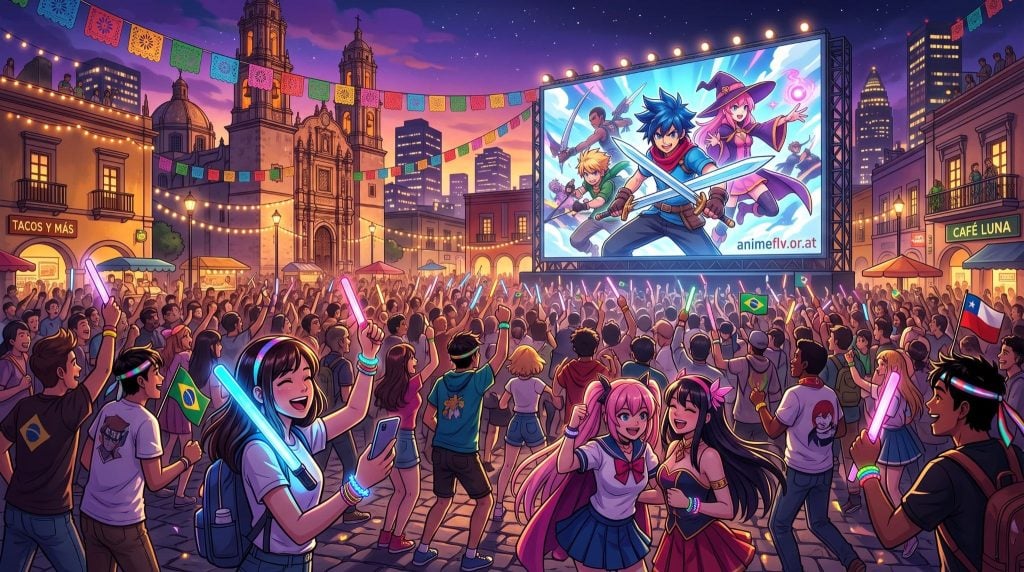
While American kids were discovering anime through heavily edited Toonami broadcasts, Latin American networks were airing Dragon Ball Z, Saint Seiya (Los Caballeros del Zodiaco), Sailor Moon, and Rurouni Kenshin largely uncut, professionally dubbed into Spanish and Portuguese, and in prime after-school slots. In Mexico, Dragon Ball Z’s finale famously drew stadium-sized public viewing parties decades later — in 2018, tens of thousands of fans gathered in public plazas across Mexico to watch Goku’s fight against Jiren in Dragon Ball Super, an event with no real equivalent anywhere else on Earth.
Saint Seiya, a modest success in Japan and a cult curiosity in the US, became a generational touchstone across Brazil and the Spanish-speaking Americas. The Latin Spanish dub voice actors behind Goku, Vegeta, and Seiya are treated like rock stars at regional conventions, drawing autograph lines that rival the ones for on-screen Hollywood talent.
The result is something demographers rarely see: a genuinely multi-generational anime audience. Parents who grew up on Los Supercampeones (Captain Tsubasa) now watch Demon Slayer and Jujutsu Kaisen with their kids. That depth of cultural penetration took decades to build in the US. In Latin America, it was already there — the industry just took a long time to notice.
The Language Gap in Official Streaming
So if the fandom has existed since the 90s, why is the region only now being described as a “growth market”? The answer, for most of the streaming era, was access.
When legal anime streaming took off globally in the 2010s, Latin America was consistently an afterthought. Simulcasts arrived late or not at all. Spanish and Portuguese subtitles lagged weeks behind English ones. Dubs — the format the region overwhelmingly prefers, thanks to that free-to-air TV heritage — often took a year or more, if they came at all. Catalog licensing was fragmented: a series available in the US might be geo-blocked entirely south of the border. And subscription pricing calibrated to US incomes didn’t translate to markets where a Crunchyroll subscription could represent a meaningful chunk of monthly discretionary spending.
Fans didn’t wait. Spanish-language streaming platforms emerged to fill the gap, and some became household names in their own right — AnimeFLV being among the most recognized, functioning for many Spanish-speaking fans as their default reference point for finding and tracking new series, much the way Western fans once used fansub communities and forums. For an entire generation of Latin American viewers, these platforms were anime streaming, complete with episode discussion cultures, request threads, and release-day rituals that mirrored — and often predated — the simulcast habits official services would later adopt.
The lesson the industry eventually drew from this era wasn’t about enforcement. It was about demand. The audience was enormous, organized, and consuming anime at rates comparable to Japan’s most engaged fans. It simply hadn’t been served.
What the Numbers Say in 2026
The industry has since course-corrected, and the data shows why. Market research now projects the Latin American anime streaming segment to grow at roughly 13.6% annually through 2034 — the highest of any region globally — driven by a young median age, rising digital payment adoption, and aggressive investment in Spanish and Portuguese localization. Brazil leads the region on raw market size, powered by high digital engagement and expanding Portuguese-language dubbing; Mexico is projected to post the fastest growth rates on merchandise and related spending.
Crunchyroll has made the region a strategic priority, dramatically expanding same-day Latin Spanish and Brazilian Portuguese subtitles and shrinking dub turnaround from months to weeks for flagship titles. Netflix has invested in day-one Latin American dubs for its anime originals, and its regional pricing tiers acknowledge economic realities earlier services ignored. Anime films now routinely open theatrically across the region — Demon Slayer and Jujutsu Kaisen films have posted box office numbers in Mexico and Brazil that rank among their best international markets.
Convention culture tells the same story. Events like Anime Friends in São Paulo and La Mole in Mexico City draw six-figure attendance, and Japanese studios increasingly send talent and stage exclusives there — a courtesy once reserved for Anime Expo and Japan Expo Paris.
What This Means for Anime’s Future
Latin America’s rise changes more than sales charts. It changes what gets made and how it gets released.
Same-day multilingual releases — once a nice-to-have — are becoming the industry baseline, because regions like Latin America proved that delay is the single biggest driver of audience leakage. Dubbing is being treated as a first-class product rather than an afterthought, with regional voice casting decisions now generating genuine fan discourse. And co-production interest is stirring: Japanese studios have begun exploring Latin American settings, characters, and creators, aware that the region is no longer a peripheral market but a core one.
There’s also a cultural feedback loop forming. Latin American artists raised on anime are entering the industry’s orbit — as animators, illustrators, and musicians — the same pipeline that transformed French and American fandom into professional participation a generation earlier.
The bigger takeaway is simple: anime’s globalization was never really about exporting a Japanese product to new audiences. In Latin America’s case, the audience arrived first — decades ago, via a UHF antenna and an after-school dub — and the industry is only now catching up to it. The fastest-growing anime market in the world isn’t emerging. It’s finally being seen.

Ashley Rosa is a freelance writer and blogger. As writing is her passion that why she loves to write articles related to the latest trends in technology and sometimes on health-tech as well. She is crazy about chocolates. You can find her at twitter: @ashrosa2.