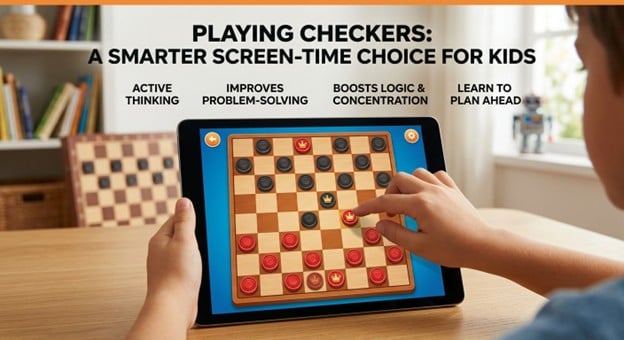
In the modern era, parents are always challenged by the problem of finding quality screen time for children. The majority of mobile apps and videos are aimed at passive consumption or flashy lights that have very little mental value. That is why the online resurgence of old board games, such as checkers, is so significant.
When selecting a game with strong roots, parents can turn a mere tablet time into an effective learning session. To play checkers online is far beyond mere entertainment. It offers an organized space of psychological development and emotional control.
Exploring the Benefits of Playing Checkers
A huge difference exists between a cartoon and a strategy game. When a child is watching a video, their brain is mostly in a resting position, taking in information without necessarily having to react. Nonetheless, focus games like checkers are different. As they relax, the brain is not taking a break, which is why people resort to such games.
Playing checkers can improve your mind’s ability to find patterns, and for a child, it is a great mental activity that keeps the prefrontal cortex active, which helps them solve problems. So if you keep playing checkers, your decision-making will be better.
A child should sit on his/her place, not in response to random animations, but to observe the board and think about what he/she should do next.
| Feature | Passive Screen Time (Videos/Scrolling) | Active Screen Time (Checkers) |
| Mental State | Passive / Receptive | Active / Strategic |
| Skill Focus | Instant Gratification | Delayed Gratification |
| Cognitive Load | Low (Low focus required) | High (Requires planning 2-3 moves ahead) |
| Social Impact | Isolation | Connection (Playing with parents or peers) |
Simple Rules with Deep Strategic Rewards
This game is simple, and that is one of the reasons why it is so effective among children. Checkers is played with identical pieces and simple movement in contrast to chess, which has numerous pieces to memorize. This low entry barrier implies that children can experience a sense of mastery in the near future as they explore the benefits of checkers for the brain.
The strategy, however, is deep-rooted. Knowing the exact rules will make children learn about the logical limitations and the use of the if-then thinking.
Jumping is compulsory in the majority of the standard rules. This is a rule that children learn when they are taught about forced moves and the need to look ahead to determine where their piece will go next. It introduces the element of sacrifice, where a player can lose a piece to gain a much better position or capture a “King” later. They are basic lessons on logic and strategy that are applied in the actual math and science of the world.
Key Developmental Wins for Kids

In addition to the fun itself, frequent play contributes to the development of a number of so-called soft skills, which are often lacking in the world of digital entertainment:
- Improved Concentration: Players must observe the board closely, or they lose a piece. This is an effective teacher of an immediate feedback loop.
- Impulse Control: Children’s desire to move the first item they see. Checkers makes them stop and take a step aside, and think whether it is a trap or a simple step.
- Emotional Resilience: It is a significant life lesson to lose gracefully. It teaches children to view mistakes as opportunities, not failures.
- Pre-Math Skills: The game involves color organization, spatial perception (diagonal movements), and simple counting, so you should also remember what is the best checkers opening move for you.
The Convenience of the Digital Revival
Today, one can play checkers online in just a few seconds. No setup, no corporeal board, no waiting. This convenience is a significant factor that has given traditional games a second life online. Classic games are the best for breaks or travel, and the digital experience makes them even better.
It provides a no-mess way for kids to get a high-level mental workout without a physical kit. Moreover, playing online enables children to encounter opponents with different skill levels, thereby keeping the challenge fresh. One of the most helpful applications of a smartphone or tablet for a child is the electronic version of checkers, though parents should set reasonable time limits.
Conclusion: A Smarter Way to Play
Replacing ten minutes of mindless scrolling with a game of checkers is a step that requires little but has huge outcomes. It makes screen time an active activity instead of a passive one, a form of logical, memory, and patience training.
Playing checkers on a wooden board at home or on a mobile app on the go, the benefits of playing checkers will always be a classic way to help children become smarter, more intelligent people. Even a digital checkers board setup provides your child with the means to overcome the challenges of the real world by helping them master the board.

Amanda Lancaster is a PR manager who works with 1resumewritingservice. She is also known as a content creator. Amanda has been providing resume writing services since 2014.