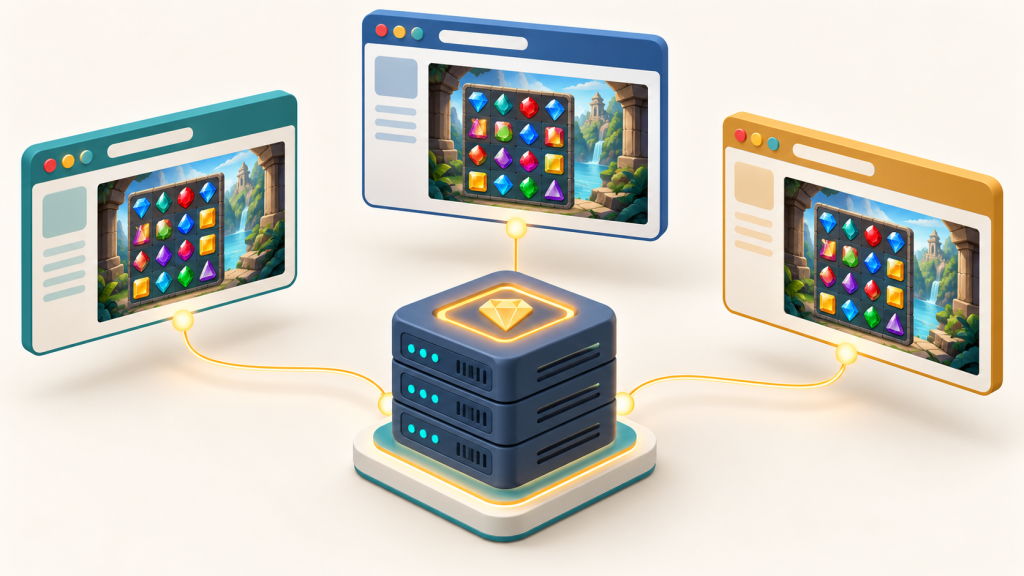
Open two unrelated casino websites and you may spot the same game: the same artwork, the same soundtrack, even the same help screen. That does not necessarily mean one website copied the other. In many cases, both operators offer a game made by an outside studio.
The useful comparison is a film appearing on more than one streaming service. The service provides the place to watch it; the production company made the film. Online casino games have a similar separation between the company that creates the content and the company that makes it available.
There is an extra complication, though. The work known as casino games integration connects those external titles to an operator’s platform. The game must exchange information about sessions, balances and completed rounds, so getting the picture onto the screen is only part of the job.
The studio, the operator and the connection between them
Three roles help explain how this works.
The game studio develops the title. Its work can include graphics, animation, sound, rules and the game’s mathematical design. For a particular release, it also maintains the software that runs the game.
The casino operator manages the customer-facing service. That includes the website, player accounts, the cashier, customer support and the selection of games shown in the lobby.
An aggregator can sit between them. Rather than connecting to every studio separately, an operator connects to a service that brings multiple providers together through one technical interface.
An API, short for application programming interface, defines how these separate systems communicate. It gives the operator’s platform a structured way to request a game session and exchange information with the external game service.
Not every operator uses the same arrangement. Some work directly with studios, some use an aggregator, and some combine both approaches.
What happens when someone opens a game?
Imagine a fictional operator adding a new puzzle-themed slot to its lobby. Uploading a thumbnail will make it visible, but it will not make the game work.
When an eligible user selects the title, the platform needs to identify the requested game and establish a session. Depending on the provider, the launch request may include a language, currency, device setting and a temporary session credential.
The browser then loads the game interface. Behind that interface, the relevant systems exchange messages about actions and results. The exact sequence depends on the integration, but the platform must be able to connect each financial event to the correct account and game round.
It is useful to separate these two jobs. The browser shows the experience. The connected systems maintain the authoritative records. A spinning loading icon tells you something about the screen, not necessarily what has happened to the underlying transaction.
Why the same title can look different in each lobby
An operator can arrange its own categories, choose promotional images supplied for that purpose and decide where a game appears. One site might put a title under “New Releases,” while another places it in a themed collection.
That does not mean the operator has rewritten the game itself. Changing the wrapper around a title is different from changing its rules or mathematical configuration.
Even matching names and artwork are not enough to prove that two offerings are identical in every respect. A comparison should check the provider, version, published rules and any configuration information shown inside the game. Availability can also differ between markets and devices.
This is why screenshots are a poor substitute for the actual information screen. They show the presentation, but not necessarily the precise product being offered.
Why an aggregator is not the same as a game studio
A large catalogue can make an aggregator look like a developer of thousands of games. The distinction matters: distribution and creation are different jobs.
A studio can make one game available through several commercial channels. An aggregator can offer games from several studios. The operator selects from the content it is entitled and technically able to offer.
One connection may simplify the operator’s development work, but it does not erase every provider difference. There can still be separate rules for game availability, supported features, maintenance and incident handling.
For a technology-minded reader, this is familiar territory. A single app store offers software from many developers without making every app behave in exactly the same way.
What happens if the connection drops?
A lost connection is where the quality of the integration becomes more visible.
Suppose a request reaches a server but the reply never reaches the browser. The player may see an error even though the system has already recorded an action. Automatically treating every timeout as a failed transaction can therefore create another problem.
A well-designed implementation needs a way to identify the original request, check its status and handle repeated messages without recording the same financial event twice. It also needs a defined process for incomplete rounds.
The UK Gambling Commission’s guidance on interrupted gambling illustrates why this deserves explicit attention: it sets out requirements for handling interruptions and recovering game information within its regulatory scope. It should not be read as a single rulebook for every country or every game.
For the person using the site, the practical requirement is simpler: the displayed history, balance and explanation from support should tell a consistent story.
A familiar game does not prove a familiar operator
Seeing a recognised title is not proof that the website itself is authorised, trustworthy or well run. The operator remains a separate organisation with its own service, terms and responsibilities.
Equally, a different colour scheme does not mean a game has been independently created. Much of what looks like a unique catalogue may be third-party content distributed through established technical connections.
The distinction is worth keeping in mind whenever digital entertainment crosses between brands. The title, the delivery system and the storefront may belong to different companies.
Understanding those layers explains the repeated games without assuming copying or a mysterious shared owner. The screen may look familiar because the content is familiar. Everything around it still needs to be judged separately.

Morgan Vance is an iGaming analyst with nearly a decade of experience covering online casinos and industry regulation. Known for breaking down complex betting systems into easy-to-understand insights, Morgan has reviewed over 500 casino platforms worldwide. His work often explores the intersection of blockchain technology and gambling, particularly the rise of crypto casinos and provably fair gaming.