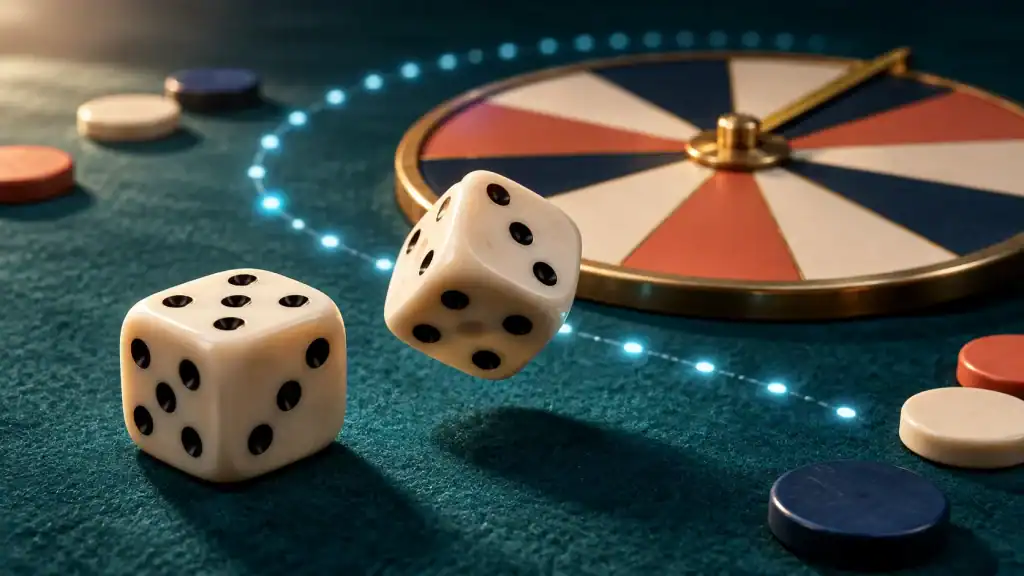
There is something deeply satisfying about not knowing what happens next. A spinning wheel, a shuffled deck, a rolling die: these objects have fascinated people across centuries and cultures, long before casinos or computers existed. The appeal isn’t just about winning money, though that certainly matters. It’s about the moment of suspense, the brief window where anything could happen, and the rush that follows when the outcome finally lands.
Psychologists and behavioral economists have spent decades trying to explain why chance-based games hold such a strong grip on human attention. Part of the answer lies in how our brains process unpredictability, and part of it lies in the social and cultural rituals built around these games. Understanding both angles helps explain why games of chance have survived every technological shift, from physical tables to mobile screens, without losing their pull.
The Brain’s Response to Uncertain Rewards
When a game like BC.Game roulette produces an unpredictable result, the brain releases dopamine not just when a reward arrives, but during the anticipation leading up to it. This is a key detail many people misunderstand: the pleasurable feeling isn’t solely tied to winning; it’s tied to the uncertainty itself. Neuroscientists have observed that dopamine activity actually spikes higher during near-misses or unresolved outcomes than during predictable, guaranteed rewards.
This explains why a game with fixed, known odds rarely generates the same excitement as one where the outcome remains genuinely uncertain until the last second. A wheel that hasn’t stopped spinning, or cards that haven’t been revealed, keep the brain in a heightened state of expectation. That state feels rewarding on its own, independent of the eventual result. Slot machines, card games, and roulette all share this mechanic: they stretch out the moment between action and outcome, which intensifies the emotional payoff.
Variable reward schedules, a concept borrowed from behavioral psychology, reinforce this effect further. Unlike a task that pays off the same way every time, chance-based games reward players unpredictably, sometimes generously and sometimes not at all. This inconsistency actually strengthens the behavior rather than weakening it, because the brain stays engaged trying to detect a pattern that isn’t really there.
Chance as a Shared Social Ritual
Games of chance rarely exist in isolation. Dice games appear in ancient Roman writings, card games spread through medieval Europe, and betting on outcomes has been documented in nearly every recorded civilization. These games gave people a shared activity with clear rules but unknown results, which made them ideal for social gatherings where competition needed to feel fair and exciting at the same time.
That social dimension hasn’t disappeared with digital gambling. Watching a live dealer spin a wheel on a video stream, chatting with other players during a round, or comparing results with friends recreates some of that communal energy that physical casinos built their identity around. The chance element gives everyone an equal starting point, regardless of skill or experience, which lowers the barrier to participation and keeps the activity feeling inclusive rather than competitive in a discouraging way.
The Illusion of Control and Skill
Many players believe they can influence outcomes that are, by design, entirely random. This is known as the illusion of control, and it shows up in small habits like blowing on dice, choosing “lucky” numbers, or timing a bet based on a hunch. These behaviors don’t change the mathematical odds, but they give players a sense of agency that makes the experience feel more personal and less passive.
This illusion is reinforced by games that blend genuine skill with chance, such as poker, where decision-making genuinely affects results alongside luck. When players occasionally win using a strategy they believe in, that success gets remembered vividly, while losses tied to the same strategy are often forgotten or excused. Over time, this selective memory strengthens the belief that chance can be managed, even in games where the outcome is purely mathematical.
Why Losses Don’t Always Discourage Play
Losing money in a chance-based game doesn’t always reduce a person’s desire to keep playing, and this puzzled researchers for years before behavioral studies offered an explanation. Near-misses, such as almost hitting a jackpot combination, are processed by the brain in a way that resembles an actual win, prompting continued play rather than discouragement. This is why slot machines and similar games are often designed with visual and audio cues that highlight close calls rather than downplay them.
Loss aversion also plays a counterintuitive role here. People tend to feel losses more intensely than equivalent gains, which would logically push someone away from risky games. But in chance-based formats, that same aversion often triggers a desire to “recover” the loss through continued play, a pattern sometimes called chasing losses. The emotional weight of an unresolved loss can feel more motivating than a completed win, which helps explain why sessions often extend longer than originally planned.
The Draw That Outlasts Every Format
Chance-based games have moved from dice carved from bone to digital wheels spun by software, yet the core appeal has stayed remarkably consistent. The uncertainty itself, not just the potential reward, is what keeps drawing people back, supported by real psychological mechanisms tied to dopamine, memory, and social connection. As long as humans remain wired to find unpredictability engaging, games built on chance will keep finding new formats to inhabit, whether physical, digital, or something not yet invented.