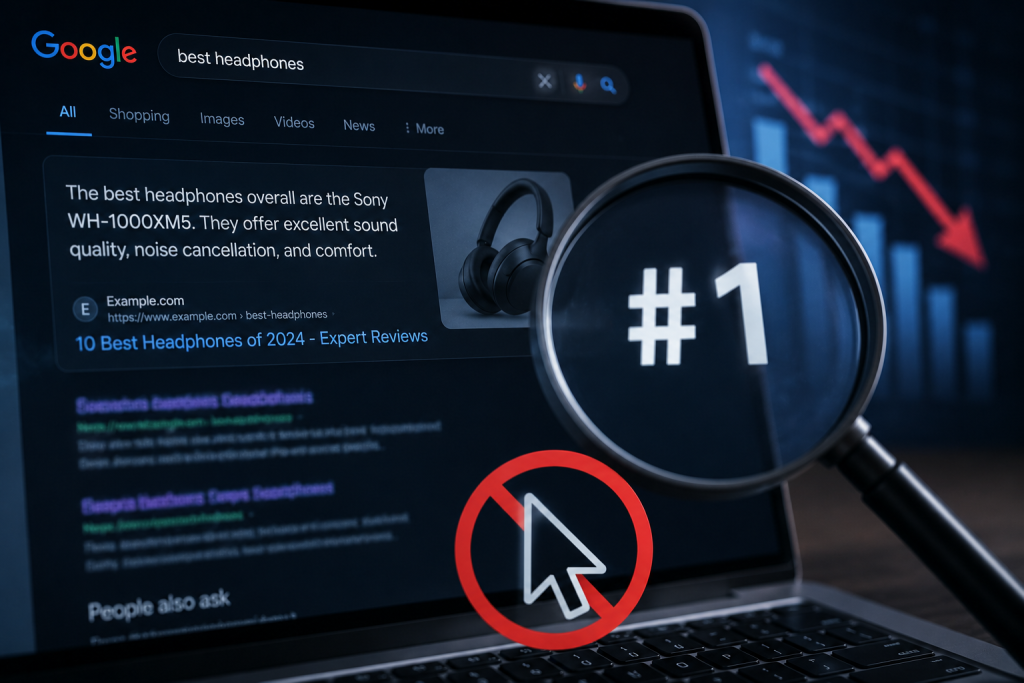
Your rankings held. Your impressions went up. Your traffic fell off a cliff. Nothing is broken. The search result you spent five years optimising for has quietly stopped sending people anywhere.
This is the report nobody wants to open on a Monday: same position, same keyword, a third of the clicks. It is not a penalty and it is not your title tag. It is the SERP itself changing shape underneath you.
Position one isn’t a destination anymore
Three numbers that reframe your traffic report
64.8% Of Google searches now end without a single click. Up from about 50% in 2019. | −58% Drop in position-one click-through rate when an AI summary sits above it (Ahrefs, February 2026). | 26% Of users end their browsing session entirely after reading one, not clicking anything, anywhere (Pew Research). |
The acceleration is the part worth pausing on. Ahrefs measured a 34.5% click reduction in April 2025. By February 2026 the same study put it at 58%. The feature didn’t change, user habits did. People learned to read the answer and stop.
Ranking is no longer the same thing as being found. You can win the position and lose the visit.
But the collapse isn’t evenly spread
This is where the strategy lives
Almost every panicked article stops at the headline number. The segmented data tells a far more useful story — some query types got hammered, and others actually improved.
| Query type | Click impact | What it means for you |
| Informational head terms “what is”, definitions, simple facts | −61% | The AI answers it completely. Stop building your funnel here. |
| Commercial and long-tail comparisons, “best for”, pricing | Materially smaller | Intent still demands a destination. Clicks survive here. |
| Branded queries people searching for you by name | +18% CTR | A clear brand answer with a source link earns more clicks than before. |
Sources: Seer Interactive (25.1M organic impressions, 42 organisations), Amsive (700,000 keywords), Ahrefs and Pew Research, 2025–2026.
So the correct response is not to abandon search. It is to move your content budget out of the query types machines now finish for you, and into the ones people still have to act on. That reallocation requires knowing, keyword by keyword, which bucket you are actually sitting in and that is not something you can eyeball.
Meanwhile, a new channel opened and most dashboards missed it
While everyone counted lost clicks, a smaller stream started arriving from a different direction — people who asked an AI assistant a question, read a considered answer and deliberately clicked through to a brand it named.
It is still a thin channel. Under 2% of referral traffic on average. But look at what it does when it lands:
| What the data shows | Figure |
| AI-assistant referrals convert versus standard organic search | 4–5x on average |
| Sign-up conversion for AI visitors vs. search visitors across 1,200+ publisher sites | 1.66% vs 0.15% |
| Growth in AI referral traffic to retail sites, year over year | +693% |
| Share of AI citations coming from earned and editorial sources, not brand-owned pages | 85% |
Sources: Microsoft Clarity, Adobe Digital Insights, Muck Rack analysis of over one million AI citations, and multiple independent 2025–2026 conversion studies.
That last row is the uncomfortable one. Whether an assistant recommends you is decided mostly off your own website and you cannot fix what you have never measured.
The scoreboard has to change too
If you are still reporting on average position and total sessions, you are measuring a search engine that no longer exists. The four questions that actually matter now:
- Which of my keywords now trigger an AI answer? Those pages need a different job than the ones that don’t.
- Am I being cited inside those answers — or is a competitor? Being quoted without a link still shapes the shortlist.
- Where does my traffic sit on the intent spectrum? If it skews informational, the 61% figure is your forecast, not a headline.
- Which commercial queries can I still realistically win? This is where the surviving clicks — and the buyers — are.
Search Console will not answer any of those. It reports what happened on the old scoreboard: positions, impressions, clicks. It cannot tell you whether an AI summary ate your click, who got mentioned instead, or which of your keywords are worth another rupee of content spend.
A handful of platforms have rebuilt themselves around exactly this gap over the last eighteen months. They are not equally good at it, and the pricing does not track the quality.
The traffic didn’t disappear. It moved to queries you may not be tracking, and to answers you may not be inside of. The teams that find it first will be the ones who bothered to look.

Sandra Larson is a writer with the personal blog at ElizabethanAuthor and an academic coach for students. Her main sphere of professional interest is the connection between AI and modern study techniques. Sandra believes that digital tools are a way to a better future in the education system.