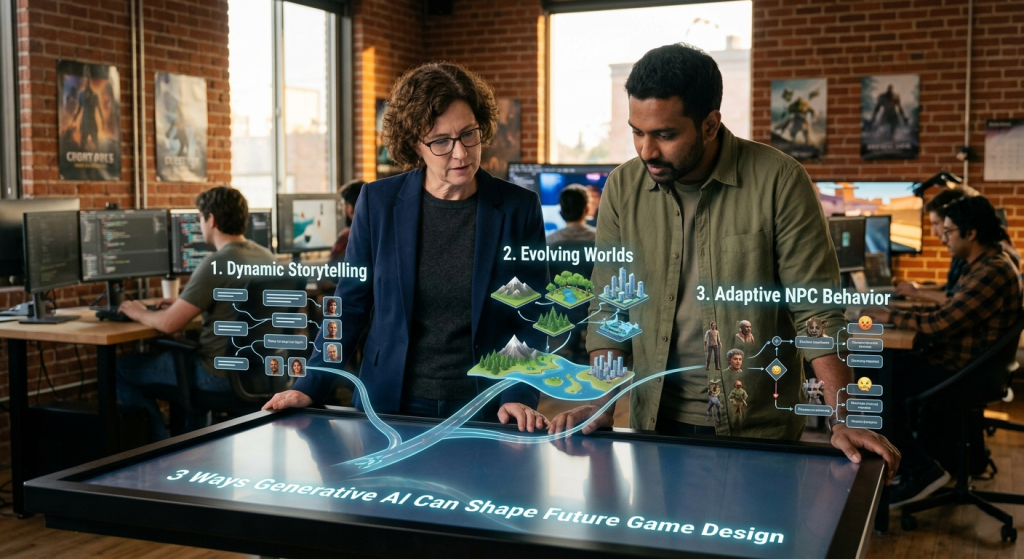
To say that generative AI is reshaping media is an understatement, as debate continues over its use in gaming. At best, it’s capable of cleaning up backend busywork without getting in the way of passionate developers who can add their own human spark to the project. Here are three ways that generative AI can add to future game design.
More Reactive NPCs
Amid all the hype surrounding open-world games, we’ve seen the best and worst of NPC behavior. Making a world feel lived-in is hard, and it’s almost impossible to capture the complex internal thoughts of 1,000+ NPCs. That’s why most developers don’t try, for good reasons, and keep interactions restricted and focused instead.
Idle chatter with NPCs is a gap that can be filled by generative AI, unlocking more in-depth, context-specific interactivity between the player and characters in fictional worlds. It’d essentially power a chatbot loaded with character sheets for every NPC, and other priors you’d expect from a fantasy peasant or a space station janitor. That’s to say, it wouldn’t act like ChatGPT, fulfilling random requests that make no sense for the world you’re exploring.
More reactive NPCs are already happening in the modding space, most notably with Mantella for The Elder Scrolls V: Skyrim. It results in NPCs that can have conversations, including group conversations, and remember what you said to them in the past.
More Challenging Gameplay via AI Directors
Gamers who were around during the original Left 4 Dead releases will remember how they debuted The Director, an unforeseen force behind every stage. This AI director was the brainchild of series creator Mike Booth, who personally coded it in a time before generative AI.
As for what it did, it watched the team’s performance and spawned items and enemies depending on how well you were doing. If you were doing a little too well, it’d throw a witch or tank in your path. If you were struggling, it’d lay off and let you breathe. Today, if it’s a game with horde dynamics, it probably uses an AI director. The caveat is that, for now, they’re made with older machine learning that switches between pre-coded intensity phases.
Generative AI could enable more fluid, contextual analysis of a player’s behavior to create better challenges. For example, limiting ammunition for a gun that’s clearly their favorite, or spawning more enemies that shake off its gunfire. It would ideally result in gameplay loops that nudge players into engaging with all game features.
Actual content generation, once sufficiently reliable, could also be used to switch up maps and levels on the fly, again adapting to your playstyle. Don’t be surprised if we see a Backrooms-style game using the same technology in the future.
Trimming Down Game Development Timelines
The last, and arguably best, improvement is less about flashy in-game features and more about the mundane, backend processes that players don’t see. It’s no secret that AA and AAA games take a long time to make nowadays. A mix of high ambitions, ballooning budgets, giant teams working globally, and a justified move away from crunch has all led to five-year minimum development times.
AI can help streamline processes for studios, so employees can work more on the game itself instead of managing large company friction. On the dev side, it can also reduce clicks necessary when tediously rigging characters or tapering polygon count to fit hardware limitations. Likewise, it can handle the boring parts of playtesting. Let the AI test collisions; use human testers for more complex challenges.
This kind of backend improvement is already happening in game studios. Using AI to offer simpler, streamlined dev and deployment experiences has also become normalized in spaces like iGaming. That’s where companies like Vyking offer operator platforms and game aggregation, both using insights derived from generative AI. These platforms move beyond fixed configurations and rigid constraints thanks to their open architecture. They also save operators a lot of time and money getting a business off the ground.
Time will tell how game development embraces generative AI, and on what terms. When it happens, players might benefit from some of these improvements to the medium they love.

Sandra Larson is a writer with the personal blog at ElizabethanAuthor and an academic coach for students. Her main sphere of professional interest is the connection between AI and modern study techniques. Sandra believes that digital tools are a way to a better future in the education system.