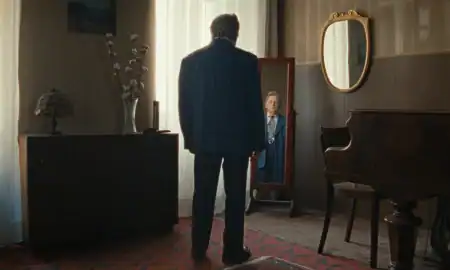

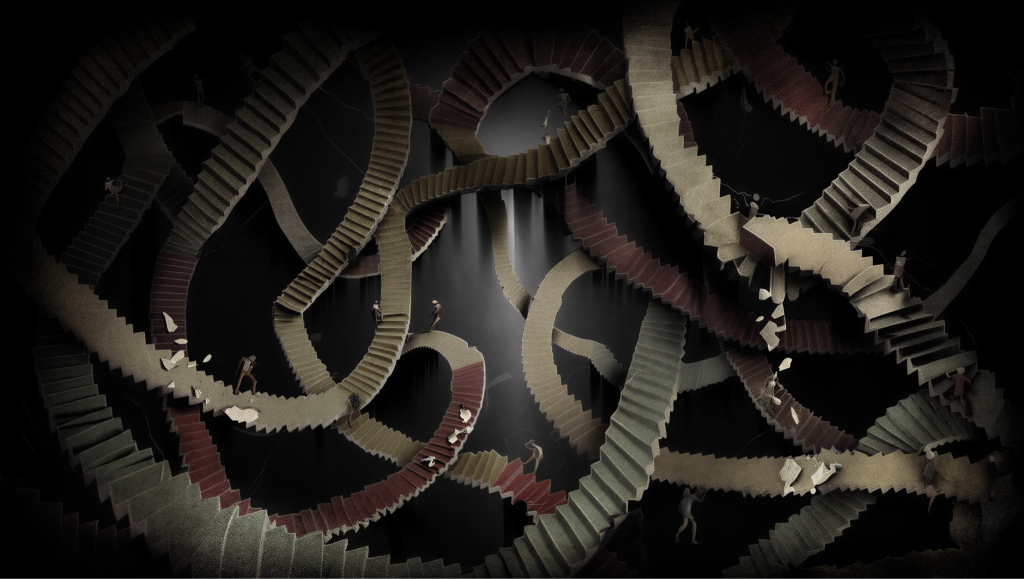
The sensation of infinite space in horror gaming shifted from a technical limitation to a psychological weapon. Early developers used fog or literal darkness to hide the edges of the map, yet modern horror utilizes the concept of infinity to erode the player’s sense of safety. True infinity in a digital environment does not require billions of virtual kilometers. It requires the convincing removal of an exit. When a player realizes that the environment is reacting to their presence by extending itself, the horror ceases to be about what is in the room and becomes about the room itself.
Designing these spaces involves a deep understanding of the Backrooms level structure and the psychological presence of a backrooms entity, because this specific aesthetic popularized the idea of non-linear, repetitive infinity. In professional level design, the goal is to break the player’s internal compass. Human spatial awareness relies on landmarks and distinct transitions between zones. By removing these landmarks and replacing them with a sequence of similar, semi-familiar rooms, developers trigger a state of liminality. This is where the environment feels like a transition point that never leads to a destination. The architecture becomes a loop that is technically linear but perceptually endless.
The Mechanics of Algorithmic Despair
By 2026, procedural generation evolved beyond the random noise seen in early survival titles. We now use semantic environmental assembly. This means the engine does not just place a random wall; it understands the logic of the architecture and subverts it. If a player looks away from a doorway, the system can rebuild the room behind them based on a seed that prioritizes disorientation. This is not just about making the map bigger; it is about making the map impossible to memorize. The technology utilizes real-time pathfinding data to ensure that no matter which direction the player chooses, the distance to an objective remains mathematically constant or even increases.
This concept of elastic distance ensures that the player feels the weight of the space. In a standard open world, walking for ten minutes covers a specific amount of ground. In horror titles focused on infinity, the game might manipulate the player’s movement speed or the scale of the environment dynamically. A hallway might subtly stretch as the player walks down it, keeping the door at the end just out of reach. This subtle manipulation of field of view and world scale creates a feeling of physical exhaustion. It mimics the sensation of a nightmare where movement feels decoupled from progress.
Non Euclidean Geometry as a Narrative Tool
The use of non-Euclidean geometry has moved from a niche gimmick to a core pillar of high-end horror production. Developers utilize portals and seamless transitions to fold space onto itself. You might enter a small shed only to find a warehouse inside, or walk around a corner and find yourself looking at the back of your own head. These spatial anomalies work because they violate the most basic laws of physics that the human brain relies on for survival. When the environment stops making sense, the player’s fight or flight response is constantly active.
Technical implementation of these spaces often involves stencil buffers and multi-camera rendering. By 2026, hardware acceleration allows for the simultaneous rendering of multiple spatial layers without a performance hit. This allows for environments where a single room can contain multiple versions of itself, accessible through different angles of approach. The horror comes from the realization that the player is trapped in a topological knot. There is no exterior to the map because every exit leads back into the system. This creates a claustrophobic version of infinity where the space is technically huge but provides no room to breathe.
The Acoustic Signature of the Void
Sound design plays an equal role in simulating endlessness. In a bounded space, sound reflects off walls in a predictable manner. To simulate an infinite or shifting space, we use dynamic acoustic modeling that ignores the visual boundaries of the room. A player might be in a small office, but the reverb tail suggests a space the size of a cathedral. This sensory mismatch creates a profound sense of unease. It suggests that while the walls look solid, the actual reality of the space is much larger and more empty than what is visible.
Advanced spatial audio in 2026 uses ray-traced sound to simulate the absence of an end. In an infinite space, the lack of an echo is more terrifying than an echo itself. If a player screams into a void and hears nothing back, the silence confirms the scale of their isolation. We also use procedural ambient shifts where the background hum of the environment subtly changes frequency based on the player’s duration in a specific zone. This prevents the brain from tuning out the noise, keeping the player in a state of high alert. The soundscape becomes a constant reminder that the space is not empty; it is merely too large to understand.
The Psychology of the Perpetual Loop
The terror of infinity is rooted in the loss of agency. In game design, we talk about the gameplay loop, but in horror, we can implement a literal spatial loop. If a player passes the same discarded soda can or flickering light every three minutes, the horror stems from the realization of being trapped. This repetition is a form of sensory deprivation. The brain craves new information, but the environment provides only a degraded copy of what came before. This leads to a phenomenon where players begin to hallucinate threats in the repetitive patterns of the wallpaper or the shadows.
We often integrate subtle changes into these loops. On the fourth or fifth pass, a door might be slightly ajar, or a texture might be swapped for something organic. These minute variations in an otherwise infinite loop suggest an intelligence behind the space. The environment is not just a dead void; it is a predator. This shifts the player’s focus from finding an exit to simply surviving the next cycle. By 2026, AI-driven asset modification allows these changes to be unique for every player, based on their specific fears or movement patterns recorded during the session.
Hardware Evolution and the Death of the Loading Screen
The technical barriers to infinite space were historically tied to memory and storage. Loading a massive, unique map required pauses or clever hiding spots like elevators. Current technology solves this through high-speed data streaming and real-time mesh compression. We can now stream gigabytes of environmental data per second, allowing for a world that literally builds itself faster than the player can move. This eliminates the “invisible wall” that used to break immersion. If a player decides to walk in one direction for six hours, the engine will continue to generate a coherent, terrifying environment that maintains the theme of the game.
This persistent generation allows for a more “honest” horror experience. The player knows that the game is not just reloading a checkpoint; it is continuing to expand the nightmare. This creates a sense of permanence. If you drop an item in an infinite hallway and walk for an hour, the game’s persistence systems ensure that if the loop brings you back, that item is still there. This confirms the reality of the infinite space. It is no longer a trick of the light; it is a persistent, alternate dimension that follows its own twisted logic.
The Ethical and Design Limits of Infinity
There is a risk in creating spaces that are too large or too repetitive. At a certain point, the fear turns into boredom. Professional developers balance infinity with “anchors of interest.” Even in a space meant to feel endless, there must be moments of narrative progression or environmental storytelling. A bloodstain on the floor or a note left by a previous victim provides the necessary context to keep the player engaged. The infinity serves as the backdrop, while these small, human elements provide the actual stakes.
The most effective infinite spaces are those that feel like they have a purpose, even if that purpose is incomprehensible to the player. The goal is to suggest a vast, indifferent system. Whether it is an endless office complex or a void of shifting platforms, the space must feel like it existed long before the player arrived and will continue long after they are gone. By 2026, the focus has moved away from “how big can we make the map” toward “how small can we make the player feel.” The sensation of being an insignificant speck in an endless, hostile machine is the ultimate achievement of modern horror game design.

Video games are my passion. Writing is my life.