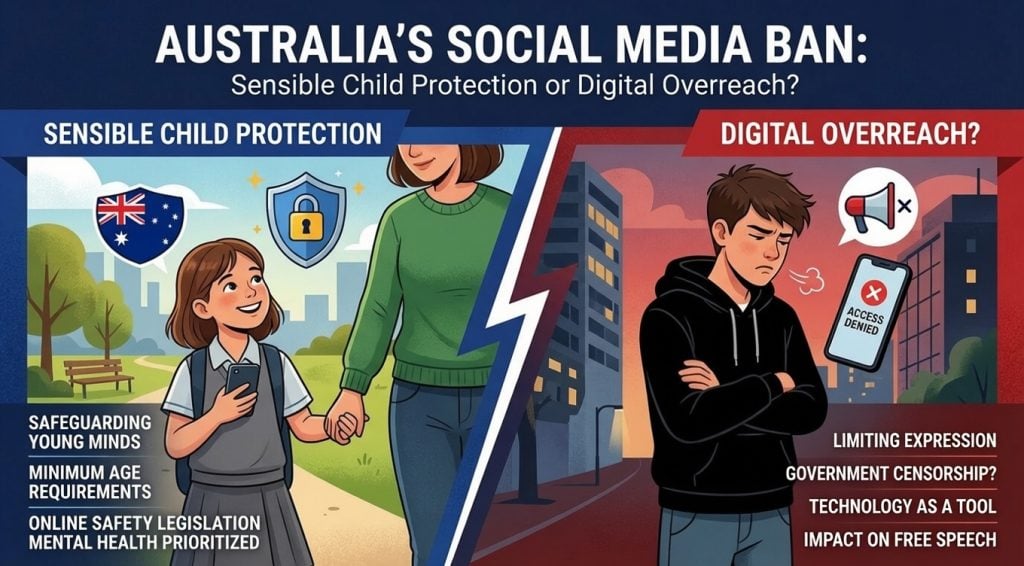
Australia’s under-16 social media ban has become one of the biggest global talking points in online safety. The law, which came into effect on 10 December 2025, requires age-restricted social media platforms to take “reasonable steps” to stop Australians under 16 from creating or keeping accounts. It applies to major platforms including Instagram, Facebook, Snapchat, TikTok, YouTube, X, Reddit, Twitch, Threads and Kick, although the list can change over time. (eSafety Commissioner)
Strictly speaking, Australia’s regulator does not frame it as a punishment-led “ban” on children. It describes the policy as a delay to having accounts. There are no penalties for children or parents if under-16s access platforms, but companies can face fines of up to A$49.5 million if they fail to take reasonable steps to comply. (eSafety Commissioner)
Why Australia Introduced the Ban
The basic argument is simple: social media is no longer just a place to post holiday photos or chat with friends. Platforms are built around feeds, notifications, recommendations and engagement loops that can keep young users scrolling for hours. Australia’s eSafety Commissioner says the rules are designed to protect young people from design features that encourage excessive screen time and expose them to harmful content while logged into accounts. (eSafety Commissioner)
Supporters argue that children are being pushed into adult digital environments too early. They point to online bullying, body image issues, harmful algorithms, sexualised content, extremist content, scams and addictive app design. From that point of view, the ban is less about stopping teenagers from ever seeing the internet and more about forcing platforms to take responsibility for who they allow inside their systems.
The Pros of Australia’s Social Media Ban
The biggest pro is that the law shifts responsibility away from parents and onto the platforms. For years, families have been told to manage screen time, privacy settings and safety risks on their own. Australia’s approach says that trillion-dollar tech companies should not be able to profit from underage attention while leaving parents to clean up the mess.
It may also give parents a stronger social norm to lean on. Instead of one family saying “no Instagram until 16” while every other child has it, the law creates a national standard. Even if some children still find ways around it, the policy gives parents, schools and regulators a clearer line.
Another benefit is pressure on platform design. If companies know they can be fined for weak age controls, they may invest more seriously in age assurance, safer defaults and child-focused product decisions. In that sense, the law could become less about account bans and more about reshaping how social media works.
There is also a mental health argument. While not every child is harmed by social media, many parents and teachers will recognise the pattern: endless scrolling, comparison culture, late-night phone use, and children being pulled into content they are too young to process. A later start may give children more time to build confidence, social skills and emotional resilience offline first.
The Cons and Criticisms
The biggest criticism is obvious: enforcement is messy. ABC News reported in June 2026 that many young Australians said the ban was not working, with some teenagers simply creating new accounts or avoiding age checks. The same report cited eSafety’s compliance update saying 70% of 898 surveyed parents said their children still had active social media accounts. (ABC News)
Age verification is also technically and ethically difficult. Face scanning can be convenient, but it raises privacy questions. Government ID checks may be more accurate, but they require people to hand over sensitive documents. That means a child safety policy can quickly become a mass age-verification system for everyone, including adults.
There is also the risk of pushing young users into darker or less regulated corners of the internet. If mainstream platforms become harder to access, some under-16s may move to private groups, clone apps, smaller networks, VPN workarounds or sites with weaker safety standards. That could make children harder for parents and regulators to see, not safer.
Researchers have also warned that young people are not passive targets of these rules. A 2026 arXiv paper based on focus groups with 12- to 16-year-olds found that participants often viewed the ban as unfair and ineffective, and that they learned how platforms’ access controls worked and where they could be evaded. (arXiv)
What It Means for Creators and Brands
For creators, influencers and businesses, the ban is a reminder that social media growth is changing. Platforms are under more scrutiny, younger audiences are becoming harder to target, and brands need to think more carefully about ethics, safety and long-term trust.
That does not mean social media marketing is dead. It means creators need to focus on legitimate visibility, consistent posting and audience quality. For example, adult creators and brands looking to build early momentum on Instagram may choose to kick-start every upload with a healthy likes boost, but this should sit alongside better content, stronger branding and responsible audience targeting.
The Balanced View
Australia’s social media ban is not perfect. It will not stop every under-16 from using Instagram, TikTok or Snapchat. It may create privacy concerns, enforcement gaps and plenty of teenage workarounds.
But it does ask an important question: should children be left to navigate addictive, algorithmic platforms designed by some of the most powerful companies in the world?
The fairest answer is probably this: Australia’s ban is a blunt tool, but it is not a pointless one. It gives parents breathing room, forces platforms to take age seriously, and starts a bigger conversation about whether social media should be redesigned around human wellbeing rather than endless engagement.
The success of the policy will depend less on the headline “ban” and more on the details: privacy-friendly age checks, genuine platform enforcement, digital education, parental support and safer design. Used alone, it is likely to disappoint. Used as part of a wider online safety strategy, it could become a meaningful step toward a healthier internet for young people.

Amanda Lancaster is a PR manager who works with 1resumewritingservice. She is also known as a content creator. Amanda has been providing resume writing services since 2014.