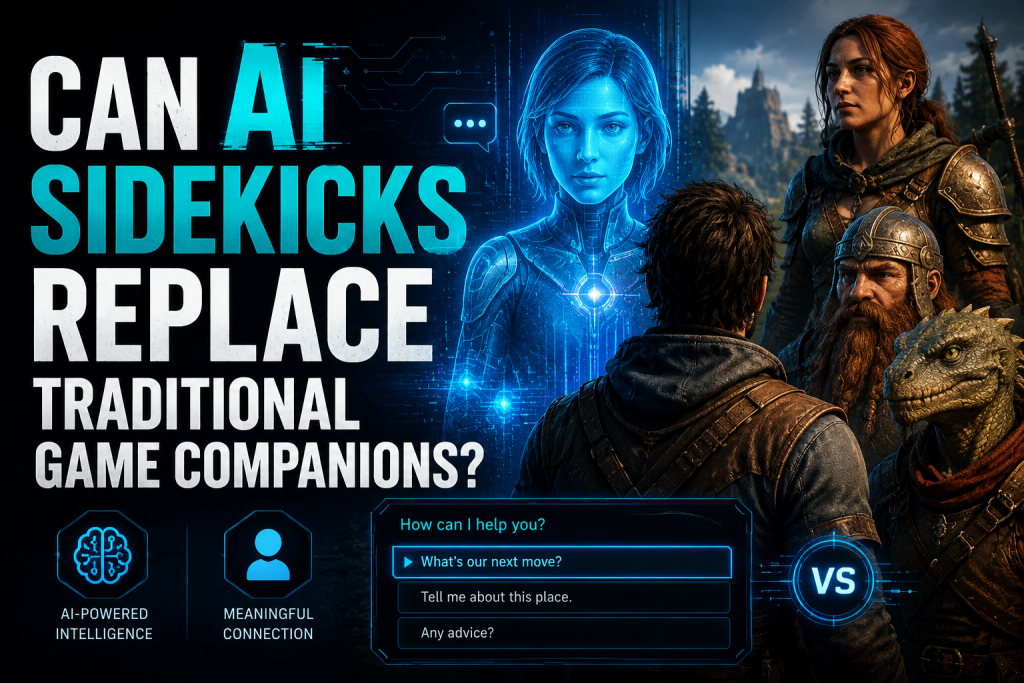
One of the most interesting characters in video games is the companions that stick around the whole way through the story. They may impact the player’s journey with their reactions to certain decisions made by the player, and by providing the player with something else to be concerned about other than the primary goal of the game. The good ones usually come to be just as important as the hero.
In the wider world of Intimeros AI companions, conversational characters have to go through scenarios and evolve their responses based on what is happening in the game. Video game companies have been thinking about whether such methods could be used for sidekick characters to allow them some flexibility in their responses without sticking to only pre-written lines.
AI Will Change Sidekicks Rather Than Replace Them
AI companions, in a form of sidekicks, will probably become more prevalent in open-world and role-playing games. They would have been able to recognize spoken language, recall past events and situations not included in a standard conversation tree.
But all of this does not mean that writers will no longer be required. It is necessary for any companion to have a distinct personality and motivation to exist in the game. AI technology will make it possible to add additional options for the character’s response within the gameplay, but the developers will still have to define the beliefs and evolution of the characters’ relationship with the player.
Why Traditional Game Companions Work
Traditional game companions work because they always have a definite point of view. Their behavior depends on both background and the place they take in the bigger picture. Disagreement or refusal to back up the decision the player makes can help the character to stand out instead of becoming only a tool for times when it is needed.
Scripted conversations also guarantee proper timing of the plotline. The key information comes in the right moments while emotional scenes get the time they need before the character starts talking. It is not so easy to keep the right balance in case the conversation takes place without any restrictions, especially if the system forgets something or reacts inappropriately.
A memorable sidekick requires a point of view but not a constant flow of speech.
Where AI Sidekicks Could Improve Games
Traditional companions often feel limited once the player moves outside major story scenes. They may repeat the same comments or fail to understand what the player is trying to do. This is where AI could be useful.
Instead of choosing a basic instruction from a command wheel, a player might ask a companion to guard a doorway while they search the next room. The character could also learn how the player approaches combat and offer advice based on those habits.
The Associated Press has reported on studios testing generative AI for more responsive NPC interactions. The goal is to let characters respond to a wider range of actions instead of relying on one fixed path.
This technology would work best when it makes controls and smaller interactions feel more natural. It becomes less useful when generated dialogue begins to distract from the game or weakens the personality that writers have already established.
More Dialogue Does Not Create a Better Character
The biggest problem with using AI sidekick is that it can come up with something convincing without taking into account the larger meaning behind the situation. The quote might make sense by itself, but not make sense to the character and plot line at all.
There is also a risk that AI companions could talk too much. Good game writing depends on timing, and not every moment needs commentary. A quiet response can be more effective than a long explanation, especially after an important event.
Generated dialogue may also appear varied while repeating the same idea in different words. The language changes, but the character does not become more interesting. This is why a larger volume of dialogue should not be confused with stronger writing.
The development of more advanced virtual assistants offers a useful comparison. Better language processing can make conversation feel more natural, but smooth responses alone do not create a convincing personality.
Writers Still Need to Control the Character
The most practical approach is likely to combine scripted storytelling with limited AI. Writers could define the companion’s personality and decide how the character reacts to major events. AI could then handle smaller exchanges that do not affect the main plot.
Major scenes would remain carefully written, while everyday conversations could adjust to what the player has done. This would give the character more flexibility without allowing the story to lose control.
Developers would also need to test these systems closely. Generated dialogue could reveal information too early or produce a response that does not match the game’s age rating. A tightly controlled system would be easier to manage than one that allows a companion to respond without clear limits.
AI Could Make Player Attachment Stronger
Players already form strong connections with fictional companions, even when every line has been written in advance. A character that remembers previous conversations and responds differently to each player could make that connection feel more personal.
This does not mean the game should pretend that the character is genuinely aware. Players can care about a fictional companion while still understanding that its responses come from software. Clear design matters because emotional engagement should come from the story rather than from misleading claims about what the AI can feel.
The Future Sidekick Will Still Need Strong Writing
AI could make game companions more responsive during exploration and repeated playthroughs. Players may be able to speak to them more naturally and receive answers shaped by earlier choices.
Still, replacing traditional companions entirely would remove much of the structure that makes them memorable. Players connect with characters because they have a clear voice and a meaningful place in the story. AI can help those characters react more freely, but it cannot replace the decisions that give them depth.
The most convincing sidekicks will probably combine both approaches. Writers will define the character and the story, while AI handles a limited amount of improvisation during gameplay. That balance could make companions feel more responsive without losing the careful writing that makes players remember them.

Heather Neves is working as a freelance content writer. She likes blogging on topics related to parenting, golf, and fitness, gaming . She graduated with honors from Columbia University with a dual degree in Accountancy and Creative Writing.