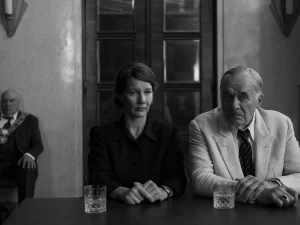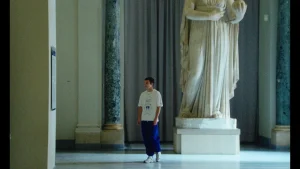
Couture is written and directed by Alice Winocour, and it is set over the course of Paris Fashion Week. It follows several women whose lives intersect through the fashion world, each carrying very different ambitions and burdens. An American filmmaker is suddenly forced to confront a breast cancer diagnosis while finishing the biggest project of her career. A young South Sudanese model steps into an industry she barely knows. A makeup artist quietly dreams of becoming a writer while working behind the scenes. Around them are seamstresses, designers, photographers, executives, and craftspeople whose work keeps the spectacle alive. It’s an ambitious framework, and for long stretches, what Winocour is reaching for is very admirable even when the film itself never fully comes together narratively.
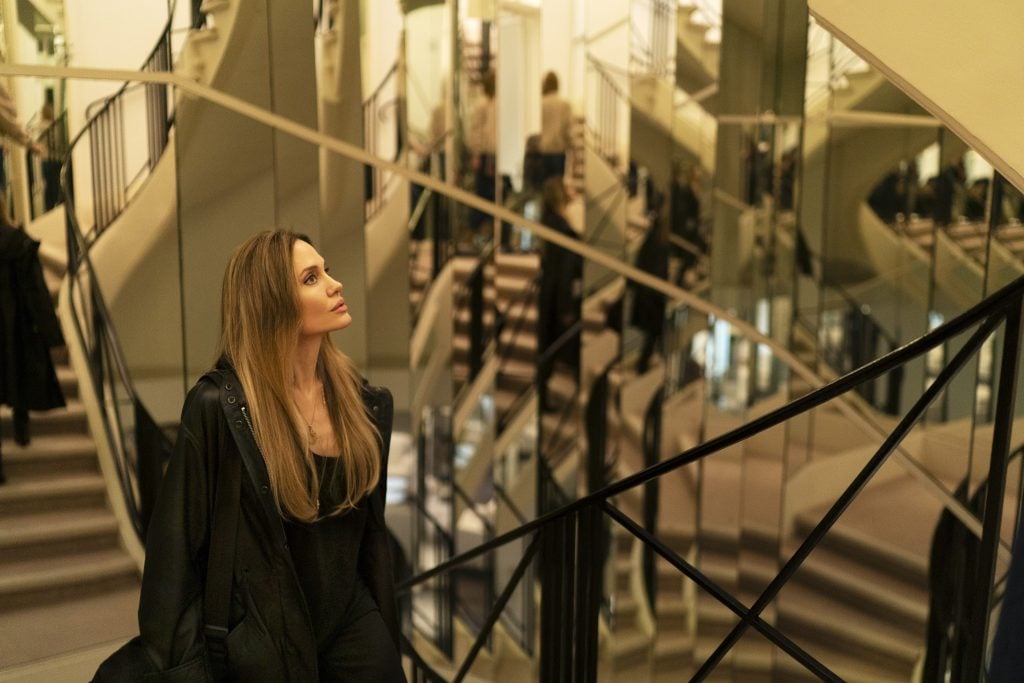
To get the performances out of the way, we can quickly say that the emotional center belongs to Angelina Jolie‘s Maxine Walker, an independent filmmaker who travels to Paris to direct a gothic short film for a prestigious fashion house. As production ramps up, she learns she has breast cancer and is told she needs to begin treatment almost immediately. Rather than returning home, she throws herself into finishing the film while privately wrestling with questions about her health, her body, and what comes next.
Jolie gives the kind of performance that reminds you how effective she can be when she’s given material that asks for restraint instead of full-on spectacle or something over the top and loud. Maxine spends much of the film trying to keep moving forward despite receiving life-changing news, and Jolie plays those scenes with lots of vulnerability that never feels overly exaggerated. You can sense the fear sitting just beneath the surface, and it feels deeply personal. She is easily the strongest part of the movie. One could say she is the sole reason to even watch it.
Winocour directs those moments beautifully, and as a result, the film has a quiet confidence visually. Backstage corridors, hotel rooms, fitting spaces, and runway preparations all feel pretty immersive. Fashion Week isn’t presented as endless glamour. Instead, it becomes a place filled with exhaustion, anxiety, and invisible labor. Some of my favorite scenes aren’t on the runway at all but behind it, watching the countless people whose work disappears the moment the show begins.
The film also has plenty on its mind. It explores mortality, creative ambition, aging, illness, and the impossible expectations placed on women’s bodies. The parallels between haute couture and surgery are particularly interesting. Designers alter fabric and surgeons alter bodies. Both involve precision and transformation, but one is celebrated while the other becomes deeply personal and frightening. Those ideas give the film an intellectual richness that is appreciated.
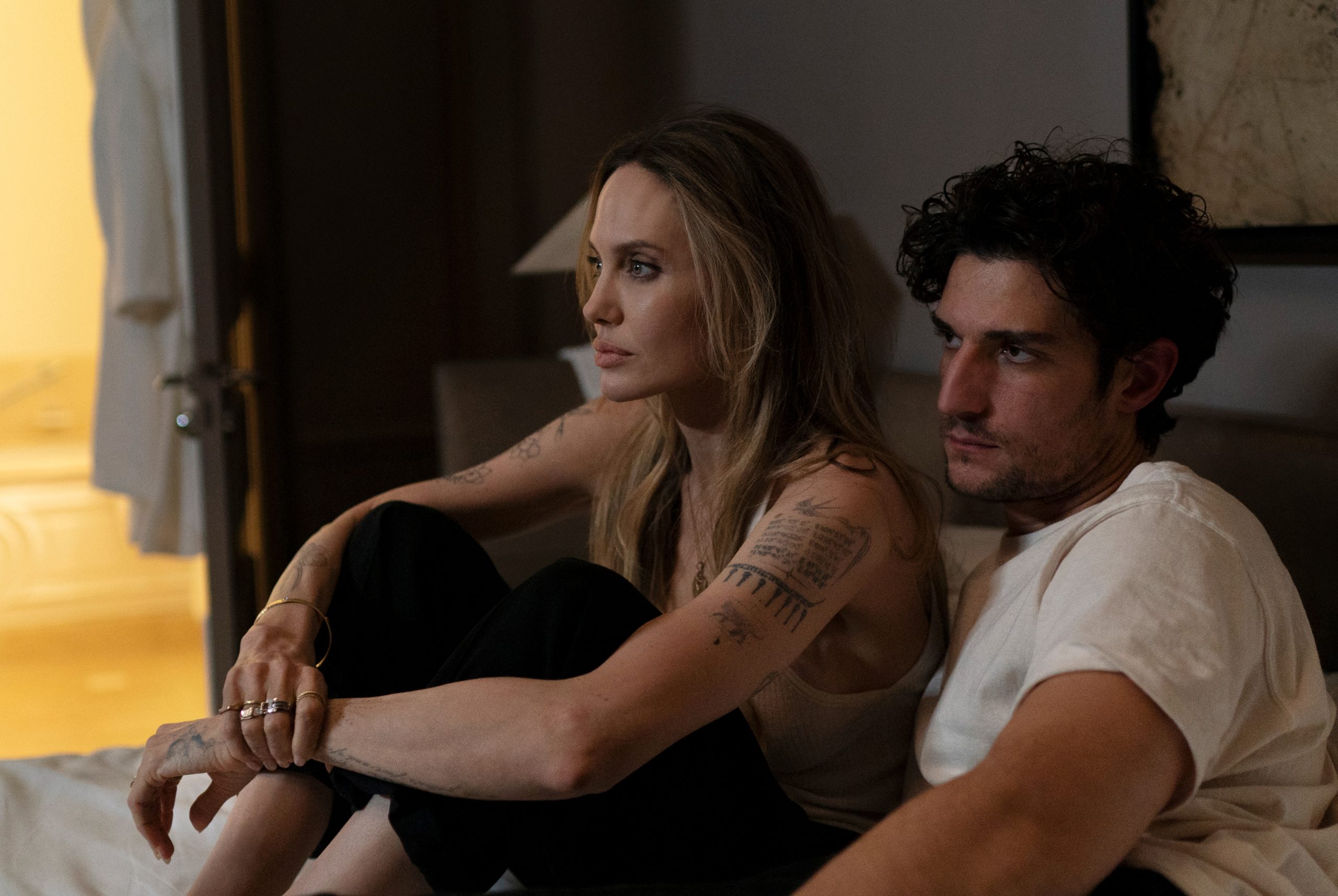
Unfortunately, the screenplay struggles to support everything Winocour wants to say. The biggest issue here is simply that there are too many people competing for attention. Alongside Maxine, we spend significant time with Ada, a young South Sudanese model navigating the fashion industry for the first time, Angèle, a makeup artist hoping to become a writer, and several supporting figures whose stories weave in and out of the narrative. None of these perspectives is inherently uninteresting. In fact, I liked all of them individually. The problem is that the film never finds the right balance between them.
Every time one storyline starts gaining emotional momentum, the film shifts somewhere else. By the time we return, some of that momentum has disappeared. Certain arcs feel incomplete, while others seem to stop rather than conclude. Instead of creating one cohesive portrait, the screenplay often feels like several promising films competing for the same running time. Ada’s storyline probably comes closest to matching Maxine’s in terms of emotional weight, helped enormously by Anyier Anei’s performance. She brings a natural presence to the role that makes Ada’s uncertainty feel authentic as she enters an industry full of opportunity but also exploitation. She’s the standout among the supporting cast, and I often found myself wishing the film committed more fully to her perspective.
Angèle’s story is where the imbalance becomes most noticeable. Her ambition to become a writer has real potential, especially as someone who observes the women around her while remaining largely invisible herself. Yet her journey never develops as much as it should. The same could be said for several of the film’s supporting characters, including the dressmaker whose perspective offers another interesting angle before gradually fading into the background.
That leaves Couture feeling more like an observational piece than a fully satisfying narrative. I understand that this may well be Winocour’s intention. Life doesn’t always build toward clean resolutions, and neither does this film. There’s value in simply observing these women as they move through moments of uncertainty and transition. Even so, I found myself wanting stronger dramatic connections between the stories.
None of this takes away from Winocour’s ability as a director. She creates atmosphere effortlessly, and there are individual scenes throughout Couture that linger long after the credits. She trusts silence, body language, and visual storytelling more than dialogue, which gives the film a thoughtful rhythm. I only wish the screenplay had matched that confidence.
It never really fully comes together, and as beautiful as the film is on paper, it doesn’t execute as well. Couture is full of compelling ideas, and it has an excellent central performance from Angelina Jolie and strong work from Anyier Anei, but for a film following so many lives, surprisingly few of them feel fully realized. I admired it more than I was moved by it, and by the end, I couldn’t shake the feeling that its strongest moments deserved a more focused story to hold them together. A respectable piece by Winocour, but one that ultimately spreads itself too thin. The individual threads are interesting, yet they never weave together into the emotionally satisfying whole that the film is clearly aiming for.
Couture is currently playing in theaters courtesy of Vertical.
Couture is full of compelling ideas, and it has an excellent central performance from Angelina Jolie and strong work from Anyier Anei, but for a film following so many lives, surprisingly few of them feel fully realized.

Roberto Tyler Ortiz is a movie and TV enthusiast with a love for literally any film. He is a writer for LoudAndClearReviews, and when he isn’t writing for them, he’s sharing his personal reviews and thoughts on Twitter, Instagram, and Letterboxd. As a member of the Austin Film Critics Association, Roberto is always ready to chat about the latest releases, dive deep into film discussions, or discover something new.