
As businesses grow, technology often becomes both an enabler and a bottleneck. What worked during the early stages, such as spreadsheets, disconnected tools, or off-the-shelf platforms, starts to break under the pressure of scale. Data silos emerge, workflows slow down, and decision-making becomes reactive instead of strategic.
This is where enterprise-grade thinking becomes essential. Growth is not just about acquiring more customers or expanding operations. It is about building systems that can handle complexity without losing efficiency. Organizations that invest in scalable digital foundations early tend to outperform those that delay modernization.
Many decision-makers reach a point where patching systems together is no longer viable. At this stage, investing in structured solutions like custom web application development services becomes critical to unify operations, streamline workflows, and improve user experiences across teams and customers.
As businesses continue to evolve, they often discover that generic platforms cannot fully support their workflows or long-term vision. This is where custom software development services become essential, enabling organizations to build systems that are tailored to their processes rather than forcing processes to adapt to software limitations.
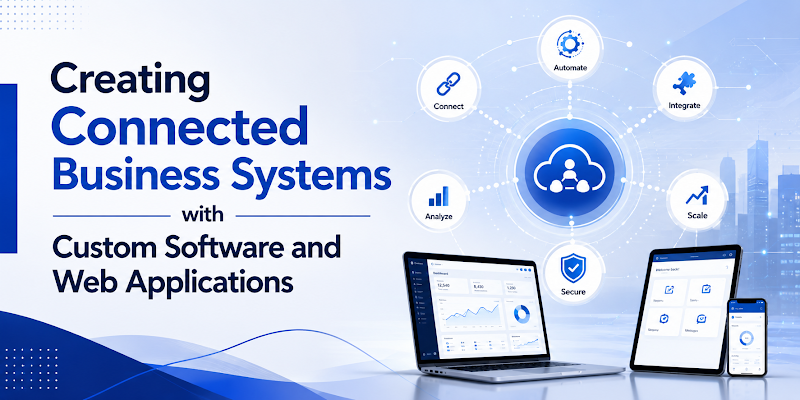
The real shift is not just about adopting new tools. It is about building connected business systems that enable visibility, automation, and scalability from the ground up.
What Defines Enterprise-Grade Applications
Enterprise-grade applications are not defined by their size or cost. They are defined by their ability to support growth without constant rework. Several core characteristics separate robust systems from fragile ones.
Scalability
A scalable system grows with the business. Whether it is handling more users, transactions, or data, the system should expand without performance degradation. This requires thoughtful architecture from the beginning rather than reactive upgrades later.
Security
As businesses grow, so does their exposure to risks. Enterprise-grade systems incorporate strong security practices, including data encryption, role-based access control, and compliance alignment. Security is not an add-on; it is foundational.
Performance
Users expect speed. Internal teams rely on real-time data. Systems must deliver consistent performance even during peak usage. Poor performance leads to inefficiencies and lost opportunities.
Reliability
Downtime is costly. Reliable systems are designed with redundancy, monitoring, and failover mechanisms to ensure continuity. Businesses cannot afford systems that fail during critical operations.
Integration Capabilities
Modern businesses operate with multiple tools. Enterprise-grade applications act as a central layer that connects these tools seamlessly. Integration capabilities ensure data flows smoothly across departments without manual intervention.
Key Pillars for Long-Term Growth
Building connected systems requires more than just good coding. It requires a strategic approach to architecture and technology decisions.
Modular Architecture
One of the most important decisions is choosing between monolithic and microservices architecture.
Monolithic systems are simpler to build initially but become harder to scale over time. Microservices, on the other hand, break the application into smaller, independent components. This allows teams to scale specific parts of the system without affecting the entire application.
For growing businesses, modular architecture provides flexibility. It allows faster updates, easier maintenance, and better resilience.
Cloud-Native Development
Cloud-native systems are designed to run in distributed environments. They leverage cloud infrastructure for scalability, reliability, and cost optimization.
Instead of relying on fixed hardware, cloud-native applications can dynamically allocate resources based on demand. This ensures that businesses only pay for what they use while maintaining performance during growth spikes.
Data-Driven Decision Making
Connected systems enable centralized data collection and analysis. This transforms decision-making from intuition-based to data-driven.
When systems are integrated, leadership gains visibility into operations, customer behavior, and performance metrics. This clarity leads to better strategic decisions and faster responses to market changes.
Automation and AI Readiness
Automation reduces manual effort and increases efficiency. From workflow automation to intelligent recommendations, modern systems are expected to support automation at multiple levels.
AI readiness is becoming equally important. Businesses that design their systems with AI integration in mind are better positioned to leverage predictive analytics, personalization, and intelligent automation in the future.
Common Mistakes Businesses Make
Despite the availability of advanced technologies, many businesses struggle because of avoidable mistakes.
Short-Term Development Mindset
Many organizations prioritize speed over structure. They focus on launching quickly without considering long-term scalability. This often leads to technical debt that becomes expensive to fix later.
Ignoring Scalability Early
Scalability is often treated as a future problem. However, redesigning systems after growth is far more complex and costly than building scalability into the initial architecture.
Choosing the Wrong Tech Stack
Technology decisions have long-term implications. Choosing tools based on trends rather than suitability can limit flexibility and performance. The right tech stack should align with business goals, scalability needs, and team capabilities.
Over-Reliance on Disconnected Tools
Using multiple tools without integration creates silos. Teams spend more time managing data than using it. This reduces productivity and increases the risk of errors.
Best Practices for Building Future-Ready Applications
Creating connected business systems requires a disciplined and strategic approach.
Strategic Planning Before Development
Before writing a single line of code, businesses should define their objectives, workflows, and growth expectations. A well-defined roadmap reduces ambiguity and ensures alignment between technology and business goals.
Choosing the Right Development Partner
Technology is only as effective as the team building it. A strong development partner brings not just technical expertise but also strategic insight. They help identify potential risks, recommend scalable architectures, and ensure long-term alignment.
Continuous Optimization and Iteration
Building a system is not a one-time effort. As the business evolves, the system must adapt. Continuous monitoring, feedback loops, and iterative improvements ensure that the system remains relevant and efficient.
Focus on Integration from the Start
Instead of treating integration as an afterthought, it should be part of the initial design. This ensures seamless data flow across systems and reduces future complexity.
Prioritize User Experience
Even the most powerful system fails if it is difficult to use. User experience should be a core consideration, ensuring that both internal teams and customers can interact with the system efficiently.
Real-World Example: From Fragmented Systems to Unified Growth
Consider a mid-sized service-based business managing operations across multiple locations. Initially, they relied on separate tools for scheduling, customer management, billing, and reporting.
As the business expanded, challenges began to surface. Data inconsistencies led to errors in reporting. Teams spent hours reconciling information across systems. Customer experience suffered due to delays and lack of visibility.
The organization decided to invest in a connected system built with a modular architecture. All core functions were integrated into a unified platform.
The impact was significant:
- Real-time visibility into operations across all locations
- Automated workflows that reduced manual effort
- Improved customer experience through faster response times
- Data-driven insights that enabled better decision-making
Within a year, the business not only improved operational efficiency but also scaled more confidently, knowing that their systems could support growth.
Conclusion
Technology is no longer just a support function. It is a core driver of business growth. Organizations that treat software as a strategic asset rather than a tactical tool are better positioned to scale sustainably.
Connected business systems built through custom software and web applications provide the foundation for this growth. They eliminate inefficiencies, enable visibility, and create the flexibility needed to adapt to changing market demands.
The key is not just to build software, but to build the right software. Systems that are scalable, secure, and aligned with long-term business goals.
For decision-makers, the focus should be on creating a technology ecosystem that evolves with the business. Investing in well-architected solutions today reduces risk, improves efficiency, and unlocks future opportunities.
In a landscape where change is constant, the ability to scale without friction becomes a competitive advantage. And that advantage starts with how your systems are designed.

Caroline is doing her graduation in IT from the University of South California but keens to work as a freelance blogger. She loves to write on the latest information about IoT, technology, and business. She has innovative ideas and shares her experience with her readers.