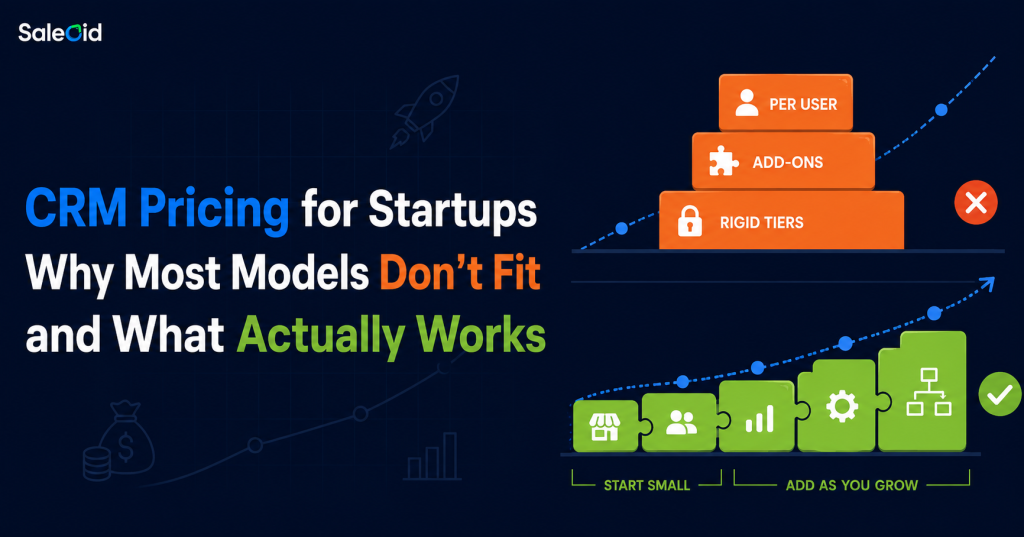
Most CRM pricing wasn’t built with a startup in mind. It was built for companies that already have a defined sales team, a marketing department, and a headcount that doesn’t change month to month. A startup with 2 co-founders and a part-time contractor gets forced into the same pricing logic as a fifty-person sales org, just scaled down, and still ends up hitting the same walls.
This is the part of buying CRM for startups that rarely gets explained clearly. It’s about which pricing model actually matches how a startup’s budget works. A founder comparing plans usually starts by listing features, when the more useful question is what happens to the bill three months from now, once the team looks different and the contact list has grown.
Before landing on an answer, it’s worth understanding exactly why the common models fail startups specifically, and why that failure isn’t accidental. Each one was designed around a business that already knows its headcount and already has a stable customer base. A startup has neither of those yet, which is precisely why the standard pricing logic keeps producing the wrong result.
Why Free Plans Run Out Fast
Free CRM plans look like the obvious starting point, and for a few months they usually are. The problems show up predictably:
-
Contact caps: Most free plans cap you around 1,000 contacts, which sounds generous until your first real marketing push fills it.
-
Visible branding: Forms, emails, and chat widgets carry the platform’s own branding on the free tier, which looks unpolished the moment you’re pitching a real client.
-
No automation: Multi-step follow-up sequences, lead scoring, and workflows are almost always locked behind a paid tier.
None of this makes free plans useless. It just means they’re a holding pattern, not a real long-term fit once you need to look professional and move faster than manual follow-up allows.
Why Per-Seat Pricing Punishes Growth
Per-seat pricing charges you for every person who logs in. On paper it sounds fair as you pay for what you use. In practice, it creates a strange incentive for a startup specifically.
-
Adding a co-founder, a contractor, or a part-time hire makes the CRM more expensive at the exact moment your cash position is tightest.
-
Teams end up sharing logins to avoid an extra seat charge, which creates its own security and accountability problems.
-
The cost curve has nothing to do with how much value you’re getting from the platform, it’s tied purely to headcount.
This model works fine for an established company with a stable team size. For a startup where headcount changes month to month, it turns every hiring decision into a software cost decision too.
Why Contact-Based Pricing Taxes Your Own Success
Contact-based pricing scales with the size of your database instead of your team. That sounds more startup-friendly on the surface, since you’re not penalized for adding people. The catch is different but just as real.
-
The better your marketing and sales efforts work, the more contacts you accumulate, and the more the CRM costs.
-
A successful product launch or a good month of lead generation can push you into a higher pricing tier without warning.
-
Businesses often end up trimming or archiving contacts just to control cost, which works against the entire point of building a database.
Contact-based pricing effectively charges you for growing, which is a strange position for a tool that’s supposed to help you grow in the first place.
Why Flat-Rate Pricing Actually Fits
Flat-rate CRM pricing charges one price regardless of team size or contact volume. This is the model that most closely matches how startup budgets actually work:
-
The cost is predictable from month to month, which matters when you’re planning a runway
-
Hiring a new team member doesn’t trigger a new software bill
-
A good marketing month doesn’t get penalized with a tier upgrade
-
Budgeting becomes a fixed line item instead of a variable one tied to headcount or list size
This is exactly the gap most CRM pricing structures leave open, and it’s the specific problem worth solving before comparing anything else.
Where Saleoid Fits Into This
Saleoid was built around flat pricing specifically because the models above don’t work for a startup’s constraints. It’s an affordable CRM for small businesses structured so that neither your team size nor your contact count changes the bill.
Let’s see how it addresses each problem covered above:
-
No per-seat penalty: Every plan includes unlimited users, so adding a co-founder or a contractor doesn’t change your monthly cost.
-
No contact-based scaling: Your price stays flat whether you have 50 contacts or 5,000. Growing your list is never taxed.
-
AI included at the base price: Saleoid $5 AI CRM includes AI functionality from the entry plan, not gated behind an expensive upgrade tier the way most AI CRM software locks it away.
-
Modular structure for tight budgets: You choose exactly what you need instead of paying for a bundle of features you won’t touch in your first year.
Saleoid’s Two Pricing Structures
Saleoid offers two ways to structure your CRM cost, depending on how far along your startup is and how much you already know about your workflow.
-
The Custom Plan: Start at $5 a Month
The Custom plan starts with a core CRM at $5 a month on two-year billing. From there, you add individual apps, billing, appointments, WhatsApp, invoicing, forms, or a client portal, at roughly $1 per app per month.
This structure works well when:
-
You’re still testing which parts of your workflow actually need software support
-
You want to control burn precisely rather than paying for a full suite upfront
-
Your team is small enough that you know exactly which two or three tools you actually touch daily
You can build out a setup and see exactly what it would cost before committing to anything.
-
The Unlimited Plan: Everything for $39 a Month
If you’d rather stop calculating app-by-app costs, the Unlimited plan bundles the full feature set into one flat price of $39 a month, still with no per-seat charges. This structure works well when:
-
You already know your team needs most of the available tools
-
You’d rather budget once and not think about it again
-
You’re past the early testing phase and ready to standardize how the whole team works
Full plan details and a side-by-side of both structures are available on the Saleoid pricing page.
Which Plan Fits Which Stage of Startup
A quick way to think about it based on where your company actually is:
-
Pre-revenue or still testing your process: Start with the Custom plan. Add only the CRM core first, then layer in apps as you figure out what your actual workflow requires. There’s no point paying for invoicing tools before you have anything to invoice.
-
Early revenue with a defined workflow: This is usually the point to evaluate whether Custom or Unlimited works out cheaper based on how many apps you’re actually using. If you’re already at four or five add-ons, Unlimited likely costs less.
-
Scaling with a growing team: Unlimited becomes the more sensible option here, since new hires don’t add cost and you’re no longer tracking individual app charges as the business gets more complex.
There’s no wrong starting point between the two. The Custom plan exists specifically so you’re not forced to guess your full feature needs on day one, and switching to Unlimited later is a straightforward upgrade once your usage makes that the cheaper option. The point of having both structures is to remove the guesswork that usually comes with CRM pricing, where you either overpay for a bundle you don’t use yet or underpay for a stripped-down plan you outgrow within a month.
The Real Takeaway
The mistake most startups make is not questioning the pricing model behind it. Per-seat pricing punishes hiring. Contact-based pricing punishes growth. Free plans run out before you’re ready. A simple CRM software setup with flat, predictable pricing is the only model of the four that doesn’t work against you as your startup actually succeeds.
Before signing up for anything, ask one question – “Does this price change if my team grows or my contact list grows?” If the answer is yes, you’re not just buying software, you’re buying a cost that scales against your own progress. That’s the problem worth solving first, and it’s the one flat-rate CRM pricing is built to avoid.

Caroline is doing her graduation in IT from the University of South California but keens to work as a freelance blogger. She loves to write on the latest information about IoT, technology, and business. She has innovative ideas and shares her experience with her readers.