There’s been a lot of hullabaloo about religious tolerance lately.
At least in an American context, religious tolerance is often an excuse to diminish those whose beliefs are in purported conflict with each other. It is such compelling obfuscation and subterfuge that when we’re confronted with real religious intolerance, we’re caught off guard. What does one do when one’s religious devotion is so far from the grain that it threatens to upend one’s entire sense of self?
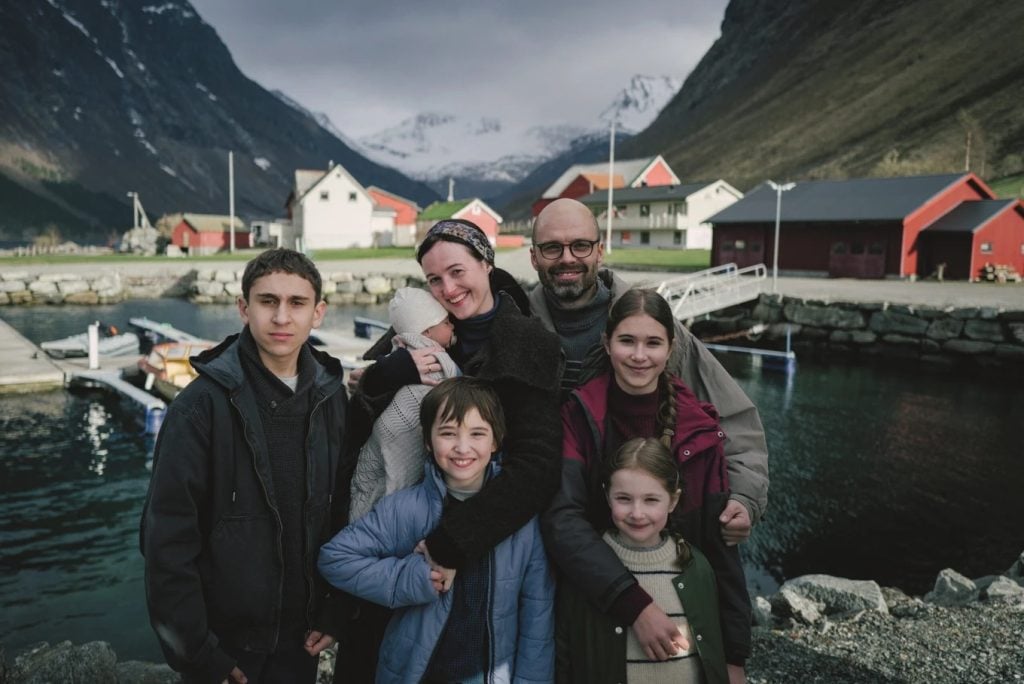
Romanian filmmaker Cristian Mungiu puts that challenge to the test with Fjord, which premiered in competition at the 79th Cannes Film Festival. The film follows the Gheorghiu family – Mihai (Sebastian Stan), Lisbet (Renate Reinsve), and their five children – upon their arrival in Norway from Romania to be near Lisbet’s mother. The close-knit Norwegian community initially welcomes them warmly, but is slightly unsettled by the family’s devout Christianity. That discomfort is torn open when a school teacher believes that two of the children, Elia and Emmanuel, were victims of physical abuse. Norway’s Child Protection department steps in, forcing the Gheorghius to navigate a system they don’t understand and to explain their values to a government system that is actively hostile towards them.
Or, from the Gheorghiu family’s perspective, the Norwegian government is actively hostile. Mungiu frames Fjord from their point of view at first, offering glimpses into a household that appears restrictive but not enough to indicate abuse. Mihai instructs the family in Biblical recitations and hymns, and the children don’t have access to smartphones and YouTube, but they seem to live in a happy home with plenty of opportunities for play. In that context, the reactions from the teachers and the Child Protection representatives seem excessive, bordering on harassment. Your heart goes out to Lisbet as she sits with Gunda from Child Protection, who tells her with little empathy or compassion that her children have been remanded into protective custody without her knowledge or consent.
It’s a sentiment that Mungiu reinforces through some of the year’s most stunning cinematography. The film is awash in whites and blues, the icy color palette reflecting the physical and psychological chill of the town and the Gheorghius. He often frames the family in wide shots that encompass the mountains and ranges surrounding them. The scale is breathtaking and overwhelming, and you imagine that the Gheorghius feel the same way. The town is beautiful, but the beauty will isolate you before it swallows you whole.
The rest of Fjord unpacks the process of that cultural and political digestion. Mihai and Lizbet try to navigate the Norwegian legal system as they fight for their roles in their children’s lives, but are met with staggering red tape at almost every turn. The resistance they face feels increasingly pointed and hostile, with the Child Protection department exerting such control over the proceedings that due process feels nigh-impossible. They demonstrate no effort by the department to acknowledge their faith, and just enough effort to recognize their Romanian heritage so that they can’t be outright accused of xenophobia. (The film is evenly split between English, Norwegian, and Romanian.) It’s maddening to observe, making you feel increasingly tense and outraged at what the family must endure. Those are emotions that the Gheorghius cannot express, as their culture prides discipline above all else (which only bolsters the case against them).
There are times when you wish that you could experience more of Mihai and Lizbet’s emotional turmoil. Some of the film’s most powerful moments capture the parents grappling with their children’s absence, such as Mihai sobbing as Lizbet hands their baby to Child Protection, and Lizbet pumping milk for the baby, which an intermediary will deliver. Both scenes are shot from behind, keeping their faces hidden from us. It’s frustrating, especially when other characters are granted those moments. However, Mungiu’s choice has a valid purpose. As Mia, their neighbor and lawyer, says to her husband, headmaster Mats, it’s hard to know them, but we’re not meant to. Their culture guards them, and their community shows no inclination to meet them even a quarter of the way.
Mungiu’s emotionally reserved script puts unique pressure on Sebastian Stan and Renate Reinsve to draw us into Mihai and Lizbet’s minds. It certainly helps that the duo worked together on 2024’s stunning A Different Man, but their characters’ dynamic is much different this time around. Here, there are few opportunities for showy work. Mungiu demands intricacy and nuance. Unsurprisingly, both actors rise to the challenge, delivering thoughtful, detailed performances that reinforce and expand their skill set and rank among their best work.
As Mihai, Stan is a powder keg, often looking like he is one more push away from wiping the Nordic peninsula off the map. His diction is clipped and lilting, and his body is remarkably, unbearably tense, radiating outrage and indignation as Mihai is picked apart. You initially sympathize, but Stan also pushes you to consider the possibility that Mihai might actually be a problem. Reinsve reflects the opposite side of the coin. She expertly uses her wavering tone and measured, meek movements to reflect Lizbet’s inability to openly express the horror of losing her children. Even though her community regards her as cold, Reinsve exudes a carefully modulated but palpable warmth that makes her persecution genuinely heartbreaking.
The deliberate lack of emotional insight also makes it easier for Mungiu to put us in the jury box as the Gheorghius go to court. The trial is one of stunning provocations by the Norwegian prosecutor and sharp redirects by Mia, which expose the hypocrisies within the system. Again, we look to Mihai and Lizbet to gauge their reactions, and you can feel the fear, humiliation, and repressed anger radiate from them. As much empathy as we feel for them, the Norwegian court does raise valid points about their ostensible duty to protect children. Yes, their prosecution, or persecution, of the parents is aggressive, but wouldn’t we want a justice system that aggressively protects children? Isn’t it a good thing that the government stepped in before, God forbid, Elia and Emmanuel suffer trauma they can’t come back from?
Fjord also forces us to contend with our religious biases. There are several times when the Norwegian prosecutor insinuates or outright states that the Gheorghius’ religious practices are harmful to the larger Norwegian community. The prosecutor uses statements about the religion’s “traditional values” to directly challenge Mihai’s worldview and claims his parenting would result in less tolerant children and, eventually, adults. (One teacher notes it already has.) Mihai asks if he is on trial for his beliefs, and while the prosecutor is nonplussed, we certainly are. Is it the business of the government to intercede in how a religious parent raises their child? Is it the government’s responsibility to ensure that parents are raising children to be more tolerant? In a liberal society that professes freedom, how far does that freedom reach before intervention is required, if it should be required at all?
These are thorny, potentially perspective-warping questions, especially for those who profess tolerance and freedom of thought in theory, as they might find that the practice isn’t as straightforward as they thought. With Fjord, Mungiu forces us to seek our own answers, refusing to give us a way out through typical Hollywood emotionality or pontification. Just as the Gheorghius are, our own worldviews are challenged, and our biases are laid bare, daring us to clarify our positioning at the risk of not being liberal, conservative, or centrist enough to operate within a highly charged sociopolitical landscape. The coldness we feel in our chests as we watch the film, as if one of the two avalanches were barreling towards us, is precisely the point. It makes Fjord one of the year’s most challenging but incredibly worthwhile creative endeavors.
Fjord held its World Premiere in the Competition section of the 2026 Cannes Film Festival.
Director: Cristian Mungiu
Screenwriter: Cristian Mungiu
Rated: NR
Runtime: 146m
Before we let you go, we have officially launched our merch store! Check out all of our amazing apparel when you click here and type in GVN15 at checkout for a 15% discount!
For major deals and money off on Amazon, make sure to use our affiliate link! If you are purchasing any of the latest and best in physical media at MovieZyng, you can support us using our affiliate link.
Fjord is one of the year’s most challenging but incredibly worthwhile creative endeavors.
-
9
-
User Ratings (2 Votes)
1

A late-stage millennial lover of most things related to pop culture. Becomes irrationally irritated by Oscar predictions that don’t come true.