From small-town high schools to youth flag leagues, the jersey on a kid’s back is doing more than ever before, and the way teams get them has completely changed.
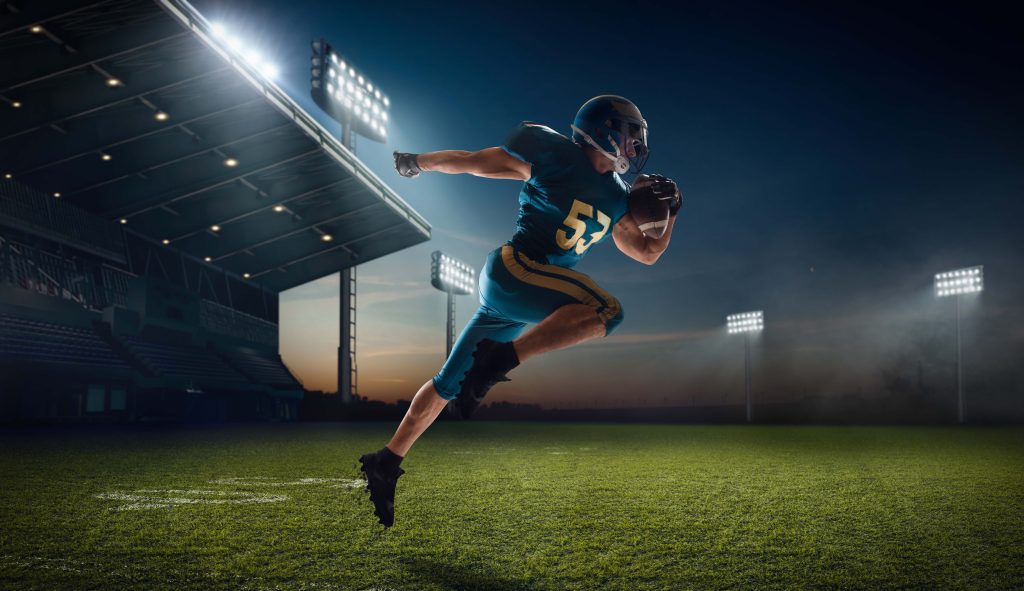
There is a particular feeling that hits you on a Friday night in late September. The bleachers are filling up. Someone’s grandmother is selling 50-50 raffle tickets at the gate. A marching band is butchering a Whitney Houston song in the end zone. Then the team comes running out of the tunnel, and the entire crowd reacts to one thing before anything else happens on the field. The uniforms.
That moment, repeated across thousands of small towns and suburbs every fall, is the heart of American football culture. It is also the part of the sport that has changed the most in the last five years, and almost nobody talks about it.
If you grew up watching high school football in the 90s or early 2000s, the home jerseys were probably some variation of three things: white, navy, or red, with a block-letter number on the front and the school’s name across the chest in something close to Times New Roman. The away jerseys were the same, just inverted. If a team got new uniforms, it was a big deal that happened every six or seven years, and they usually came from one of two suppliers that every coach in the county already knew.
That entire system has quietly collapsed. Today, the average high school football program in America cycles through new looks every two to three seasons. Youth flag leagues, which now exist in nearly every American suburb, outfit their teams in fully sublimated, photo-quality jerseys that would have cost a fortune in 2010. And the supplier list is no longer two old-school regional names. It is a sprawling marketplace of specialty manufacturers, design platforms, and direct-to-team operations that can ship a custom set in three weeks.
The reason for all of this comes down to a few overlapping shifts that, taken together, have rewritten what a football uniform actually means.
Football Is Bigger Than It Has Been In Twenty Years
First, the demand side. Football participation in the United States is in the middle of a quiet boom that almost nobody outside the high school athletics world is paying attention to. According to the National Federation of State High School Associations, boys’ 11-player football has grown three of the past four years. That kind of streak hasn’t been seen in roughly two decades. The 2024-25 season counted 1,029,588 high school football players across 14,269 schools, the second-highest school count in the entire 55-year history of the NFHS survey.
That is just the traditional game. The bigger story is on the girls’ side. Girls’ flag football has exploded by roughly 388% since the first post-pandemic NFHS survey, with 68,847 girls playing at the high school level in 2024-25. That’s a 60% jump in a single year. Sixteen states have officially sanctioned the sport, two more are scheduled to follow by 2027, and another twenty-plus run independent or pilot programs. The 2028 LA Olympics will include flag football as a medal sport, which has lit a fuse under every athletics director in the country who suddenly wants to be ahead of the curve.
All of these new players need uniforms. And not just any uniforms. They need uniforms that look like they belong on a real team.
Why The Old Way Of Outfitting A Team Stopped Working
Here is what most people don’t realize about how teams used to get their gear. Until about ten years ago, ordering football uniforms was a slow, frustrating process built around minimum order quantities, screen-printed logos that cracked after a season, and a six-week turnaround that always seemed to push delivery into the second week of the season. Coaches would hand out mismatched practice jerseys for the first two games while waiting for the real ones to show up. Numbers would peel off in the wash. The white jerseys would be gray by Halloween.
The shift to sublimation printing changed all of that, and it changed it quickly. Sublimation is a process where the design is dyed directly into the fabric instead of being printed on top of it. The result is a jersey that doesn’t crack, doesn’t peel, doesn’t fade, and can carry an unlimited number of colors and patterns at no extra cost. For a coach who used to pay an upcharge for every additional color in a logo, this is a small revolution. For a kid who wants the team’s name in a custom typeface and a sleeve pattern that looks like the night sky, it just opened a door that was previously locked.
That door is wide open now. Today’s specialist makers, the companies that focus exclusively on the team-apparel market, can produce fully personalized football uniforms with team colors, sponsor logos, player names, and custom numbers in two to three weeks, often with no minimum order requirement. A program with 75 players and a coach with 25 specials can place a single order and get exactly what they designed. Compare that to the old days, when you had to commit to 50 jerseys of the same size whether you needed them or not, and the difference is night and day.
The economics work out, too. Volume pricing has come down to the point where complete custom football jerseys with matching pants can run as low as $57 a set in larger orders, which is genuinely competitive with the off-the-rack stock options that used to dominate the market. There is no longer a real reason for a team to settle for generic gear when fully custom is available at the same price.
The Youth Game Is Driving The Market
Walk into any youth football league registration day in October and you’ll see what the market is actually built around now. According to a 2026 youth sports trends report from i9 Sports, flag football is one of the fastest-growing youth sports in the country, fueled in part by the 2028 Olympics announcement and in part by a parent population that is more comfortable with the non-contact format. Roughly one in four American kids ages 6 to 12 has played some version of football in the last twelve months.
Those kids and their parents have very specific expectations now. Youth football jerseys aren’t supposed to look like youth jerseys anymore. They’re supposed to look like scaled-down versions of what their favorite college or NFL team would wear. Parents who grew up wearing baggy mesh practice jerseys handed down from older siblings are not satisfied seeing their seven-year-old in something that looks like an afterthought. They want the kid to feel like they’re on a real team. And the suppliers have responded.

This is where the modern custom football category really earns its keep. A small parks-and-rec league in central Ohio can now order the same caliber of uniform as a high school program in Texas. The sublimation process doesn’t care about the size of the order. The design tools don’t care if the league has a marketing budget or just a coach with a Google Doc full of ideas. The barrier to looking professional has essentially evaporated.
The Identity Layer Most People Miss
There is a deeper reason this market has grown the way it has, and it has nothing to do with fabric technology. It has to do with what a team uniform actually does for the people inside of it.
Anyone who has played a team sport will tell you the same thing: putting on a jersey before a game does something to your brain. It’s a small ritual that signals you are now part of something larger than yourself. For a kid playing organized sports for the first time, that signal is enormous. It tells them they belong. It tells them the adults in their life cared enough to make this look real. And it tells them, for as long as the season lasts, that they are a member of a tribe with a name and colors and a flag.
Industry watchers have started to notice this. The Youth Sports Business Report’s 2026 trends roundup flagged the rise of “brand-building” in youth athletics as one of the most important shifts to watch this year. Programs that build a real visual identity, including a sharp uniform, a clean logo, and a set of team colors that the kids actually like, see meaningfully better retention than programs that don’t. The jersey, in other words, isn’t just gear. It’s part of why the kid comes back next season.
That insight has pushed even the smallest organizations to take their look more seriously. Travel ball teams now have brand books. Booster clubs argue about pantone codes. A booster’s mom in suburban Atlanta will spend three weeks tweaking the placement of a sleeve patch because she knows, on some level, that this stuff matters.
What Coaches Are Actually Looking For Now
Talk to a high school football coach in 2026 and you’ll hear a consistent set of priorities when it comes to outfitting a team. Number one is durability. A jersey that looks great in week one and falls apart by week eight is worse than no jersey at all, because it telegraphs to the players that the program isn’t built to last. Coaches want fabric that survives forty washes, numbers that stay readable on game film, and stitching that doesn’t come undone after one big hit.
Number two is speed. Coaches don’t have eight weeks to wait for a delivery anymore. Roster changes happen, kids transfer in, sizing has to be flexible. A supplier that can turn around a custom set in three weeks, with free design mockups inside of 24 hours so the head coach can sign off before production starts, is the kind of partner programs actually want to work with. The old model of “place your order in May for a September delivery” is dead.
Number three is flexibility. The biggest shift in the custom football market is the disappearance of the minimum order quantity. A coach who needs to add three jerseys mid-season for new players, or replace one that got destroyed in a Week 4 brawl, doesn’t want to be told to order 25 or nothing. The new generation of suppliers will sell a single jersey at the same per-unit price as a fifty-piece order, with the same custom design, on the same timeline. That is genuinely new.
Where This All Goes Next
If you zoom out, the trend lines all point the same direction. More kids are playing football than at any point in two decades. Girls’ flag football is going to keep growing through 2028 and probably well beyond. The expectations around how a team looks have permanently changed, and the suppliers that can deliver custom, durable, fast-turnaround gear are going to keep eating market share from the old generic brands.
Friday Night Lights isn’t going anywhere. The marching band is still going to butcher Whitney Houston in the end zone. The grandmothers are still going to sell raffle tickets at the gate. But when the team comes running out of the tunnel this fall, what they’re wearing is going to look better, fit better, and last longer than what any team wore even five years ago. And the kid in jersey number 7, who has been waiting all week for this moment, is going to feel exactly the way every football player has felt since 1875: like they belong to something that matters.

Robert Griffith is a content and essay writer. He is collaborating with local magazines and newspapers. Robert is interested in topics such as marketing and history.