

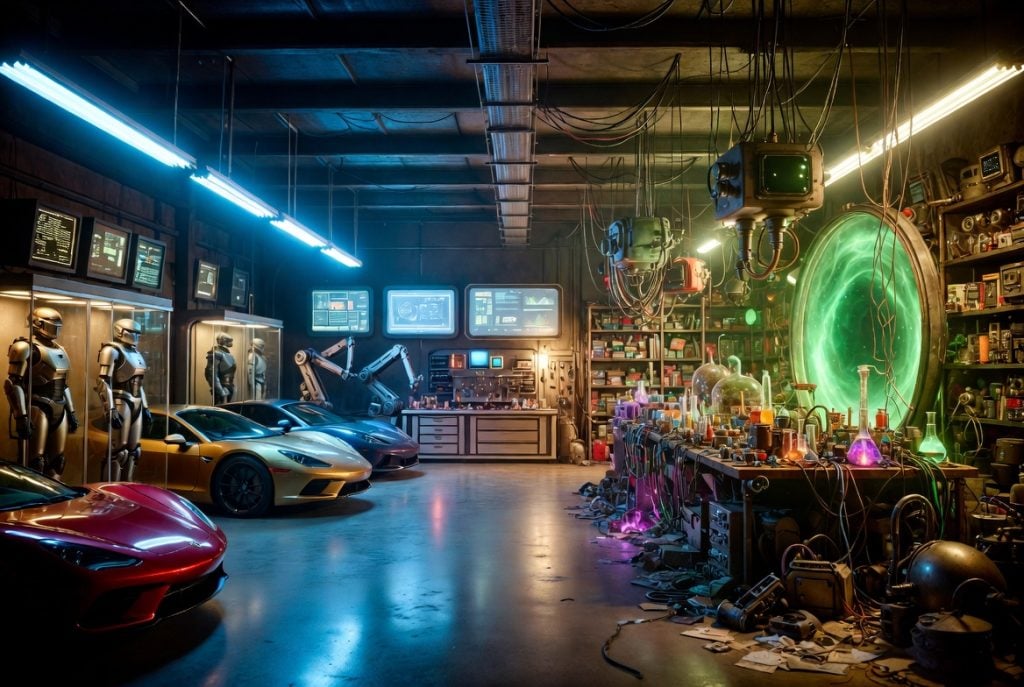
Almost every one of these builds starts the same way. Somebody picks one signature detail off the screen, gets it right, and lets the rest of the room grow around it. That is how fans recreate iconic pop culture garages in real life: not by rebuilding a whole movie set, but by copying the one element that carries the mood (the light, the clutter, the floor) and then filling the space with a hobby they actually have. It is why a $900 Rick Sanchez corner can read more convincingly than a $40,000 build that nailed every measurement and still feels like a car dealership.
Why the garage became pop culture’s favorite room
Because it is the only room where a character gets to be honest. No guests, no dress code, nobody to perform for. Writers figured this out a long time ago, which is why so much of what we love happens between a workbench and a roll-up door.
Look at the lineup. Tony Stark builds the suit in a shop under a Malibu cliff house. Rick Sanchez runs an interdimensional operation out of a garage that still has the family washing machine in it. Doc Brown backs a DeLorean out of a lift gate. Dom Toretto’s crew treats a Los Angeles garage like a kitchen table. The Batcave is the same idea with a bigger budget and worse ventilation.
Most of us do not have a cliffside mansion or twenty-two secret sublevels. We have a detached box out back, or a two-car bay holding bikes and a broken treadmill. That gap is exactly why so many of these projects turn into a single car garage with apartment above: shop on the ground floor, hideout up the stairs, nobody to negotiate with about the mess. It is the Stark layout scaled down to a normal American lot, and it is one of the few ways to add real square footage without giving up the yard.
The garages fans build most often
Four keep coming back: Stark’s workshop, Rick’s garage, the Batcave, and the Ghostbusters firehouse. Each one asks something different from the builder, and the honest comparison looks like this.
| The original | What actually sells it | Hardest part to fake | Entry cost |
|---|---|---|---|
| Tony Stark’s Malibu workshop | Cool blue light, glass, empty surfaces | The holograms | Medium |
| Rick Sanchez’s garage | Clutter with a story, one green light source | Almost nothing | Low |
| The Batcave | Rock texture, darkness, one dramatic reveal | Scale and the car | High |
| Ghostbusters firehouse | The facade, the arch, the sign | The building itself | High |
Tony Stark’s workshop
You copy Stark with light and empty space, not gadgets. That is the part people miss. His shop is expensive, but it is not cluttered, and the personality in it is subtle: an airplane propeller on the wall, a couple of cars, no trophy shelf anywhere. Fans get closest with a cool white LED wash, cabinets with under-mount lighting, a gray or charcoal epoxy floor, and one hero object sitting under a spotlight. The holographic interfaces are the only thing you genuinely cannot buy, so builders fake the feeling with oversized wall monitors, a projector aimed at a pale surface, and blue accent strips run along the toe kicks. Add a smart speaker for the Jarvis bit and you are most of the way there.
Rick Sanchez’s garage
Rick’s garage is the cheapest icon on this list to pull off, and it is the one people still get wrong. The set works because it is a laundry room that got taken over, not a lab. Washing machine still in the corner. Corkboard with pins. A shelf of junk hauled back from somewhere else. A cardboard box labeled TIME TRAVEL STUFF sitting there like an accusation. When Adult Swim shot its live-action shorts, the crew built that garage as a physical set over a few days instead of going green screen, and the reason it lands is that the mess reads as lived in. So copy the clutter, add one green light source, and fight the urge to tidy up. An artist rebuilt the whole room in Unreal Engine 5 down to the easter eggs, and even that version’s charm is the junk.
The expensive ones
These are the builds where the budget stops being a hobby line item. One Batman fan spent roughly two years and about $120,000 turning a basement into a Batcave, hidden door on a red button, screen-accurate suit on display, home theater in the back. A prop builder in California finished a street-legal Batmobile, realized he had nowhere to park it, and built the cave around the car. In Napa, a fan put a Hook and Ladder 8 facade across the front of his house one Halloween with Stay Puft bursting through the roofline, then turned the whole display into a fundraiser. None of these are weekend projects. They are hobbies that ate a house.
What does a themed garage build actually cost?
Most people land somewhere between $1,000 and $15,000, and the viral builds are outliers. Here is the rough map for a US project:
- Weekend version: paint, LED strips, a pegboard wall, one shelf of props, roughly $300 to $1,500;
- Serious theme: epoxy floor coating, insulation, cabinets, layered lighting, a display case or two, roughly $4,000 to $20,000;
- Obsession tier: hidden doors, custom millwork, a replica vehicle, a theater corner, $50,000 and up with no real ceiling;
- New structure entirely: a detached shell built for the purpose, usually $15,000 to $50,000 depending on size and finish;
- Detached build with finished living space above it, which most cities treat as an accessory dwelling unit, commonly $150,000 to $400,000 once you count the engineer, the permits, the stairs and the utilities.
The details that separate a real build from a mood board
Floor, light, climate, in that order. Ask anyone who has done a garage conversion twice and you get the same answer: the choices that make a themed space feel like a place are boring, and the choices that make it photograph well are cheap. Do the boring ones first.
- Fix the floor before anything else, because a stained slab quietly undoes every other decision you make;
- Light in layers instead of one ceiling fixture, since accent light is what gives a room its mood;
- Insulate and add heat or a fan before you decorate, or you will stop walking out there in February;
- Give every prop an assigned home, so the display reads as intentional instead of as storage;
- Keep one honest work surface clear, because a garage you cannot use is a museum;
- Run more outlets than you think you need, and put them at bench height;
- Leave the door working, since a sealed-up bay with a dead opener is a problem for the next owner.
Start with the building, then the theme
The order matters more than the budget. Plenty of fans discover halfway in that the structure they are decorating cannot take what they want to do with it, and that is where projects quietly die. Working with an existing bay, the questions are insulation, headroom and the electrical panel. Adding a structure, the questions are the pad, the setbacks, and whether you ever want a room on top. This is where a specialist beats a general contractor. “Storage Sheds And Garages”, a reliable storage building provider, works in Amish-built and prefab structures where the shell shows up finished, so you get a blank slate to theme instead of a two-month framing job in your driveway. That shortcut is why a lot of these builds now start with a delivery truck instead of a foundation crew.
Why this is not slowing down
Because the fantasy got cheap. LED strips cost nothing now. Epoxy kits sit on the shelf at any big box store. A 3D printer puts screen-accurate props in reach of anybody with a weekend and a spool of filament. The culture moved too: a themed garage used to read as the last stop of the man cave era, and now it reads as someone who knows exactly what they like and built a room around it.
The best ones are never the most accurate. They are the ones where somebody borrowed the mood from Stark or Rick or Bruce Wayne and then used the room anyway, to fix a bike, to solder something, to sit in a chair with a beer and look at a thing they made. That is the actual point of every garage on this list. The characters were never showing the space off. They were just the only ones who used it.

Hi! I’m Bryan, and I’m a passionate & expert writer with more than five years of experience. I have written about various topics such as product descriptions, travel, cryptocurrencies, and online gaming in my writing journey.