The history of merge games looks simple only from a distance. Once you check release pages, developer statements and genre definitions, the story splits into precursors, breakthroughs, clones and a very different mobile business model. That’s where the real story starts.
TL;DR. The merge mechanic grew from older combine and chain puzzles, became an explicit casual loop in Triple Town, exploded publicly through Threes! and 2048 in 2014, scaled commercially with Merge Dragons! in 2017, mainstreamed narrative marketing with Merge Mansion in 2020, and matured into a hybrid-casual service category by 2025.
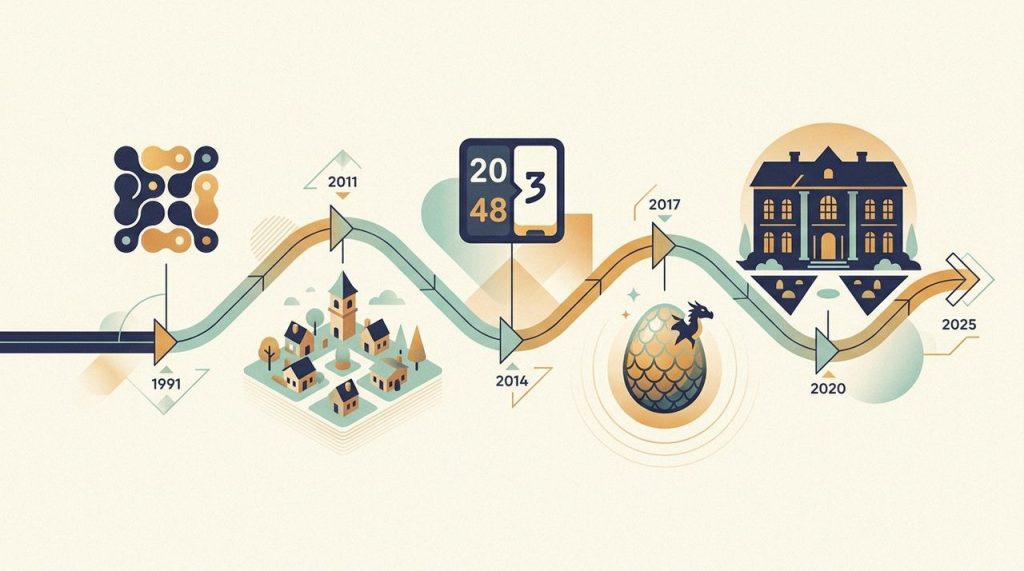
Illustrated horizontal timeline of merge game genre milestones 1991 to 2025
Evolution of merge games: a visual timeline
-
1991 — Puyo Puyo (Compile): earliest documented chain-combine puzzle precursor.
-
2010–2012 — Triple Town (Spry Fox): first widely cited explicit merge-upgrade casual game; debuted on Amazon Kindle in 2010, expanded to Facebook in 2011 and iOS/Steam in 2012.
-
6 February 2014 — Threes! (Asher Vollmer, Greg Wohlwend, Jimmy Hinson): genre-shaping number combining, the commercial precedent.
-
9 March 2014 — 2048 (Gabriele Cirulli): open-source web release, viral explosion, mass public awareness.
-
2014–2017 — Gap years: drag-and-drop input replaces number sliding; energy systems and persistent meta-progression enter the loop.
-
2017 — Merge Dragons! (Gram Games, later acquired by Zynga in May 2018): first major mobile F2P proof of concept for the category.
-
16 September 2020 — Merge Mansion (Metacore): narrative-led user acquisition, mainstream casual visibility.
-
2022–2025 — Hybrid-casual era: live ops, event passes and story layers become standard across the genre.
Where did merge games originate?
The honest answer depends on whether you track the mechanic or the genre. Mechanically, combine-like logic appeared in earlier puzzle design. As a recognizable commercial category, merge games emerged much later — and those two timelines are genuinely different things.
Two layers matter here. First, precursors: games built on matching, chaining or combining similar elements. Second, genre-forming titles: games where combining objects into higher-tier outputs became the central loop, not just a side mechanic.
For the precursor layer, Puyo Puyo (Compile, 25 October 1991) is documented as an early chain-combine puzzle. Identical pieces connect into chains and clear. Source documentation from the period calls this match, pair or chain rather than merge — which is exactly why the origin-of-merge-games debate fragments by definition. The vocabulary wasn’t there yet.
For the genre-forming layer, Triple Town by Spry Fox is the cleaner historical anchor. Three identical objects combine into something more valuable — much closer to what players now call a merge game. So when someone asks about the original merge game history, Triple Town is the safer answer when the discussion concerns object-upgrade merge loops rather than chain-clearing puzzle ancestry.
“Combining three identical objects into a higher-tier object became the core of Triple Town — that loop is the practical prototype of the modern merge genre.”
Why the loop scaled later on touchscreens is partly structural: a drag-and-merge gesture is a single continuous action expressing a single intent, while match-3 swaps require identifying a line and verifying the resulting clear. Fewer cognitive steps per action — that’s a meaningful piece of why this mechanic kept growing on mobile.
Fact check: was there a first merge game ever?
No single confirmed source supports a clean claim about the first merge game ever. That phrase is popular in search, but too absolute for the evidence. The cleaner approach is a set of checkpoints rather than one origin moment.
-
Earliest documented combine-like puzzle precedent: Puyo Puyo (1991).
-
First widely cited explicit merge-upgrade casual game: Triple Town (2010).
-
First viral mainstream awareness of tile/number merge: 2014, via Threes! and 2048.
-
First mobile F2P breakout for merge as a category: Merge Dragons! (2017).
-
First narrative-marketing breakout for merge: Merge Mansion (2020).
That’s the merge games genre history in five clean checkpoints. Each one is verifiable against release pages or developer statements. None of them is “the” first — they’re each first at something specific.
Threes! and 2048: the 2014 hinge
If you want the turning point, it’s 2014. That year answers both when did merge games become popular and why the public still confuses number-merging with the entire genre.
Threes! launched on 6 February 2014, created by Asher Vollmer and Greg Wohlwend with Jimmy Hinson. It used a sliding board and number-combination rules that were more nuanced than later clones. Then 2048 arrived on 9 March 2014 as an open-source web game by Gabriele Cirulli.
So who created the 2048 game has a clear answer: Gabriele Cirulli. But authorship is not precedent — Threes! came first and directly inspired the wave that followed. In a much-quoted March 2014 blog post and follow-up interviews, Vollmer and Wohlwend publicly described the 2048 lineage as a rip-off of Threes! — that’s the documented basis of the plagiarism conversation around the history of 2048 game origin. Cirulli himself has acknowledged that 2048 is conceptually similar to Threes! and was specifically a clone of an earlier title called 1024.
“2048 was released as an open-source web game on 9 March 2014.” — gabrielecirulli/2048, GitHub project repository
Whatever you call the lineage, 2014 was the moment when number-merge puzzles broke out of niche casual circles and into general internet culture. Open-source code plus a one-page web build plus a clean rule set produced a derivative ecosystem with well over a thousand variations within the first year — by far the most visible event in the merge mechanic’s public memory.
Short version: Cirulli authored 2048; Threes! is the earlier commercial precedent in the same design family; and how the merge mechanic was invented reaches farther back than either title.
Merge vs match-3 vs idle vs crafting
This is the comparison most history articles skip. It matters because the merge games genre development history only makes sense once you can tell these four apart.
-
Merge. Core reward: a new higher-tier object that stays on the board. Player action: drag identical items together. Progression: fixed merge graph, visible upgrade tree. Spatial pressure: high — limited board space drives tension.
-
Match-3. Core reward: clearing tiles off the board. Player action: swap adjacent pieces to form lines. Progression: level-based, often a linear map. Spatial pressure: medium — the board refills automatically.
-
Idle / clicker. Core reward: passive resource accrual. Player action: tap or wait. Progression: exponential numeric growth. Spatial pressure: low — minimal spatial element.
-
Crafting. Core reward: a functional output from a recipe. Player action: combine unlike ingredients. Progression: open-ended, recipe-driven. Spatial pressure: variable — depends on inventory rather than a fixed board.
The distinction that matters most: in match-3 the clear is the reward, while in merge the new object is the reward. It stays, grows and becomes part of a progression tree. That single difference rewrites the emotional loop and explains structurally why merge fits long-running service formats so well — the board literally remembers what you built.
2014–2017: the gap years
Between the 2048 wave and Merge Dragons!, the genre matured quietly. The browser version of merge was simple, fast and viral; the mobile version had to become a business. That transition took three years and involved real design work, not just porting.
What stabilized in this period: drag-and-drop combining replaced number sliding as the dominant input; merge-3 (three identical objects → one higher-tier) became the default arithmetic; limited board space turned into the primary tension lever; energy systems and timers entered the loop; persistent meta-progression — camps, collections, maps — replaced the single-board score chase.
This is where merge games 2014 vs 2025 starts diverging. In 2014, merge meant a self-contained puzzle. By 2017, it meant a session inside a larger service. The mechanic stayed; the wrapper changed completely.
Merge Dragons release and why 2017 changed everything
The strongest mobile milestone is Merge Dragons!, released by Gram Games in 2017. It didn’t just use merge — it productized merge for long-term play.
The loop: combine matching objects, hatch dragons, collect dragon power, clear cursed land, restore a persistent camp. Each element feeds the next. Commercially, the game was strong enough that Zynga acquired Gram Games in May 2018 in a deal valued at around $250 million, and Merge Dragons! has been a consistent contributor to Zynga’s casual portfolio ever since (Zynga itself became a subsidiary of Take-Two Interactive in May 2022). Industry coverage over the years has placed the title’s lifetime revenue well into nine figures and downloads in the hundreds of millions across the App Store and Google Play.
That’s not a niche puzzle story. That’s category proof — and it’s the central event in merge dragons history development and the wider merge games genre milestones discussion. Before 2017, merge was a mechanic. After 2017, it was a business model.
 Mobile phone displaying merge dragons board with revenue growth icons
Merge Mansion and the narrative turn
Metacore launched Merge Mansion on 16 September 2020. If Merge Dragons! industrialized the merge board, Merge Mansion mainstreamed narrative-led performance marketing and the “merge to unlock story and renovation” loop.
That’s also the heart of viral merge games history. Virality in 2014 came from open-source simplicity and clones. Virality in 2020 came from ad creative, character hooks — the now-famous grandma trope — mystery framing and social discussion about the campaign itself. The game’s marketing became part of the product’s cultural footprint, and Metacore’s campaigns have been widely studied as a case in modern mobile UA. Every major 2022–2025 merge launch added some version of a narrative or character layer because that combination of mechanic plus story plus paid creative became the new genre baseline.
Merge games 2014 vs 2025
The contrast is sharper than most retrospectives admit:
-
Core loop. 2014: single-board puzzle. 2025: service game with merge inside.
-
Session shape. 2014: one sitting, then quit. 2025: short, scheduled, repeated daily.
-
Progression. 2014: high-score chase. 2025: persistent map, story, collection.
-
Monetization. 2014: premium or ad-supported. 2025: F2P with energy, IAP, battle pass.
-
UA strategy. 2014: organic, clone-driven. 2025: paid, narrative-led creative.
-
Operations. 2014: static release. 2025: continuous live-ops calendar.
The mobile games market itself is a moving target — Mordor Intelligence’s current sizing places it at roughly $148 billion in 2026 with a projected CAGR around 10% through the late 2020s. Puzzle and casual sit at the top end of that mix, and merge is one of the most active subgenres inside that segment. The merge action itself barely moved across the decade. Everything around it became a service business.
Monetization: how the business model evolved
This is the part most genre histories skip — which is strange, because monetization is the reason the category survived past 2017. A modern merge game’s commercial funnel typically layers several systems on top of each other.
Energy gating. A finite energy bar limits how many merges a player can perform per session. When it depletes, players either wait, watch a rewarded ad or pay. Merge Dragons! and Merge Mansion both use this as the spine of the loop.
Event passes. Limited-time events bolt collection goals onto the merge board with a paid premium track. By 2022, event passes had become the largest non-ad revenue line in most live merge titles.
Cosmetic and decoration layers. Camps, mansions and gardens give players a reason to spend on visual progression that doesn’t affect the merge math itself. It’s a clean separation of power and aesthetics.
Hybrid-casual creative. A casual core wrapped in mid-core mechanics — collection, characters, narrative gates — acquired through performance-marketing creative borrowed from hyper-casual playbooks. Pacing in well-tuned 2025 titles keeps the merge tempo brisk enough to maintain flow without overwhelming the player.
Merge games hall of fame
A compact list of titles that changed direction rather than just charted well. The merge games hall of fame, if you want to call it that, is really a list of inflection points.
-
Puyo Puyo (1991). Early chain-combine precursor; the mechanic existed before the vocabulary did.
-
Triple Town (Spry Fox, 2010). Explicit merge-upgrade reference point; the practical prototype of the modern loop.
-
Threes! (6 February 2014). Genre-shaping polish and strategic number combining; the commercial precedent for the 2014 wave.
-
2048 (9 March 2014, Gabriele Cirulli). Open-source virality and mass awareness; thousands of derivatives in year one.
-
Merge Dragons! (2017, Gram Games / Zynga). Proof that merge could anchor a major mobile F2P business; the central commercial milestone for the genre.
-
Merge Mansion (16 September 2020, Metacore). Narrative-led user acquisition and mainstream casual visibility; defined merge advertising for half a decade.
That sequence doubles as a clean 2048 to merge dragons timeline for readers who want the shortest possible genre memory, and it sets up the best merge games over the years discussion by historical role rather than personal taste. If you want to see what the genre actually looks like today — what a current merge catalog spans across puzzle, idle and physics-drop subtypes — the merge category on a games portal is the fastest way to scan it. Browse a wide selection of free merge games in your browser, no install, and treat the list as a living snapshot of where the genre has landed after the 2014–2025 arc described above.
Why the merge mechanic fits mobile
The mechanic translated cleanly to touch, short sessions and visible progress. Dragging two identical icons together with a thumb is more legible on a 6-inch screen than tap-to-match on a grid, because the player’s intent is expressed by a single continuous gesture instead of two discrete taps.
Compare that to a match-3 swap: identify a line, plan the swap, verify the clear — three cognitive steps versus one. Add the visible permanence of a merged object (you can see what you built; it stays) and you get an emotional loop that rewards thumb-driven sessions of two to five minutes. That’s the real engine behind the evolution of puzzle games merge after 2014: not just elegance, but compatibility with mobile product design.
The merge mechanic origin casual gaming story is essentially this: a design pattern that was already cognitively efficient became physically efficient on touchscreens, then commercially efficient through F2P service design. Three efficiencies stacking on each other — that’s why it stuck.
 Thumb gesture merging two icons on touchscreen illustrating mobile mechanic efficiency
Biggest merge games ever made
The biggest merge games ever made question depends on which lens you use. Three different answers, three different metrics.
Viral reach: 2048 and its clone ecosystem — well over a thousand derivatives in year one, web-based and borderless.
Commercial scale: Merge Dragons! — the title that proved merge could anchor a long-running mobile F2P business at scale and triggered Zynga’s $250M acquisition of Gram Games in 2018.
Marketing visibility: Merge Mansion — the grandma campaign defined merge advertising for roughly half a decade and made the genre legible to audiences who had never touched a merge board.
For senior SEOs reading this for cluster planning: separate those three angles in your content. A user searching the phrase may want downloads, revenue, cultural memory or recognizability. One number won’t serve all of them — and conflating them is how thin content gets written.
Final takeaway: the evolution of merge games
How merge games started — through puzzle combination and upgrade logic before the mobile boom, in titles that didn’t even use the word “merge.” When did merge games become popular — 2014 for public awareness, 2017 onward for mobile category strength. How merge games changed over time — by adding narrative, meta-progression, live ops and service design around a stable core mechanic that barely changed. Merge mechanic origin casual gaming — from the adaptation of combine-and-upgrade logic into touch-friendly casual loops that fit a thumb and a two-minute session.
Not one inventor. Not one release. A chain of design moves, platform shifts and commercial refinements — which is, usually, how genres are actually born.

Susan Wallace is a pro gamer and has been a strong influence over the gaming community. She also writes about the positive effects of gaming and how to avoid the negative effects of gaming. Her amazing writing has reached and helped many gamers. She actually helps people decide the best games to play based on their current situation.