What leaders should automate, what must remain human, and how to build a performance system employees can trust.
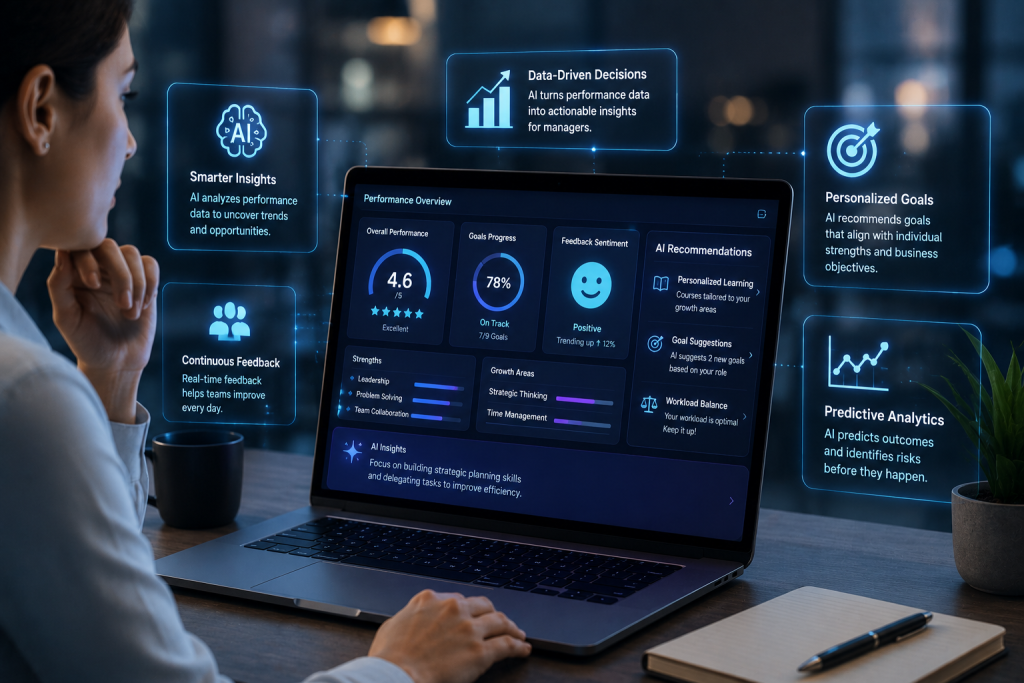
Artificial intelligence is changing performance management software from a system of record into a system that can actively assist managers.
Traditional platforms primarily stored objectives, review forms, ratings, and employee records. Newer systems can organize performance information, identify recurring themes, prepare summaries, and help managers arrive at important conversations with more context.
That evolution creates a significant opportunity. Performance management can become more continuous, less administrative, and more useful to employees.
It also introduces new risks.
If organizations use AI without clear boundaries, performance technology can begin measuring activity instead of contribution, converting incomplete information into confident conclusions, or encouraging managers to accept recommendations they cannot explain.
The question is no longer whether AI will influence employee performance management. It already does.
The more important question is how leaders can use it without automating the responsibilities that require context, accountability, and human judgment.
Why Traditional Performance Management Software Is Evolving
The traditional annual performance review was designed for a slower and more centralized workplace.
Managers gathered information at the end of a review period, employees completed forms, ratings were assigned, and the process was repeated the following year. Much of the conversation focused on reconstructing what had already happened.
Modern work does not fit neatly into that model.
Employees contribute across projects, collaborate with people outside their immediate teams, work remotely or across locations, and adjust their priorities as business needs change. An achievement from eight months ago may be just as important as one completed last week, but it is less likely to remain fresh in a manager’s memory.
The Chartered Institute of Personnel and Development describes performance management as a continuous cycle rather than an isolated event. It recommends feedback that is regular, timely, and focused on improvement.
Performance management software is evolving to support that continuous rhythm. Instead of serving only as the place where annual forms are completed, it can connect:
- Ongoing feedback
- Performance reviews
- Objectives and key results
- Recognition
- One-on-one conversations
- Development priorities
- Employee surveys
- Agreed follow-up
Connecting this information creates a more complete performance history. AI can then help managers understand that history without requiring them to search through months of disconnected notes and systems.
What Modern Performance Management Software Should Actually Do
The purpose of performance technology should not be to observe employees more closely. It should help organizations manage performance more clearly.
That distinction matters.
A system can collect large amounts of activity data without producing meaningful performance evidence. Online presence, message volume, meeting attendance, keyboard activity, and hours connected to a platform may be easy to measure, but they rarely explain the quality or impact of someone’s work.
Some of the most valuable employee contributions are difficult to capture through activity metrics. Preventing a customer escalation, helping a colleague solve a difficult problem, improving an internal process, identifying a hidden risk, or rebuilding trust with a client may not produce an obvious digital signal.
Modern performance management software should therefore help managers capture relevant context—not replace context with monitoring.
Organizations evaluating performance management software for growing teams should look for a platform that creates a reliable performance history while keeping managers accountable for interpretation and communication.
A useful system should help answer questions such as:
- What expectations were established?
- What meaningful progress occurred?
- What feedback was provided?
- What support did the manager offer?
- What commitments were made?
- What important contributions were recognized?
- What context did the employee provide?
- What follow-up remains incomplete?
AI becomes valuable after the organization has this foundation. Without reliable information, automation simply processes incomplete evidence more quickly.
Four Performance Management Tasks AI Can Improve
AI works best when it has a clearly defined supporting role. In performance management, there are four areas where it can create meaningful value without taking ownership of the final decision.
1. Organizing Performance Information
Relevant performance information is often distributed across objectives, feedback, recognition, one-on-one notes, development plans, and review forms.
AI can organize these inputs into a timeline, group related examples, and connect observations to established expectations.
This can help a manager see the full performance period rather than relying on whatever happened most recently.
Organization is not evaluation. The AI is making existing information easier to retrieve and examine—not deciding what the employee deserves.
2. Preparing Review Summaries
Managers often spend hours turning performance notes into a coherent review narrative.
AI can prepare an initial summary, identify recurring themes, and draft language for the manager to inspect. It can also help reduce repetitive administrative work when several employees must be reviewed during the same cycle.
However, every summary should remain connected to its source information.
A professionally written paragraph should never become more authoritative than the evidence behind it. Managers need the ability to verify examples, correct inaccurate language, add missing context, and reject an unsupported interpretation.
The AI-generated draft should be the beginning of managerial review—not the end of it.
3. Identifying Gaps and Imbalances
AI can help managers recognize when a performance record may be incomplete.
For example, it might identify that:
- Nearly all documented examples come from the final month of the review period
- Feedback covers only one responsibility or objective
- One recent mistake dominates an otherwise positive record
- An employee received coaching but no recognition
- Important periods contain no documented information
- Agreed development follow-up was never completed
These signals do not prove that a review is unfair. They tell the manager where further examination may be necessary.
The manager can then look for missing evidence, ask the employee for context, and assess whether the emerging conclusion is genuinely supported.
4. Preparing Better Management Conversations
The most valuable outcome of performance management is not a completed form. It is a better conversation.
AI can help managers prepare by summarizing previous commitments, identifying unresolved follow-up, organizing examples, and suggesting questions for an upcoming one-on-one or review.
This preparation can give managers more time to focus on the responsibilities technology cannot fulfill: listening carefully, clarifying expectations, discussing development, and agreeing on meaningful next steps.
AI should help managers enter conversations better prepared. It should not conduct the relationship on their behalf.
What Leaders Should Never Fully Automate
Some performance-management responsibilities require human ownership because they can directly affect an employee’s income, development, reputation, and career.
Final Performance Ratings
AI should not independently assign the final performance rating.
A rating may influence compensation, promotion, development opportunities, formal performance management, or continued employment. These decisions require context and an accountable decision-maker who can explain the reasoning behind the conclusion.
AI can organize the information considered during the process. The authorized manager must evaluate it and own the final result.
Judgments About Intent or Character
Technology can record that a deadline was missed. It may not know why.
The employee may have received conflicting priorities, lacked necessary resources, encountered an unexpected technical issue, or believed that ownership had changed. These circumstances can materially alter how the event should be understood.
AI should not convert an observable event into a conclusion about someone’s motivation, loyalty, attitude, or character.
“Missed the agreed handoff date” is an observation.
“Does not care about the team” is an interpretation that requires evidence and context the system may not possess.
Promotions, Discipline, and Terminations
Consequential employment decisions should never be delegated to an algorithm.
AI may help authorized leaders assemble relevant information, but people must evaluate the evidence, consider contradictory information, follow organizational policy, and accept responsibility for the decision.
“The software recommended it” is not an acceptable explanation for an action that changes someone’s career.
The Performance Conversation
An automatically generated review cannot replace the conversation between a manager and an employee.
Employees need an opportunity to ask questions, disagree, explain circumstances, and participate in determining what happens next. Even when the written assessment is accurate, the quality of the conversation affects whether the employee understands the expectations and believes the process was credible.
Performance management remains a human relationship supported by technology.
Why Human Oversight Is More Than a Safety Feature
Human oversight is sometimes presented as a final approval step: the AI generates an answer, and a manager clicks a button to accept it.
That is not sufficient.
Effective oversight means the manager understands what information was used, can inspect the underlying examples, recognizes the limitations of the output, and has the authority to change or reject it.
The NIST AI Risk Management Framework emphasizes governance, defined responsibilities, and the management of risks associated with AI systems. The OECD AI Principles similarly promote trustworthy AI that respects human-centered values and preserves human agency and oversight.
Applied to performance management, meaningful oversight requires organizations to establish:
- Who can access employee performance information
- Which information AI is permitted to process
- Which outputs require human verification
- Who owns the final decision
- How employees can provide context or challenge inaccuracies
- How sensitive information is protected
- Which uses of AI are prohibited
These boundaries should be established before AI-generated content begins influencing consequential decisions.
Better Data Does Not Mean Collecting Everything
Organizations may assume that AI needs as much information as possible. In performance management, indiscriminate data collection can make the system less trustworthy.
More information creates more noise, increases privacy concerns, and raises the likelihood that irrelevant activity will influence a decision.
A stronger approach is to capture information that has a legitimate performance-management purpose.
Useful performance evidence normally contains four elements:
- Observation: What happened?
- Impact: What changed for the customer, team, project, or organization?
- Expectation: Which established responsibility, objective, or competency was involved?
- Follow-through: What action, support, or next conversation was agreed?
This structure distinguishes evidence from labels.
“Identified the billing error before the customer account was affected” provides useful information.
“Great attitude” does not explain what occurred.
“Missed the agreed project handoff and did not notify the project owner” provides a specific event that can be discussed.
“Unreliable” is a conclusion that may ignore relevant context.
Better performance management depends on improving the quality of information—not simply increasing its quantity.
Continuous Feedback Still Requires Meaningful Feedback
Technology can make feedback more frequent, but frequency alone does not make it valuable.
Gallup reports that 80% of employees who say they received meaningful feedback during the previous week are fully engaged. The important qualification is that the feedback was meaningful.
Automated reminders, generic praise, and AI-generated coaching statements will not build trust if employees believe their manager does not understand their work.
Meaningful feedback is:
- Connected to a real example
- Relevant to an established expectation
- Timely enough to support improvement
- Delivered through a two-way conversation
- Balanced between recognition and development
- Followed by appropriate action or support
Performance management software can help managers remember what happened and prepare for the next conversation. It cannot supply genuine managerial attention.
The strongest technology reinforces the manager-employee relationship rather than attempting to automate it away.
How to Evaluate AI Performance Management Software
Organizations considering a new system should look beyond feature lists and demonstrations. They should evaluate how the technology behaves when the information is incomplete, sensitive, or consequential.
Leaders should ask:
- What employee information does the platform collect?
- Does it collect meaningful performance evidence or general workplace activity?
- Can employees see and contribute to information that concerns them?
- Can managers trace summaries back to specific examples?
- Does the system distinguish observation from interpretation?
- Can managers correct or reject AI-generated content?
- Does AI assist with reviews or independently determine ratings?
- Who can access sensitive performance information?
- Are employee context and contradictory evidence preserved?
- Who remains accountable for final decisions?
- Does the platform improve management conversations or simply produce more documentation?
- Can the organization clearly explain how AI is being used?
A platform that cannot provide clear answers may create administrative efficiency while weakening trust and decision quality.
The Future Is Continuous, Evidence-Based, and Human-Led
AI will continue to expand what performance management software can do.
It will become faster at organizing information, better at identifying patterns, and more useful in preparing managers for conversations. It may also reduce much of the repetitive work associated with review cycles and performance documentation.
But technological capability should not determine organizational policy.
The future of performance management should not be a workplace where employees are observed more closely and judged by increasingly complex algorithms.
It should be a workplace where expectations are clearer, feedback arrives while it can still help, important contributions are less likely to be forgotten, and formal reviews are supported by evidence from across the full performance period.
The organizations that use AI most effectively will not be those that automate the greatest number of judgments.
They will be those that establish the clearest boundary between technological assistance and human accountability.
That is how AI can improve performance management without replacing responsible leadership.

Caroline is doing her graduation in IT from the University of South California but keens to work as a freelance blogger. She loves to write on the latest information about IoT, technology, and business. She has innovative ideas and shares her experience with her readers.