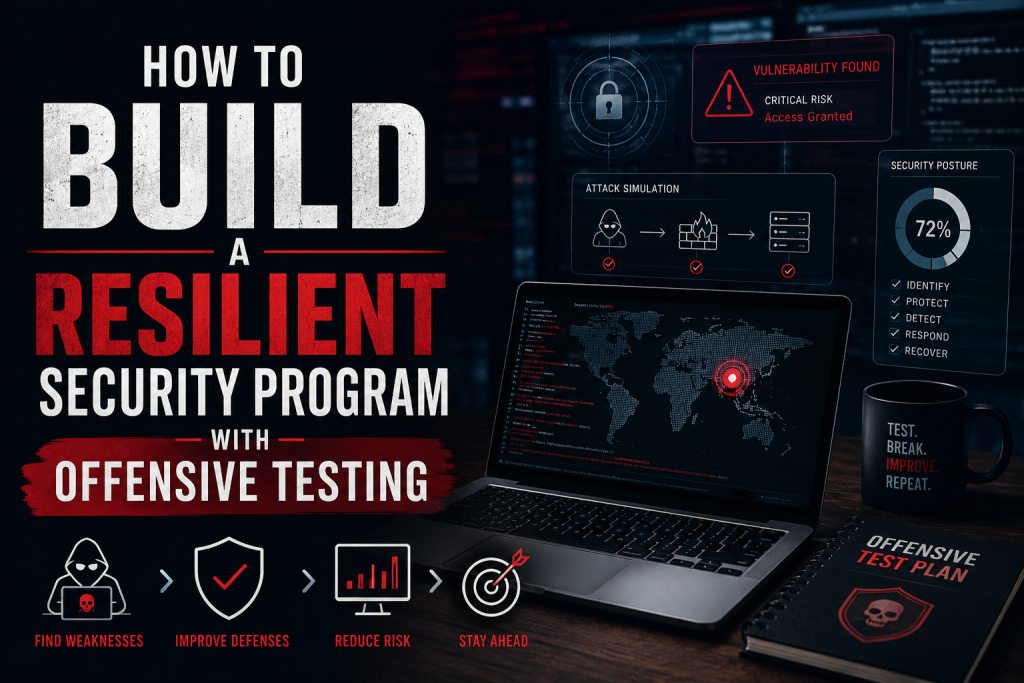
Security programs often look stronger on paper than they are in practice. Policies may be documented. Tools may be deployed. Controls may be in place. Still, none of that proves the organization can withstand a real attack.
Attackers do not follow checklists. They look for weak access controls, exposed systems, misconfigurations, overlooked applications and gaps between teams. A resilient security program must be tested against that reality. Offensive testing gives organizations a structured way to find weaknesses before someone else does.
What Is Offensive Testing?
Offensive testing is the controlled use of attacker-like methods to evaluate security. It can be used against applications, networks, cloud environments, identity systems, internet-facing assets and internal processes. The goal is not to cause harm. The goal is to understand where harm could happen.
Unlike basic vulnerability scanning, offensive testing does more than identify known issues. It shows whether those issues can be exploited. It also shows how small weaknesses can connect into larger attack paths. A low-risk misconfiguration in one system may become serious when combined with weak credentials or excessive permissions in another.
This is why organizations often use offensive testing as part of a broader security improvement strategy. In services-led security work, including approaches associated with Bishop Fox, offensive testing is often used to validate real-world exposure, prioritize risk and help teams focus on issues that create measurable business impact.
Why Offensive Testing Matters for Cyber Resilience
Cyber resilience is the ability to prevent, withstand, respond to and recover from cyber incidents. It is not just about blocking attacks. It is about knowing what happens when controls fail.
Offensive testing helps answer important questions. Can an attacker reach a critical system? Would the security team detect suspicious activity? Are alerts routed to the right people? Can the organization contain an attack before it spreads?
These questions matter because security tools can create a false sense of safety. A control may be enabled but misconfigured. A monitoring rule may exist but fail to trigger. A response plan may be written but untested.
Realistic testing exposes those gaps. It gives security leaders evidence, not assumptions.
The Core Parts of a Resilient Security Program
A resilient program starts with asset visibility. Teams need to know which applications, systems, users, cloud resources and internet-facing assets are in scope. Unknown assets create unknown risk.
Next comes risk-based prioritization. Not every issue deserves the same level of urgency. A vulnerability on a public-facing system that handles sensitive data should receive more attention than a similar issue on an isolated test system.
Strong security controls are also required. These may include identity management, endpoint protection, secure configuration, network segmentation, logging, monitoring and access management. But controls must be tested to prove they work.
Detection and response capability is another core part. Resilience depends on how quickly teams identify suspicious activity, investigate it and take action. A good program does not stop at prevention. It prepares for failure and learns from it.
Finally, resilience requires continuous improvement. Every test, incident, audit and remediation effort should make the program better.
How Offensive Testing Strengthens Security Programs
Offensive testing reveals exploitable attack paths. This is one of its most valuable outcomes. Instead of showing a long list of isolated findings, it can show how an attacker might move from initial access to privilege escalation, lateral movement or data exposure.
It also challenges security assumptions. Teams may believe that multi-factor authentication is fully enforced, that cloud storage is private or that segmentation prevents movement between systems. Testing confirms whether those beliefs are accurate.
Offensive testing improves remediation too. When teams understand how a weakness could be used in a real attack, they can make better decisions about what to fix first. Context matters. A finding with a clear path to sensitive data should rise above low-impact noise.
It also helps executives understand risk. A realistic attack narrative is easier to grasp than a spreadsheet full of severity scores. Leaders can see how technical gaps connect to business impact, such as data loss, service disruption, regulatory exposure or reputational damage.
Types of Offensive Testing to Include
Penetration testing is one of the most common forms. It focuses on finding and exploiting weaknesses within a defined scope, such as a web application, network or cloud environment.
Red teaming takes a broader view. It tests how well the organization detects and responds to realistic attacker behavior. The goal is not only to find weaknesses, but to evaluate readiness.
Adversary emulation models tactics, techniques and procedures associated with relevant threat groups. This can help organizations test defenses against the kinds of attacks they are most likely to face.
Application security testing focuses on web applications, APIs and business logic. Cloud security testing reviews identity, storage, networking, workloads and configuration. External attack surface testing helps find exposed systems that attackers can see from the internet.
Continuous offensive testing adds another layer. Instead of relying only on annual or occasional assessments, it helps teams keep pace with new deployments, changing infrastructure and evolving threats.
How to Build an Offensive Testing Strategy
A strong strategy begins with clear objectives. The organization should know what it wants to learn. The goal might be to test access to critical systems, evaluate cloud exposure, validate detection and response or identify paths to sensitive data.
Testing should be mapped to business risk. Start with the systems and processes that matter most. This may include customer-facing applications, identity platforms, payment systems, sensitive databases, cloud environments and operational technology.
The right testing method should match the goal. A penetration test may be right for a specific application. A red team assessment may be better for testing detection and response. Attack surface testing may be needed when the organization lacks visibility into exposed assets.
Scope and rules of engagement are essential. These should define target systems, excluded assets, testing windows, communication paths, safety limits and escalation procedures. Offensive testing should be realistic, but it must also be controlled.
After testing, findings should be prioritized by exploitability and business impact. Then they should be assigned to owners and routed into remediation workflows. Retesting is important. Without it, teams cannot be sure the issue was fixed.
Common Mistakes to Avoid
One mistake is treating offensive testing as a compliance task. A test should produce useful insight, not just a report.
Another mistake is testing without clear goals. Unfocused work can create noise and miss the risks that matter most.
Some organizations also ignore detection and response. Finding vulnerabilities is important, but resilience also depends on whether the team can detect and contain attacker behavior.
Finally, many teams fail to retest. Remediation is not complete until the fix is validated.
Final Thoughts
A resilient security program is not built by assuming defenses work. It is built by testing them, finding weak points and improving over time.
Offensive testing helps organizations understand how attackers might operate in their environment. It validates controls, exposes attack paths, improves response and helps teams prioritize the risks that matter.
The strongest programs are not the ones that never find problems. They are the ones that find them early, fix them well and keep testing.

Sandra Larson is a writer with the personal blog at ElizabethanAuthor and an academic coach for students. Her main sphere of professional interest is the connection between AI and modern study techniques. Sandra believes that digital tools are a way to a better future in the education system.