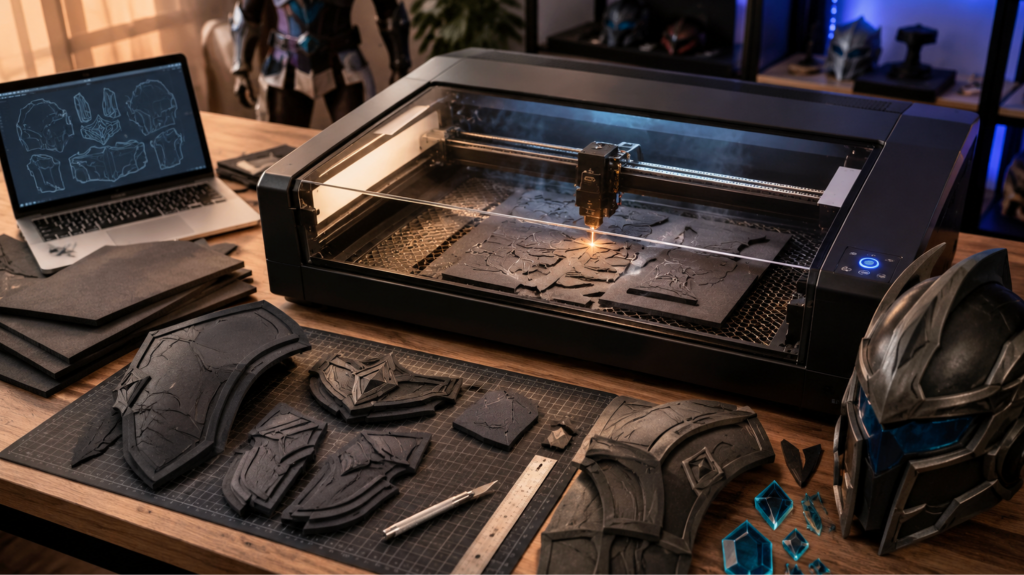
Every cosplayer hits the same wall eventually. The design in your head is sharp and symmetrical, but cutting it by hand from foam or acrylic leaves wobbly edges, mismatched pairs, and an evening lost to a hobby knife. This is the point where a lot of makers start eyeing a laser cutter, and for good reason. Few tools change a prop-making workflow as dramatically. If you have been curious about adding one to your setup, here is a practical, jargon-light guide to what these machines do, what they can and cannot cut, and how to get started safely.
What a laser cutter actually does
A laser cutter uses a tightly focused beam of light to burn, melt, or vaporize material along a path you design on a computer. Turn the power up and move slowly, and it cuts clean through a sheet. Turn the power down and move quickly, and it engraves, etching detail into the surface without cutting through. That single machine, then, gives you two abilities cosplayers prize: perfectly clean cut-out shapes and crisp surface detailing, both repeatable as many times as you need.
The repeatability is the part that tends to win people over. Need two identical shoulder plates, a run of twenty identical scales, or a symmetrical emblem for both sides of a chestpiece? The laser cuts each one exactly the same. What used to be the most tedious part of a build becomes a few minutes of machine time.
The materials that matter for cosplay
The good news is that a laser handles most of the staples of prop making beautifully. EVA foam, the backbone of so many armour builds, cuts cleanly and the beam even seals the edge as it goes, which is ideal for the beveled cuts cosplayers rely on. Acrylic cuts with a smooth, glossy edge that is perfect for visors, gems, glowing accents, and display bases. Plywood and MDF are great for props, weapon cores, and sturdy bases. Leather, craft foam, cardstock, cork, and many fabrics all cut well too.
The bad news is that some materials are genuinely dangerous to put in a laser, and this is not optional knowledge. Never cut PVC or vinyl: they release chlorine gas that is toxic to you and corrosive to the machine. Avoid polycarbonate, which cuts poorly and can catch fire, and be cautious with any unknown plastic. When in doubt about a material, look it up before it goes anywhere near the bed. The rule of thumb is simple: know exactly what a material is before you cut it.
CO2 or fibre: which laser suits cosplay
You will see two main types advertised, and the choice is easy for cosplay. CO2 lasers are the right tool for the job, because their wavelength is absorbed well by the organic and non-metallic materials cosplayers actually use: foam, acrylic, wood, leather, and fabric. Fibre lasers, by contrast, are built for marking bare metal and are poorly suited to foam and acrylic. Unless your builds are mostly metal engraving, a CO2 machine is what you want.
From design to finished part: the workflow
The process is more approachable than it looks. You start by drawing your design as vector artwork in software such as Adobe Illustrator, the free Inkscape, Affinity Designer, or CorelDRAW. Vectors matter because the laser follows lines and paths rather than pixels. Lines set to cut become cuts; areas set to engrave become surface detail.
From there, the design goes into laser control software, most commonly LightBurn, which talks to the machine and lets you set power and speed for each element. You place your material on the bed, set the focus, run a small test on a scrap to dial in the settings, and then cut. The first few jobs involve some trial and error with settings, but once you have a reliable recipe for a given material and thickness, you can reuse it forever.
Choosing your first machine
A few specifications matter more than the rest when you are starting out. Bed size determines the largest single piece you can cut, which matters for armour panels and large props. Wattage affects how thick a material you can cut and how quickly. Air assist, a jet of air at the cutting point, produces cleaner edges and reduces flare-ups, so it is worth having. And build quality and support matter more than beginners expect, because a well-made machine with real customer support saves you enormous frustration.
It is worth buying from an established maker rather than the cheapest listing you can find. Established brands that build dedicated laser cutting and engraving machines tend to offer proper extraction, safety interlocks, reliable optics, and the kind of support that helps a newcomer past the first hurdles. A machine built for the job will outlast and outperform a bargain unit, and for a tool that involves a focused beam and combustible materials, that reliability is not a luxury.
Safety comes first, every time
A laser cutter is a genuinely useful tool, but it is one that produces heat, smoke, and the occasional flame, so a few habits are non-negotiable. Ventilate properly, exhausting fumes outside or through a suitable filter, because even safe materials produce smoke you should not breathe. Never leave the machine running unattended, since a small flare-up can become a fire in seconds. Keep the lid closed while cutting to protect your eyes from the beam, and have a small fire extinguisher within reach. Treat the machine with respect and it will serve you for years.
Starter projects to build your confidence
If you are new, begin small and let the wins build. Flat emblems and insignia cut from acrylic or foam are a satisfying first project. Armour detailing, such as trim, rivets, and layered panels, teaches you how the laser handles foam. Simple prop parts, jewellery, and name badges for conventions are quick and rewarding. Layered acrylic display stands for finished pieces are a favourite once you find your feet. Each project teaches you a little more about settings and materials, and before long the machine stops feeling intimidating and starts feeling like the most valuable tool on your bench.
The bottom line
A laser cutter will not design your cosplay for you, and it will not replace the craft and creativity that make a build yours. What it does is remove the tedious, error-prone parts, the endless hand-cutting, the mismatched pairs, the shapes that never quite came out symmetrical, and give you clean, repeatable results in a fraction of the time. For a hobby where detail and consistency separate a good build from a showstopper, that is a serious upgrade. Start with the right machine, respect the safety rules, and learn one material at a time. Your future builds will look all the sharper for it.