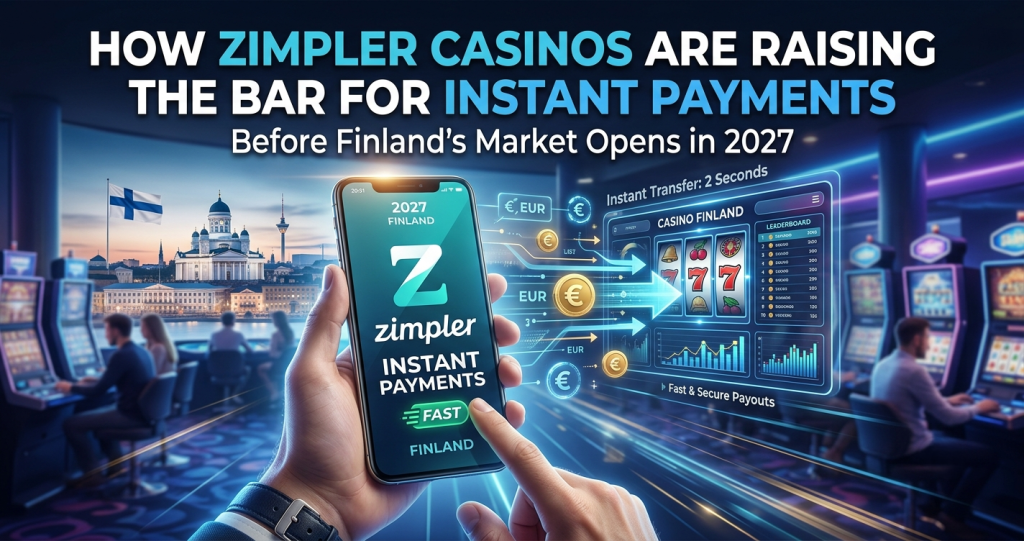
Gamers have quietly normalised instant everything. A cloud save syncs before you have set the controller down, a digital storefront charges your card in a single tap, and a day-one patch finishes downloading while you make coffee. Speed stopped being a luxury years ago and became the baseline anyone expects from a screen. Yet one part of online play has stubbornly clung to an older decade, and it is the least fun part of all: the cashier. Deposits that stall on a card verification page, payouts that take three business days, and a fresh sign-up form for every new site are the sort of friction most people would never tolerate anywhere else in their digital lives.
In Finland, a handful of payment providers have spent the past few years chipping away at exactly that lag, and Zimpler is the one most players now recognise by name. Finnish readers who want to see which operators already run the method tend to start with comparison directories rather than with the casinos themselves. Zimplerkasinot, for example, keeps a running list of zimpler casinos organised around the payment flow instead of around the game lobby, which is a small but telling sign of how much the rail itself has become the selling point.
The timing is not accidental. Finland is in the middle of tearing down a decades-old gambling monopoly and replacing it with a licensing system, and the domestic market is planned to open to private operators in mid-2027. That deadline is doing something interesting to the payment layer: it is turning speed, security, and clean identity checks into competitive features rather than back-office plumbing. This piece looks at what Zimpler actually does, why open banking is the real engine underneath it, and how the 2027 opening is pushing the whole standard upward.
The Cashier Was Always the Slowest Part of the Session
Think about the last time a piece of software made you wait for no obvious reason. For a lot of players, that memory is a casino withdrawal. You win, you request the money, and then you wait while the request sits in a review queue, clears a card network, and finally lands days later. None of that delay comes from the game. It comes from the payment rails underneath, most of which were designed for a world of plastic cards and manual checks rather than for someone who wants their winnings the same evening.
Card payments carry a lot of legacy baggage. They route through networks built in the twentieth century, they invite chargebacks, and they hand a third party your card number every time you use them. E-wallets solved part of the speed problem but added another account to create, fund, and remember. What players actually wanted was simpler than either option: pay straight from the bank account they already have, prove who they are once, and get the money back the same way it went in. That is the gap Zimpler set out to close, and it is why the method spread so quickly across the Nordics.
What Zimpler Actually Does Behind a Single Tap
Zimpler is a Swedish fintech founded in 2012 that started life as an e-wallet and then pivoted to what the industry calls account-to-account payments. In plain terms, it moves money directly between your bank account and the operator without a card network sitting in the middle. When you pick it at a cashier, you enter a phone number, choose your bank from a list, and confirm the payment inside your own bank’s authentication flow. The funds move, and you are back in the lobby.
Image by Hugo Lindberg
The part players notice most is what is missing. There is no separate Zimpler account to register, no extra app to install, and no long form to fill in before a first deposit. In Finland the service connects directly to the major banks, including OP, Nordea, S-Pankki, Saastopankki, and Alandsbanken, so identity is confirmed through the same credentials people already use for everyday banking. The provider also runs a product it calls Zimpler GO, which powers the no-account or Pay N Play style of casino: instant deposits, identity verification folded into the payment, and payouts that return to the same account without a card in sight. For a player, the whole thing feels less like a checkout and more like tapping to open a door.
Open Banking Is the Engine Under the Hood
The reason any of this works is a piece of European regulation that rarely gets a mention in gaming circles: the second Payment Services Directive, usually shortened to PSD2. It forced banks across the European Economic Area to open standardised interfaces so that licensed third parties can, with the customer’s consent, both read account information and initiate payments. Before PSD2, fintechs often resorted to screen scraping, effectively logging in on your behalf, which was fragile and hard to secure. The directive replaced that with proper application interfaces and a requirement for strong customer authentication, meaning a payment has to be confirmed with at least two independent factors.
Zimpler sits on top of that framework. It is not a bank and it does not need to be, because open banking lets it act as the trusted middle layer that talks to the bank on one side and the operator on the other. That is a genuinely different model from a card, where your details travel with every transaction and sit in more databases than you can count. With an account-to-account payment, the sensitive credentials never leave your bank’s own login screen. The security is not bolted on afterward; it is a property of how the rail is built.
Gamers Set the Speed Expectation, Payments Are Catching Up
None of this happened in a vacuum. The reason a laggy cashier feels so jarring is that the rest of interactive entertainment has spent two decades getting faster and smoother. The same shift that took games from boxed discs to instant digital libraries, and from local saves to cloud sync, reset what people consider normal. A broader look at how technology is changing gaming makes the pattern clear: once one part of an experience becomes instant, every slower part of it starts to feel broken by comparison.
Payments were simply the last domino. Players who expect a game to stream to any device without a download were never going to accept a three-day wait to touch their own money. Fintechs like Zimpler read that expectation correctly and built for it, which is why the method landed hardest with younger, mobile-first players who treat their phone as the default way to do almost everything. The casino cashier is now being judged by the same standard as a music app or a food-delivery order, and that comparison is not flattering to the old ways of paying.
Why the 2027 Opening Raises the Stakes on Payment Quality
Finland is rebuilding its gambling framework from the ground up. Parliament adopted a new Gambling Act at the end of 2025, and it was approved by the President early in 2026. Licence applications opened on 1 March 2026, and the licensed market is planned to go live on 1 July 2027. Until then, the state operator Veikkaus keeps its exclusive rights over online casino games and betting, after which it will hold on only to lotteries, scratch cards, and physical slot machines while private operators compete for everything else.
Image by Hugo Lindberg
That reshuffle matters for payments in a way that is easy to miss. When dozens of operators suddenly compete for the same players, the differences between them narrow fast. Everyone will offer similar games from the same studios, similar bonuses within the same rules, and similar apps. What is left to compete on is the experience around the edges, and the payment flow is one of the biggest edges there is. Finland has already received a wave of licence applications ahead of the opening, and the operators thinking seriously about the market are treating a fast, well-verified cashier as a feature they lead with rather than an afterthought. A rail like Zimpler, already trusted by Finnish players and already wired into the local banks, becomes an obvious foundation to build on.
A Side-by-Side Look at the Payment Rails
It helps to put the options next to each other. The table below is a general comparison of how the common methods behave at Finnish-facing casinos. Exact speeds and limits vary by operator and by bank, so treat these as typical patterns rather than guarantees.
| Payment method | Typical deposit speed | Typical payout speed | Separate account to create | Identity check built in |
|---|---|---|---|---|
| Zimpler (open banking) | Instant | Often within minutes to a few hours | No | Yes, through your bank login |
| Debit or credit card | Instant | One to three business days | No | Partial, network dependent |
| E-wallet | Instant | Minutes to a day | Yes | Separate from your bank |
| Standard bank transfer | Hours | One to three business days | No | Manual, done by the operator |
The pattern is hard to unsee once you have looked at it. The account-to-account rail is the only column that pairs an instant deposit with a genuinely quick payout and folds the identity check into a login you already trust. That combination, rather than any single feature, is what has made it the default choice for a growing share of Finnish players.
Identity Checks That Happen in the Background
Know Your Customer rules are the part of online gambling players complain about most, usually because they arrive at the worst possible moment. You win, you try to withdraw, and only then does the site ask for a photo of your passport and a utility bill. The delay is not the operator being difficult; regulators require that verification, and a lot of platforms simply defer it until a payout forces the issue.
Open banking changes the order of operations. Because a Zimpler payment already runs through your bank’s authenticated login, a strong signal about who you are is captured at the very first deposit rather than weeks later. That does not remove every check an operator may need to run, but it front-loads the hardest one and does it without asking the player to upload anything. The result is fewer accounts frozen at withdrawal time and less of the friction that pushes frustrated players toward unlicensed sites. For a market about to invite a crowd of new operators under a fresh set of rules, an identity check that happens quietly at deposit is exactly the sort of quality bar regulators tend to reward.
The TrueLayer Deal and What It Signals for the Rail
There is a piece of fintech news from the last year that gaming coverage mostly skipped, and it says a lot about where this is heading. In late 2025 the open banking firm TrueLayer announced it was acquiring Zimpler, and the deal completed in early 2026 after Swedish regulators signed off on the change of control. The combined company is now described as one of Europe’s largest pay-by-bank networks by user count, reportedly serving more than 20 million users across markets that include the United Kingdom, Sweden, Finland, and Brazil.
Image by Hugo Lindberg
Consolidation like that is not just corporate housekeeping. It tells you that account-to-account payments have moved from a Nordic experiment to serious infrastructure that big players want to own. For Finnish gambling specifically, it means the rail underneath many casinos is now backed by a larger, better-funded network with reach across several countries, which tends to translate into steadier uptime, wider bank coverage, and faster iteration on features. A payment method is only as good as the company keeping it running, and the direction of travel here is toward scale rather than away from it. That is a reassuring signal to read right before a market opens and volume jumps.
What Quicker Payouts Actually Change for Players
It is tempting to treat all of this as a convenience story, but faster and cleaner payments change behaviour in ways that matter. A withdrawal that lands the same evening removes one of the classic traps of online play: the long wait during which a pending cash-out is easy to cancel and gamble back. When the money simply arrives, the decision to stop stays a decision rather than a hurdle. Clear, bank-linked payments also make spending easier to track, because everything shows up in the same account history a player already checks.
The security side rests on foundations bigger than any one casino. The rules that make open banking safe come from EU law, and the European Commission’s rules for secure payment services under PSD2 are what force strong authentication and standardised bank interfaces across the region. None of that guarantees any single operator behaves well, and players should still check licensing and set their own limits. One accurate note worth keeping in mind is tax: for a Finnish resident, winnings from an operator licensed inside the European Economic Area are currently tax-free, while winnings from operators licensed outside it are treated as taxable income, a distinction the 2027 domestic framework will layer its own rules on top of. A fast payout is welcome, but it is worth knowing whose licence sits behind it before you deposit.
Frequently Asked Questions
Do I need to open a Zimpler account before I can use it?
No. One of the main reasons the method spread so quickly is that there is nothing to register in advance. You confirm the payment inside your own bank’s login, and the identity step is folded into that flow, so a first deposit works without a separate sign-up or a dedicated app.
Why are Zimpler payouts often faster than card withdrawals?
Because the money moves directly between bank accounts rather than through a card network with its own clearing and review steps. The identity check also happens up front at deposit, so there is less verification left to run when you cash out, which is where most card-based delays actually come from.
Does Finland’s 2027 market opening change how these payments work?
The payment technology itself does not depend on the reform, but the opening raises the stakes. As many licensed operators start competing for the same players from mid-2027, a fast and well-verified cashier becomes a feature they compete on, so expect payment quality to get more attention rather than less.
Is open banking safe for gambling deposits?
The framework was built for security. PSD2 requires strong customer authentication and standardised bank interfaces, and your card or bank credentials never travel to the casino because the payment is confirmed inside your bank’s own login. That is generally a lower-exposure setup than typing a card number into a site.
Are casino winnings taxable for Finnish players?
For a Finnish resident, winnings from an operator licensed within the European Economic Area are currently tax-free, while winnings from operators licensed outside the EEA count as taxable income. The domestic licensing system arriving in 2027 will add its own rules, so it is sensible to check an operator’s licence before playing.
Article Disclaimer:
This article is for informational purposes only and does not constitute legal, financial, or gambling advice. Gambling regulations and payment options vary by jurisdiction and may change as Finland’s licensing framework is implemented. Readers should consult official regulatory sources and use only licensed operators where permitted by law.