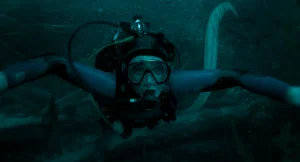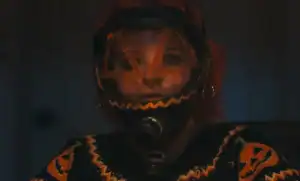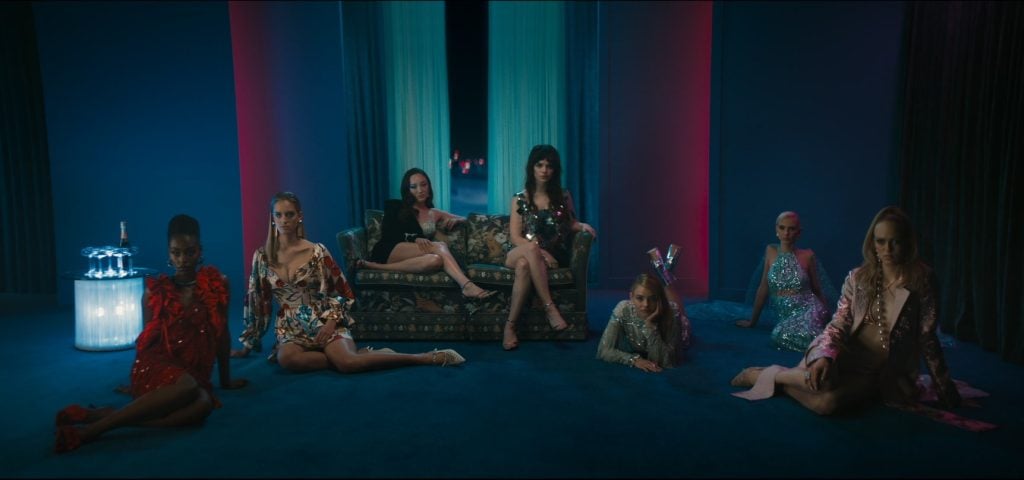
What makes Nicolas Winding Refn such a fascinating filmmaker is that he has always been interested in the space between cinema and pure sensation, as his films can feel less like stories being told than images, sounds, colors, and bodies being arranged into some kind of fever dream. Her Private Hell takes that approach further than almost anything he has made before. It is a hypnotic, strange, wildly self-indulgent blend of giallo, noir, space opera, and surreal horror, set in a futuristic city swallowed by a mysterious mist. Sophie Thatcher plays Elle, a young actress staying at the Tower Hotel while filming a low-budget science-fiction movie. As the city disappears beneath the fog, Elle becomes entangled with Hunter (Kristine Froseth), Elle’s way too young stepmother, and former friend Dominique (Havana Rose Liu), and a series of increasingly bizarre events involving a demonic figure known as the Leather Man.
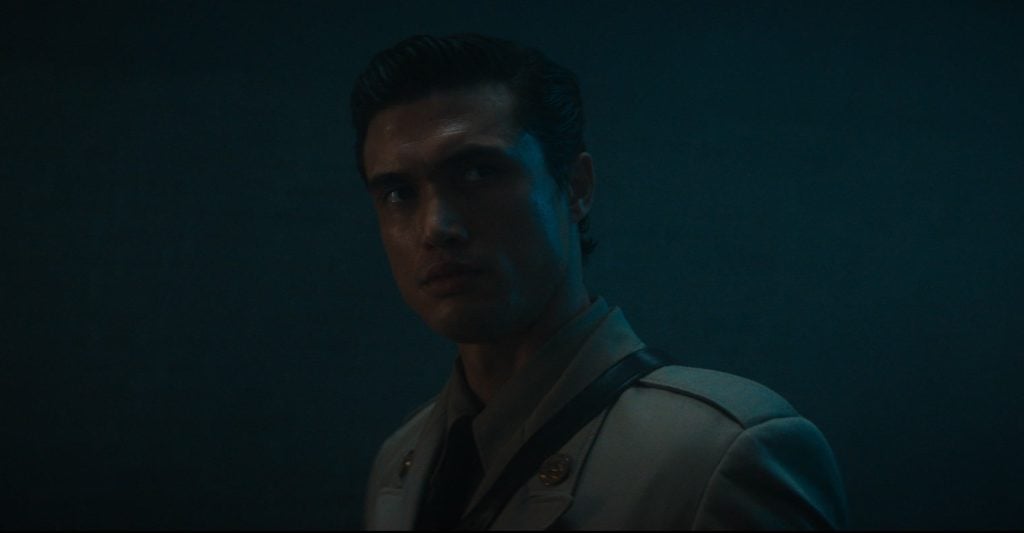
Somewhere outside the hotel, Private K (Charles Melton), a soldier referred to as “the most depressed man on the planet,” is searching for his missing daughter. His journey brings him closer to the Leather Man, a mysterious killer who stalks the city wearing black gloves fitted with diamond-studded knuckles. The more the film unfolds, the less interested it becomes in explaining exactly what is happening. The mist has no clear origin, and The Leather Man’s motives remain deliberately murky. The connections between the characters become increasingly abstract, and by the end, I was still not entirely sure what I had watched, and I mean that both as a compliment and a criticism.
There is something genuinely enthralling about the world Refn creates here. The city feels like it has been pulled out of some forgotten midnight movie from another dimension, filled with neon, haze, strange architecture, and people who seem to have wandered in from entirely different films. The cinematography is colorful and dreamlike, with the mist turning almost every location into a glowing, artificial nightmare. Pino Donaggio’s score is one of the film’s biggest strengths, giving the movie an operatic quality that makes even the strangest moments feel grand and ominous.
At the same time, the film can feel like it is constantly admiring its own reflection. Refn clearly knows how good certain images look, and he is more than happy to sit with them. There are sequences that are beautiful to look at but contribute very little beyond atmosphere. The movie is so committed to its visual language that the plot often feels like an afterthought. It is almost as if there was a blank canvas and Nicolas Winding Refn grabbed multiple buckets of paint and just threw them at it. Sometimes the result is striking, but some other times you’re left wondering what any of it is supposed to mean.
The performances fit the film’s heightened tone surprisingly well. The dialogue is very campy and intentionally bad, the delivery is often deliberately theatrical, and the entire cast seems to understand that they are operating in a world where subtle realism would probably feel out of place. Sophie Thatcher is particularly good at navigating that strange tone. Elle is surrounded by absurdity, yet Thatcher gives her enough presence to keep the character from disappearing completely into the film’s aesthetic. Kristine Froseth and Havana Rose Liu also play into the movie’s stylized world effectively, while Charles Melton’s mostly silent performance as Private K gives the film a more traditional noir figure to follow.
That exaggerated acting is also part of what makes the movie difficult to connect with. Almost everyone feels like they are performing inside a dream rather than living in a real world, and while that is clearly intentional, it creates an emotional distance that the film never really overcomes. Granted, this should be expected if you know about NWR films. The characters are often more interesting as images than as people, and at times you can watch them for a long time without necessarily feeling like you know them.
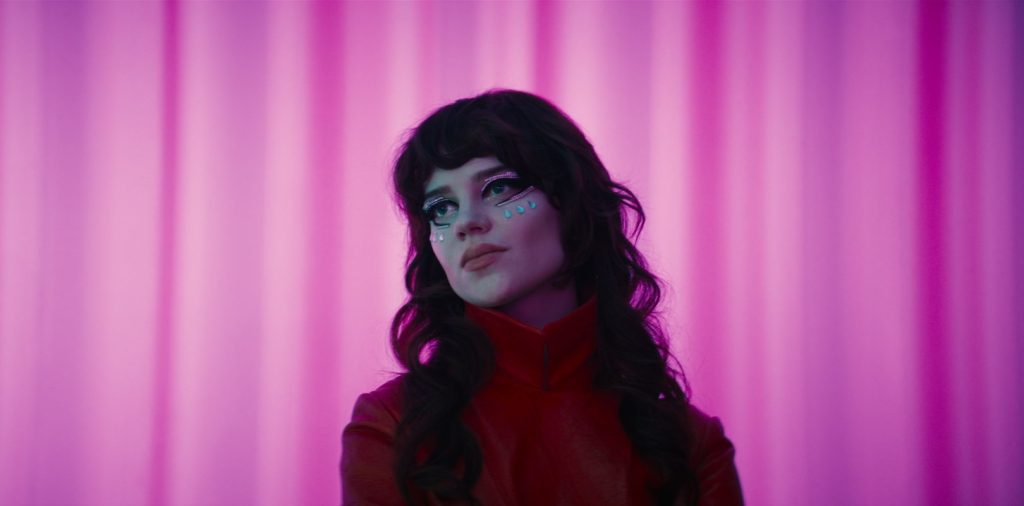
The movie does have a clear affection for classic genre cinema as it is filled with stylish murders, strange symbolism, morally ambiguous characters, sudden bursts of violence, and a constant sense that something lurid is about to happen. Refn is clearly playing with the traditions of giallo and noir while throwing in elements of science fiction and space opera. The problem is that the film rarely develops those ideas beyond their surface appeal. It understands the look and mood of these genres extremely well but is much less interested in giving them a story with any real weight.
That is ultimately the central problem with Her Private Hell. It is so easy to become hypnotized by what you are watching, but the more you think about it, the harder it becomes to grasp or wrap your head around what the film is actually trying to say. The imagery feels deliberate, yet the story feels increasingly random. The symbolism and visual imagery appear to mean something, but the movie refuses to give you enough to understand what that meaning might be. Ambiguity can be fascinating when there is something underneath it to uncover. Here, the ambiguity often feels like a substitute for development.
The pacing makes that problem even more apparent. This is a slow film, and there is nothing inherently wrong with that. A movie can move slowly and still be completely absorbing. Her Private Hell, however, frequently feels like it is waiting for something to happen. The story moves forward in fits and starts, then pauses to linger on another image, another piece of music, another strange conversation. There are stretches where the atmosphere is so strong that the lack of momentum doesn’t matter. There are other stretches where the movie becomes a genuine patience tester.
And yet, I can’t say I disliked watching it. There is a strange confidence to the whole thing as Refn has made a film that seems completely uninterested in whether every viewer understands it, and there is something admirable about that level of commitment. The movie has a very specific personality where you can feel the influence of the filmmaker in almost every frame, even when that influence becomes the film’s biggest weakness.
That is why Her Private Hell is likely to divide people so sharply. Fans of Nicolas Winding Refn will probably find plenty to admire in its neon-soaked imagery, operatic score, strange violence, and refusal to explain itself, but anyone coming to the film without much patience for his style will probably be exhausted really quickly. This movie is why the term “style over substance” exists with many general audiences. The style is often exceptional, but the substance is much harder to find.
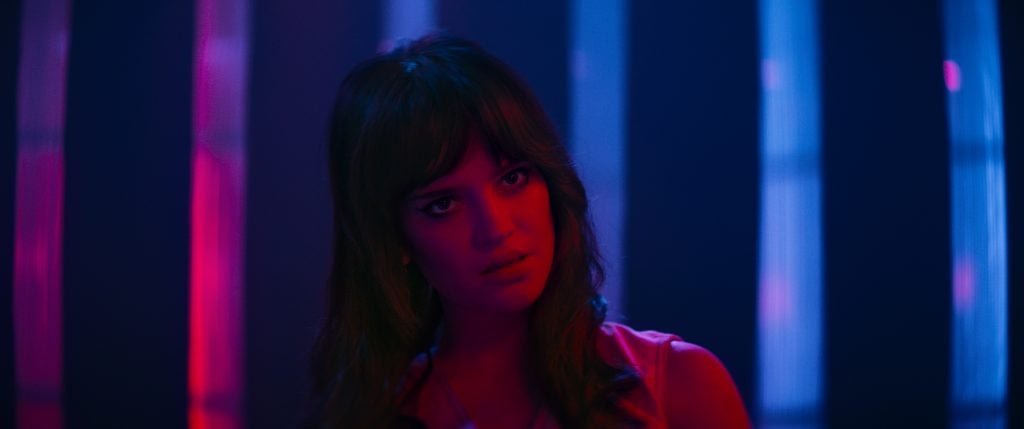
There are moments where Her Private Hell feels like a genuinely immersive nightmare, and there are others where it feels like an expensive mood board that somehow became a feature-length movie. I admire the ambition, the commitment to its aesthetic, and the willingness to embrace something this strange. I also kept wishing there was more underneath all of it. It is a beautiful, bizarre, occasionally fascinating, and frequently frustrating movie that for better or worse exists. It is the kind of film that can completely pull you into its world while you are watching it, only for the whole thing to start slipping through your fingers the moment you try to explain what you just saw. That may be exactly what Nicolas Winding Refn wants. For me, it was both the film’s greatest strength and its most serious limitation.
Her Private Hell will be released exclusively in theaters on July 24, 2026, courtesy of NEON.
Her Private Hell is likely to divide people so sharply. Fans of Nicolas Winding Refn will probably find plenty to admire in its neon-soaked imagery, operatic score, strange violence, and refusal to explain itself, but anyone coming to the film without much patience for his style will probably be exhausted really quickly.

Roberto Tyler Ortiz is a movie and TV enthusiast with a love for literally any film. He is a writer for LoudAndClearReviews, and when he isn’t writing for them, he’s sharing his personal reviews and thoughts on Twitter, Instagram, and Letterboxd. As a member of the Austin Film Critics Association, Roberto is always ready to chat about the latest releases, dive deep into film discussions, or discover something new.