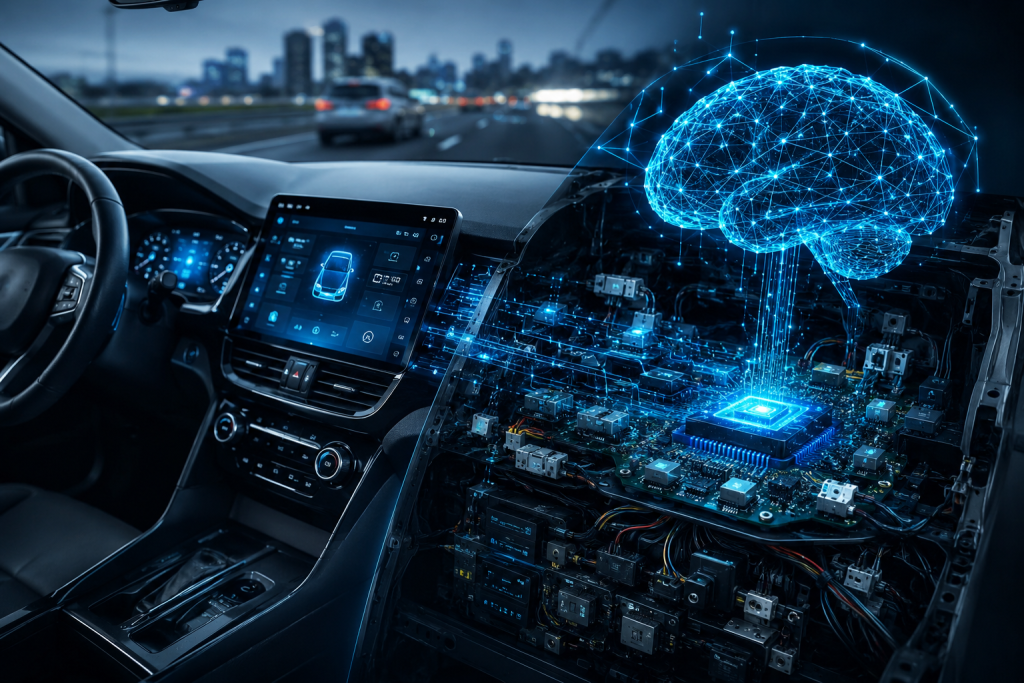
Artificial intelligence has become one of the most influential forces shaping the modern automotive industry, yet much of its impact remains invisible to drivers. Unlike dramatic concept vehicles or fully autonomous prototypes, the most significant AI transformation is happening quietly behind everyday dashboards.
Modern cars are increasingly capable of learning driver behaviour, predicting maintenance issues, analysing traffic conditions in real time, and assisting with safety decisions faster than any human could react. What once felt futuristic has gradually become integrated into ordinary driving experiences.
The result is a shift in how vehicles are designed, operated, and understood. Cars are evolving from mechanical machines into intelligent digital systems powered as much by software as hardware.
Navigation Systems Have Become Predictive Rather Than Reactive
Traditional satellite navigation simply provided directions from one location to another. AI-powered navigation systems now operate very differently.
Modern systems continuously analyse live traffic data, driving patterns, road conditions, weather, and historical congestion trends to predict the most efficient routes before problems even occur. Some vehicles can recommend departure times based on expected traffic or suggest charging stops optimised around battery levels and availability.
These systems increasingly learn from individual behaviour as well. Over time, vehicles begin recognising common destinations, preferred routes, and driving habits without requiring manual input.
This predictive capability reflects a wider shift across the automotive industry. Cars are no longer passive tools responding to commands. They are becoming active participants in decision-making processes.
For many drivers, convenience and seamless integration now matter as much as traditional performance metrics. AI-driven navigation represents part of a broader expectation that vehicles should simplify daily life rather than merely facilitate transport.
Safety Systems Are Becoming Increasingly Intelligent
Artificial intelligence also plays a growing role in vehicle safety.
Driver assistance technologies such as lane-keeping support, adaptive cruise control, collision avoidance systems, and pedestrian detection rely heavily on AI models trained to interpret enormous amounts of visual and environmental data in real time.
Rather than following fixed programmed instructions alone, many systems continuously improve through machine learning and software refinement. Vehicles can now process surrounding conditions with remarkable speed, identifying potential risks before drivers fully register them.
Importantly, this does not mean cars are replacing human judgement entirely. Most current systems are designed to support drivers rather than remove them from the process. However, the balance between human input and software intervention is steadily shifting.
As sensors, cameras, and processing power continue advancing, AI-assisted driving is likely to become increasingly normalised across both premium and mainstream vehicles.
Predictive Maintenance Is Changing Vehicle Ownership
One of the less visible but most practical applications of AI lies in predictive maintenance.
Modern vehicles generate enormous quantities of operational data. AI systems can analyse patterns across engine performance, battery health, tyre pressure, braking systems, and software diagnostics to identify potential issues before they become serious failures.
This changes the relationship between drivers and maintenance entirely.
Rather than relying solely on scheduled servicing intervals or visible warning signs, vehicles can increasingly anticipate problems based on behavioural trends and component analysis. Some systems already notify drivers about declining battery efficiency, abnormal mechanical behaviour, or upcoming servicing requirements long before breakdowns occur.
For manufacturers and drivers alike, predictive maintenance offers obvious advantages: reduced downtime, lower long-term costs, and improved reliability.
It also reinforces the growing perception of vehicles as connected digital products rather than isolated mechanical systems.
Cars Are Becoming More Personalised Through Software
AI is also influencing how vehicles adapt to individual users.
Many newer cars now personalise seating positions, climate settings, infotainment layouts, navigation preferences, and driving modes automatically based on recognised user profiles. Voice assistants are becoming more conversational and context-aware, while some systems can adapt recommendations according to driving habits and routines.
This level of customisation mirrors developments across consumer technology more broadly. Smartphones, streaming services, and online platforms already shape experiences around user behaviour. Increasingly, vehicles are doing the same.
The shift reflects changing consumer expectations, particularly among younger drivers accustomed to highly personalised digital environments.
At the same time, physical presentation remains important within automotive culture. As cars become more software-driven, many drivers still value opportunities for visual individuality and subtle personalisation. For motorists interested in refining the appearance of their vehicles, brands such as Number 1 Plates reflect the continuing appeal of automotive identity beyond purely digital experiences.
The Definition of Driving Is Slowly Changing
The rise of AI raises broader questions about the future role of the driver.
For over a century, driving has been associated with direct mechanical control and human decision-making. AI-driven systems gradually alter that relationship by automating more aspects of the experience.
In some ways, this transition mirrors developments in other industries where software increasingly manages complex tasks once handled manually. Navigation, communication, entertainment, and even financial systems already rely heavily on automated intelligence operating behind the scenes.
The automotive world is following a similar path.
This does not necessarily diminish enthusiasm for driving itself. Many drivers still value engagement, skill, and emotional connection with vehicles. However, expectations around convenience, safety, and digital integration are reshaping what people prioritise in modern cars.
Increasingly, consumers judge vehicles not only by horsepower or handling but by how intelligently they integrate into everyday life.
The Car as a Technology Platform
Perhaps the most important change AI introduces is conceptual rather than technical.
Cars are no longer viewed purely as mechanical products. They are becoming technology platforms that evolve through software updates, connected services, and ongoing digital refinement.
Manufacturers now compete not only on engineering quality but also on interface design, processing capability, and software ecosystems. Some vehicles receive major functionality improvements long after purchase through over-the-air updates alone.
This fundamentally changes the pace of automotive development. Historically, a car’s capabilities were largely fixed at the moment it left the factory. Increasingly, vehicles continue evolving throughout their lifespan.
The AI revolution behind modern dashboards may feel subtle compared with dramatic visions of autonomous driving, but its influence is already substantial. Quietly and steadily, artificial intelligence is reshaping what cars do, how drivers interact with them, and what mobility itself means in an increasingly connected world.

Sandra Larson is a writer with the personal blog at ElizabethanAuthor and an academic coach for students. Her main sphere of professional interest is the connection between AI and modern study techniques. Sandra believes that digital tools are a way to a better future in the education system.