Run a single model provider long enough and you’ll eventually hit the three events every team hits: a price change with no warning, an outage at the worst moment, and a model deprecation that forces a rewrite. A ai gateway removes that exposure by giving you one place to access, manage, and route between many model providers at once — one API key, one set of rules, one record of what everything costs. The spec sheet for GPT-5.6 Terra is a concrete example — one catalog entry with its live rates and context window, a cross-section of the models a platform fronts; this piece is the plain-English version of what the category is, why single-vendor is a risk rather than a strategy, and how to evaluate a platform before you route production traffic through it.
Most teams don’t adopt a multi-LLM platform on purpose. They start with one provider because it’s the easiest call, then add a second because one engineer is reading benchmarks, then a third because a customer needs a specific capability. Before long you have four SDKs, three dashboards, two billing systems, and no single place to see which model is actually earning its cost. That moment — not the moment of picking a first model — is when a multi-LLM platform stops being a nice-to-have and becomes the cheapest way to run AI at all.
What a multi-LLM platform actually is
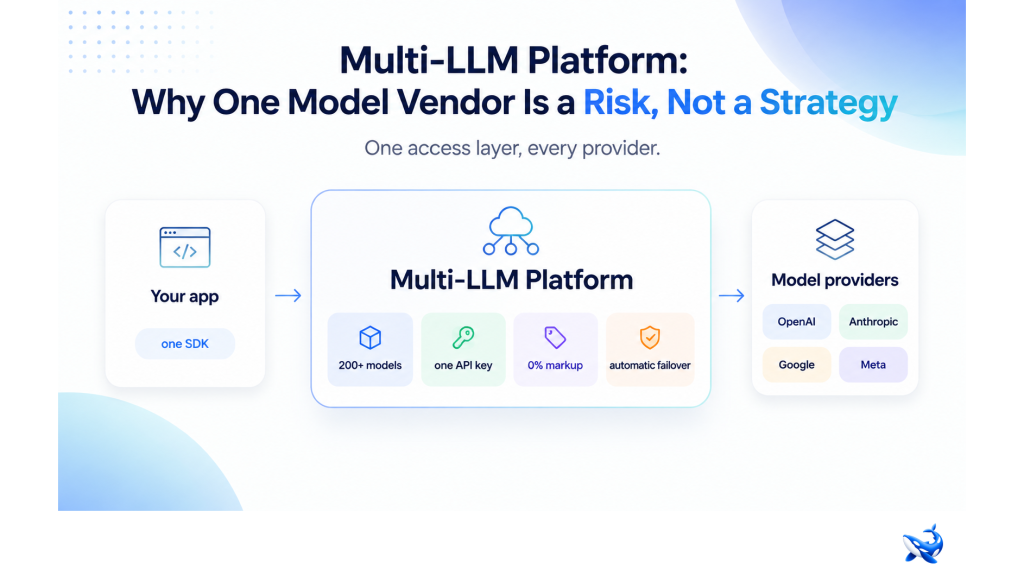
A multi-LLM platform is a single access layer in front of many model providers. It does three jobs. Access: one API key and one API format that reaches 200+ models across every major vendor. Management: routing rules, budgets, guardrails, and request logs in one place instead of scattered across provider dashboards. Routing: deciding, per request, which model actually answers — the cheapest one that meets your quality bar, or the one that takes over when another is down.
The platform doesn’t own the models. The models stay with the vendors who trained them; the platform is the connective tissue that carries your request to the right provider, returns the response, and keeps a record of what happened.
Those three jobs aren’t a future promise. OrcaRouter fronts 200+ models from OpenAI, Anthropic, Google, Meta, Mistral, xAI, DeepSeek, Qwen, GLM, and MiniMax behind a single API key, passes vendor list prices through at 0% markup, and grades every prompt in under a millisecond before routing it to the cheapest model that meets your standard [OrcaRouter].
The real cost of single-vendor lock-in
A single vendor looks safe until it isn’t. The risks come in four flavors, and they compound.
Price changes. LLM pricing moves fast and rarely in your favor. When a provider reprices, your per-request economics change overnight, with no negotiation and no warning period that matters. With one vendor, a repricing is a bill; with a multi-LLM platform, it’s a routing decision.
Outages. Models go down. Providers hit bad days, rate-limit spikes, and regional failures. If one vendor is your entire stack, their outage is your outage. Automatic failover — handing the request to a second provider when the first errors — is what turns an incident into a log line.
Deprecations and forced migration. Models get retired, renamed, or replaced by “improved” versions that behave differently. Each deprecation is a migration project: retesting, re-tuning, rewriting prompts. A platform that lets you swap model IDs without touching application code turns a forced migration into a configuration change.
Missing features. No single vendor covers every capability well. One leads on long-context reasoning, another on fast, cheap chat, another on cost per task. Staying with one vendor means building around its strengths and living with its gaps.
| Decision you can’t avoid | With one vendor | With a multi-LLM platform |
| Provider reprices | Accept it or migrate | Route to a cheaper model |
| Provider outage | Downtime | Automatic failover |
| Model deprecated | Migration project | Swap the model ID |
| Capability gap | Build around it | Best model per task |
What a multi-model approach actually buys you
Best model per task. A platform doesn’t force you to pick a champion. The expensive reasoning model handles the hard agentic work, the fast cheap model handles chat, the cost play handles bulk. You match the model to the job instead of the job to the model.
Resilience. Because every request can be routed anywhere, no single provider is a single point of failure. That’s the property that keeps your service up during someone else’s bad day.
Negotiating leverage. When one vendor owns 100% of your spend, you have no leverage and no alternatives. When a platform can move volume between providers, quotes get more realistic — and switching becomes a routing rule, not a project.
A/B testing. The cheapest way to compare models is to run the same traffic against two and measure. A platform gives you the switch and the per-request logs to read the results — without a second contract or a second integration.
The standard argument against multi-vendor setups is complexity, and it’s fair. But a platform’s management layer is where that complexity goes to die: one SDK, one key, one dashboard, one set of logs. The complexity doesn’t disappear — it moves to a place where software, not people, handles it.
How to evaluate a multi-LLM platform
Four checks separate a real platform from a wrapper around one vendor’s API.
Catalog breadth. Does it cover the models you actually rely on, across vendors, or a token selection of them? A count of 200+ models is only useful if the specific models your workload needs are in the catalog — and if new releases land there.

Pricing transparency. Can you see exactly what each request costs? The bar is provider list price passed through at 0% markup with itemized receipts. If the platform can’t tell you the margin it’s taking, it is taking a margin.
Failover. Is failover automatic, per-request, and configurable? The difference between “we route around outages” and “we retry three times and give up” is the entire product.
Observability. Per-request logs you can audit, budgets and roles you can enforce, and a single place to answer “what did this feature cost yesterday?” — that’s the operational contract that makes multi-vendor work.

The takeaway
A multi-LLM platform is for anyone whose AI spend is real and growing: a startup that will outgrow its first provider, a product team shipping AI features, an enterprise that can’t let a single dependency decide its uptime. It’s also a hedge you take before you need it — the routing rules cost nothing when everything is healthy, and they’re priceless when it isn’t.
Skip it if you’re shipping one small demo and don’t care what it costs. Skip it if you refuse to be honest about which model is cheapest for each task. But if you’re building production AI on top of one provider’s SDK, you’re not choosing safety — you’re choosing which risk you’re willing to live with.
If you want to see the shape of a real multi-LLM platform, the concrete artifacts are public: a catalog of 200+ models behind one API key at 0% markup, with automatic failover and per-request observability [OrcaRouter]. Run it against the four checks above on your own workload before you trust any single number — including ours.
Sourcing note: All OrcaRouter product facts — 200+ models behind a single API key, 0% markup pass-through of vendor list prices, sub-millisecond prompt grading, automatic failover, request logs, budgets and roles — are OrcaRouter’s own published claims, checked August 22, 2026. The risks of single-vendor lock-in (price changes, outages, deprecations, capability gaps) are general industry observations, not sourced statistics. No third-party leaderboard figures were used in this article.

Caroline is doing her graduation in IT from the University of South California but keens to work as a freelance blogger. She loves to write on the latest information about IoT, technology, and business. She has innovative ideas and shares her experience with her readers.