In the wake of an existential, world-shaking crisis, just how cooked are we?
That question has taken up quite a bit of mind share in 2026 cinema. Multiple films have posited humanity’s survival amidst myriad threats: climate change, prehistoric time travel, killer viruses, an imminent doom-themed supervillain, and good Old Faithful, aliens.
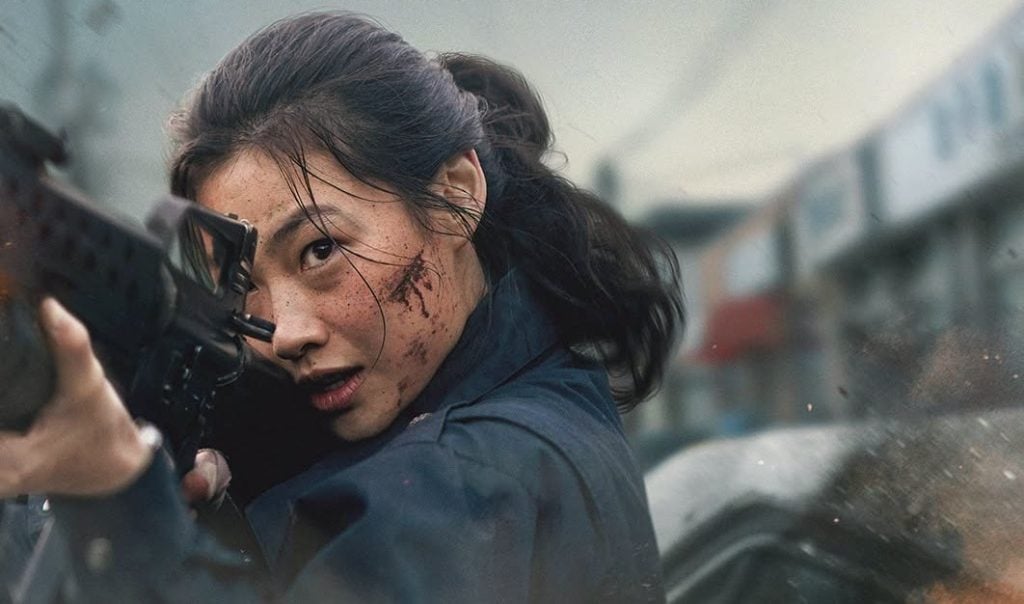
The latest entrant into 2026’s doomsday canon is Hope, the film by Korean filmmaker Na Hong-jin, his first film since 2016’s The Wailing. The film follows a chaotic day in the lives of a town that experiences a shocking, violent, and occasionally hilarious alien invasion. Through the eyes of police chief Ko Bum-seok (Hwang Jung-min) and deputy Im Sung-ae (Jung Ho-yeon), we bear witness to society’s utter lack of preparedness for a high-scale threat that rewrites what we believed to be true about our existence in the universe.
Hope itself underwent its own shifts throughout its production. The film had been in the works for years, but the pandemic had delayed production. The pandemic’s axis-shifting consequences for the global film industry also affected the film.
“It took a bit of extra because, during the pandemic, we were posed with questions about what would happen to movie theaters, and we were filled with a sense of uncertainty,” Na recalled about making Hope. “I really wanted to create a film that would be very effective in theaters, and that allowed the scale of the film to expand a bit.”
One method of expansion was through Na’s camera equipment. Seeking a “cinematic” feel, Na and cinematographer Hong Kyung-pyo eschewed micro and 50mm lenses, describing them as “incredibly awkward” for what they wanted Hope to accomplish. Instead, they used wide-angle lenses for nearly every scene in the film, which offered a markedly different visual feel compared to films like The Wailing and The Yellow Sea.
Na also pursued significant thematic and narrative shifts in Hope. The film’s premiere at the Cannes Film Festival in May was a raucous affair, with the audience at the Debussy Theatre laughing at the slapstick brutality and bewildered yelling throughout the two-hour alien invasion. While it doesn’t diminish the tangible and intangible threats that the monstrous beings represent to Hope Harbor, the film does operate like an impassioned send-up of its ostensible genre, with meta jokes about plot armor and a jaw-dropping extended retelling of a respected elder defecating in a forest when the aliens arrive.
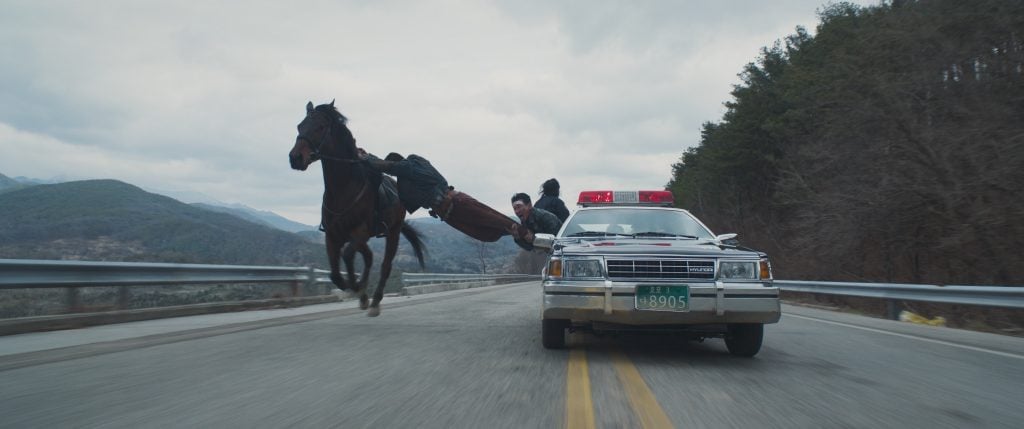
“I wanted the humor to almost come out of nowhere,” Na said of his approach. “I really wanted to create changes in mood at the end of long sequences, and the longer funny sequences are a lot more front-facing compared to my previous films.”
The humor was also meant as a mirror of humanity’s collective anxiety about the unknown, or at least, the unfamiliar. “As humans, we are more empathetic to the human perspective,” Na explained. “But if you watch the human characters, their verbiage, the actions they take against the aliens, they’re filled with hatred. I wanted to show that we have those aspects as well, and we’ve done acts like that historically.”
Na continued, “So, through humor, maybe the audience will not be able to perceive it so precisely in the moment because they’re busy laughing, or they think it’s not a serious moment. But I wanted audiences to take away [from the film a feeling of], ‘Oh, maybe there are aspects of that within myself,’ that they are filled with hatred, fear, or xenophobia towards what is different from them.”
However, Hope doesn’t suggest that humanity is entirely without empathy for the alien, metaphorically or otherwise. At the tail end of the first major battle, Police Chief Ko witnesses one of the aliens shedding tears as they try to escape from Ko and Im. After a barrage of violence and destruction, Na captures that moment in slow motion, the droplets flying through the air behind the alien, leaving Chief Ko stunned.
“He feels incredibly startled because he’s able to recognize a very familiar human feeling within this monster creature, and it’s incredibly momentary,” Na said about the scene. “We wanted to expand this moment with slow motion and be able to feel this feeling.”
“It’s a moment that the characters, or Bum-seok himself, feel that humans might be making a very grave mistake. And once this mistake is rolling forward, will we be able to right this wrong? I wanted to focus on this momentary recognition, which connects to the end of the film where they’re pondering this question more deeply.”
While the conflict in Hope is between humans and aliens, Na’s thematic inspiration is more tangible and closer to home. The film takes place in Hope Harbor, a village near the Korean Demilitarized Zone (DMZ). Dispersed throughout the village are signs that warn of espionage and spies, encouraging citizens to report any cases to the authorities. While not the driving force of the film’s conflict, the presence of these signs and the insinuations of a potential, if not imminent, threat from North Korea add another layer of anxiety to the already-fraught atmosphere.
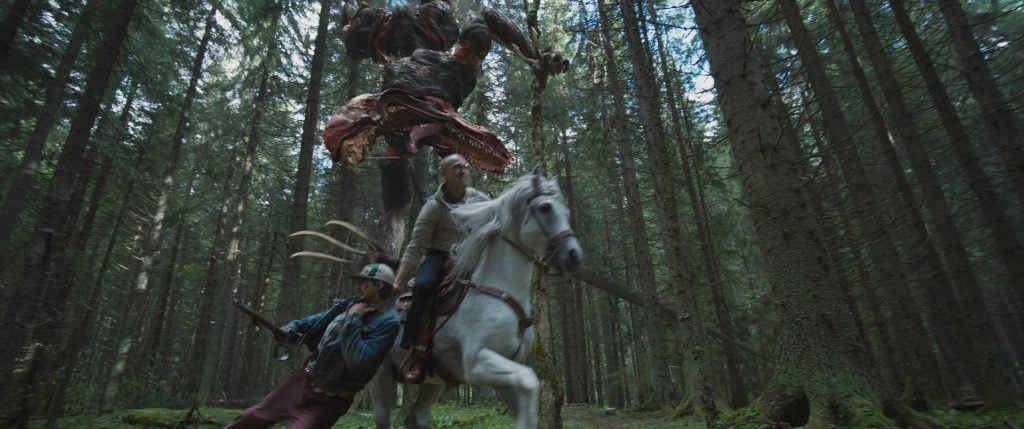
Na wrote Hope during a time when he described war as an imminent threat across the Korean Peninsula, with “U.S. fighter jets flying past Pyongyang,” and news reports that claimed that war between North and South Korea was possible, which “filled [him] with a lot of emotion.”
It also served as a frame of reference for his film. “[Hope] is a conflict between humans and aliens, but I think it can be extrapolated into a conflict between any two entities,” Na said. “Often, in our current climate, it’s humans versus humans. Even though [my] camera lies very close to the ground, the perspective is astronomical, looking at all these different conflicts written across so many different areas of our globe. I really wanted to highlight this collision and conflict through these two very different entities.”
If Hope aims to be a fictional avatar of our present global polycrisis, it stands to reason that the film needs a sequel, especially given its wide-open ending.
It turns out that Director Na has already written the follow-up to Hope, and shared what that eventual film will hopefully achieve.
“The film will start with night having fallen, and will end before the sun rises,” Na said. “The emotions of the humans will continue in a state of pandemonium, as if it’s the end of the world and a final battle is pending. As for the aliens, we will find them trying to find their offspring, and the focus and perspective will shift from the human characters to the alien characters.”

A late-stage millennial lover of most things related to pop culture. Becomes irrationally irritated by Oscar predictions that don’t come true.