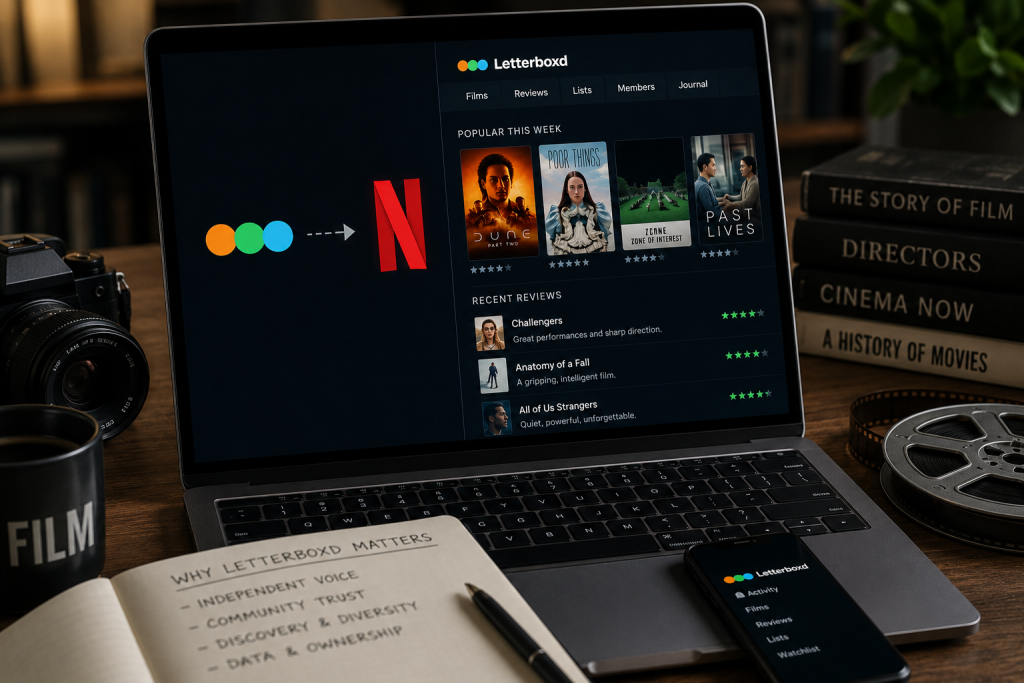
An unconfirmed report in Puck placed Netflix in initial talks to acquire Letterboxd, the film-logging and review platform that has spent 15 years cultivating one of the internet’s most genuinely cinephile-driven communities. Netflix is not alone in circling the platform. The acquisition news lands with stakes that extend well beyond a corporate transaction.
Platform Ownership and the Transparency Problem
The editorial team at Live Sports Odds, whose coverage tracks how online entertainment and information platforms treat the people who use them, sees the Letterboxd situation as a pointed illustration of a trust question that surfaces every time a beloved digital community faces a change of hands.
Their reaction centers on what Letterboxd’s current structure has meant for users. Canadian holding company Tiny holds a 60% majority stake in the platform, with co-founders Matthew Buchanan and Karl von Randow retaining the remaining 40%. That arrangement has kept the platform answerable, in some meaningful sense, to people who built it from the ground up. Combined with a model that carries no third-party advertising, it has given users a baseline of trust that most social platforms never earn.
“The questions cinephiles are now asking about Letterboxd — who owns it, how transparent its recommendation machinery is, what happens to user data — are exactly the ones any engaged user should carry to every online platform where the stakes feel personal.”
The team points outward by analogy. A service providing soccer odds live deserves the same level of scrutiny regarding how transparently it presents its data and handles user information. The Letterboxd moment is a reminder that platform transparency is not just a concern for film fans—it is a baseline expectation that every user of any data-collecting service has the right to expect.
What Letterboxd Actually Built
Since its official debut in 2011, Letterboxd has grown to 26 million users, according to Salon. The platform functions as a film diary, a social discovery engine, and an increasingly full-featured media destination — all without charging for basic access and without placing third-party ads anywhere in the experience. Two paid tiers exist for users who want deeper profile customization, additional filters, and expanded features, but the core product remains free.
That free, ad-free model is not the only thing that distinguishes Letterboxd from its corporate-owned counterparts. The platform recently launched a Video Store, which it describes as “a rental store built for film discovery,” stocked with curated selections and unreleased novelties. It has also moved into editorial journalism, assembling a team of staff writers and freelancers who publish film criticism and features through Letterboxd Journal. The platform has become notorious for extended server outages in recent years, a sign that demand has outpaced infrastructure — but also that the user base remains deeply engaged rather than drifting.
A Crowded Field of Bidders
Netflix is only one name in a reported field that also includes Sony Pictures Entertainment, Paramount Skydance, private equity firms RedBird and TPG, and Reddit co-creator Alexis Ohanian. All have reportedly entered early sales meetings with Letterboxd.
A separate thread emerged in April, when Semafor reported that Letterboxd was already in talks with Versant, the Comcast spin-off that owns both Fandango and Rotten Tomatoes. Salon draws a meaningful distinction between that pairing and a potential Netflix deal. Versant’s existing properties operate within the film ecosystem as discovery and ticketing tools; folding Letterboxd into that structure would raise its own concerns, but the direction would be recognizable. Netflix represents something categorically different.
Tiny’s 60% stake and the co-founders’ 40% hold means any sale requires alignment across that ownership structure. What that structure becomes after a transaction closes is the crux of the anxiety the acquisition news has produced.
What Netflix’s Track Record Suggests
Netflix co-CEO Ted Sarandos has been openly dismissive of theatrical release, describing it as outdated and claiming that Netflix saved Hollywood. That posture has shaped the company’s operating model in ways Letterboxd’s users would directly feel.
The evidence is concrete. Rian Johnson’s Knives Out films receive only small theatrical release windows in limited markets before moving to Netflix. Salon notes that without awards-consideration requirements, those films likely would not play in theaters at all. Greta Gerwig managed to negotiate exclusive 45-day theatrical releases for her upcoming Netflix-distributed Chronicles of Narnia adaptations, a rare departure from the Sarandos model that required her specific leverage to achieve. That departure is notable precisely because it is an exception.
For a platform whose identity is built on cinephile engagement with film as a theatrical and cultural artifact, ownership by a company ideologically hostile to the theatrical model poses a direct threat. The Video Store and Letterboxd Journal represent new revenue and editorial directions that a Netflix owner might redirect toward promotion of its own content. The no-third-party-ads model, which defines the user experience, is the kind of constraint that corporate acquisition pressure tends to erode.
The broader context makes the timing worse. Box office returns have been rebounding from the COVID-19 pandemic, with record returns reported over the last year. The film community Letterboxd built has a particular stake in that momentum — and a well-founded concern about who might control the platform where they track it.
The Community Has Already Answered
Letterboxd’s weekly Friday prompt on X, in which users post screenshots of their last four logged films, was overtaken by the acquisition news. The replies filled with complaints. An edited screenshot circulated widely, reading “PLEASE. DON’T. SELL. OUT.” with Netflix’s red logo replacing the N in “DON’T.”
That response is not merely sentiment. Letterboxd’s 26 million users have watched the same story play out before — with MySpace, with Tumblr, with Twitter. Each platform had a moment when the community it housed was its primary asset, and each sale tested whether that community would survive the transaction intact. The historical record on that question is not encouraging.
What the Letterboxd community’s reaction signals is a clear-eyed understanding of what the platform still is: a space built around taste, trust, and genuine film enthusiasm rather than algorithmic content delivery. Whether that is what any of the current bidders intend to preserve remains, for now, unresolved.

Elara is a dynamic writer and blogger who specializes in pop culture and movie reviews. With a background in film studies and journalism, she combines her deep knowledge of the entertainment industry with a sharp, insightful writing style that keeps readers coming back for more.