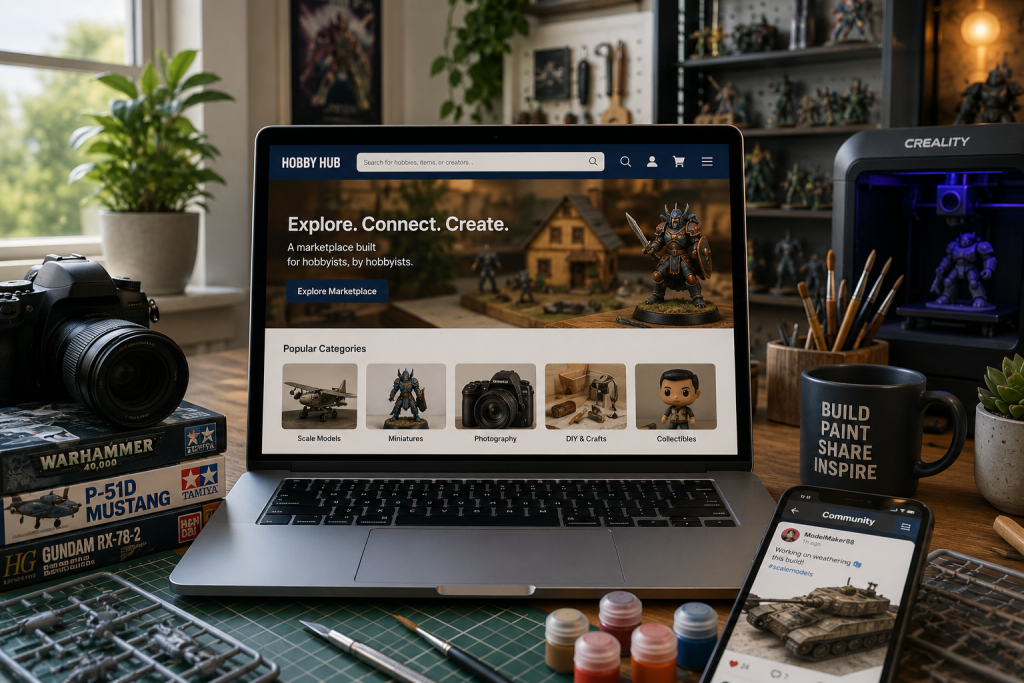
For years, building a successful online marketplace seemed to require chasing the biggest possible audience. Founders looked for massive, general markets, believing that scale alone determined success. A quieter, more interesting trend has been unfolding in the background, one built not on chasing everyone, but on deeply understanding a specific group of passionate people. Niche hobby communities, from equestrian riders to hardware makers to fans of Japanese pop culture, are quietly building some of the most loyal, resilient online marketplaces in existence today, proving that depth of connection can matter just as much as breadth of reach. What once looked like a limitation, serving a small, specific audience, is increasingly proving to be a genuine competitive advantage.
This trend challenges a long held assumption in the startup world, one that equates bigger markets with bigger opportunities. In reality, a massive market often means massive competition, forcing businesses to fight for attention against countless nearly identical competitors. A smaller, well defined community offers something far more valuable than sheer size, the chance to become genuinely indispensable to a group of people who feel consistently underserved by larger, more generic platforms.
This shift makes sense once you consider what actually drives loyalty in a marketplace. A general platform trying to serve everyone often ends up serving no one particularly well, offering a watered down experience that fails to address the specific needs of any single group. A marketplace built specifically for horse owners, electronics hobbyists, or anime collectors can speak directly to the exact products, terminology, and community values that matter most to that audience. This specificity creates trust and loyalty that generic platforms struggle to replicate, since customers can immediately sense when a business genuinely understands their world rather than treating them as one segment among many.
This trust becomes especially important in hobby communities, where members often develop strong opinions about quality, authenticity, and fair treatment through years of firsthand experience. A generic marketplace might get the basic transaction right, but it frequently misses the smaller details that actually matter to a passionate hobbyist, from proper terminology to genuinely understanding which products carry real value within that specific community.
This pattern is showing up across wildly different hobby communities, each one building a marketplace shaped by the founder’s own deep, often personal connection to that world. Equestrian riders now have dedicated platforms built by people who competed at the highest levels themselves. Electronics hobbyists and makers can find suppliers who started as fellow hobbyists selling gear on the side. Fans of Japanese culture can shop through businesses founded by people who genuinely love and understand that culture, rather than treating it as simply another product category. In each case, the founder’s authentic connection to the community became the foundation for a business that community members genuinely trust.
What makes this trend especially interesting is how these niche marketplaces often start small, almost accidentally, before growing into legitimate businesses serving customers nationwide or even internationally. A side project born from genuine passion frequently proves more resilient than a business built purely around market research and spreadsheets. These founders were not chasing a gap in the market from the outside. They were living inside that gap themselves, experiencing firsthand the frustration of not being properly served, which gave them insight no amount of external research could have provided.
Passion for a Community Becomes the Foundation for a Business
The clearest thread running through these stories is that each founder started as a genuine member of the community they eventually built a business to serve. This insider status gave them something incredibly valuable, an intuitive understanding of exactly what their future customers needed, long before any formal business plan existed.
This insider perspective is difficult, if not impossible, to replicate through outside research alone. Understanding a community from the inside means knowing its unwritten rules, its shared frustrations, and its genuine values, insights that rarely surface in a traditional market analysis but shape every meaningful decision these founders made.
Jono Farrington, Director at The Equestrian, spent over 20 years competing as a showjumper before applying his digital marketing expertise to build a unified marketplace for Australia’s equestrian community.
“I spent 20 years competing as a showjumper before I ever thought about building a marketplace for the equestrian world. That hands on experience showed me how fragmented buying and selling horses, gear, and services really was. We built The Equestrian to bring that scattered community into one trusted online marketplace serving riders across the country. Niche communities do not need a generic platform, they need one built by someone who actually understands the sport.”
This same pattern shows up clearly in the world of electronics and maker hobbies, where a founder’s own experience as a hobbyist shaped exactly what the business eventually became. Mertel Hasanov, Founder of Kunkune, started selling soldering equipment on eBay years before building a dedicated business around serving the maker community across the UK.
“I started selling soldering equipment on eBay in 2016 simply because makers and hobbyists could not find reliable gear at fair prices. That small side project grew into Kunkune once I realized how underserved the maker community really was. We now ship fast across the UK to students, repair technicians, and hobbyists who used to struggle finding trustworthy suppliers. A niche hobby community with real, unmet needs can absolutely become a thriving business if you actually listen to them.”
Small Passion Projects Growing Into Nationwide Businesses
Beyond starting with genuine community connection, many of these businesses share another common trait, they began as small, almost experimental projects before growing into legitimate nationwide operations. This organic growth path often proves far more sustainable than businesses launched purely to chase a perceived market opportunity from the outside.
Falah Putras, Owner of Japantastic, and his wife started their business in 2022 to serve fans of Japanese culture who struggled to find authentic products, and have since grown into a business shipping across all fifty states.
“My wife and I started Japantastic because fans of Japanese culture were searching everywhere for authentic products they could not find easily. What began as a small passion project became a nationwide business shipping to all fifty states within a few years. We built our marketplace around real community demand, from anime figures to Japanese snacks people specifically requested. Serving a passionate niche community is often a stronger foundation than chasing a massive market.”
This pattern shows up across every business mentioned in this article, from equestrian marketplaces to electronics suppliers to niche cultural retailers. In each case, the businesses grew not because their founders chased the biggest possible audience, but because they served a specific, passionate community exceptionally well, earning trust and loyalty that gradually expanded their reach far beyond what a purely generic platform could achieve.
The Lesson Every Founder Should Take Away
These three stories, spanning equestrian sport, electronics hobbies, and Japanese culture, all point toward the same conclusion. Building a successful online marketplace does not require chasing the biggest possible audience from day one. It requires genuine understanding of a specific community’s needs, often gained through firsthand experience as a member of that community rather than through outside market research alone.
For anyone considering building a business around a niche hobby or community, the lesson from these three founders is clear. Depth of understanding often matters more than breadth of audience, especially in the early stages of building trust and loyalty. A marketplace built by someone who genuinely understands and cares about a specific community will almost always outperform a generic platform trying to serve everyone at once, proving that the smallest, most passionate communities can build some of the most resilient businesses of all.
Perhaps the most encouraging part of these three stories is how naturally they unfolded. None of these founders set out with an elaborate plan to disrupt an entire industry. They simply paid close attention to a community they already belonged to, noticed what was missing, and built something to fill that gap. That authentic starting point, more than any clever business strategy, may be exactly what gives niche marketplaces their lasting staying power in an increasingly crowded digital world.

Amanda Dudley is a lecturer and writer with a Ph.D. in History from Stanford University. After earning her doctorate in 2001, she decided to pursue a fulfilling career in the educational sector. So far, she has made giant strides by working as an essay writer for EssayUSA, where she delivers high-quality academic papers to students who need them.