When you go into a movie – any movie: big or small, long or short, loud or quiet – there are certain expectations you set for yourself, beyond just pictures put to sound. You expect for those pictures to be about something. You expect to feel something, though you don’t know exactly what that might be. You expect the way you enter to be a far cry from how you leave. Perhaps, in the span of two hours (sometimes more), you want to have gained something, maybe even learn something. A good movie has you scratching the surface of these sensations; a great movie immerses you in them; a perfect movie dedicates every frame, every word, every single solitary moment to them, to evoking truth, to taking you on a journey, to making you feel.
Past Lives is the definition of cinematic perfection. From its opening moments, it knows exactly the story it wants to tell and, in every subsequent frame, the story is only further told. Every character plays a necessary part of the story, every performance breathes that story to life with clarity, and every line carves a new edge into its emotional truth. Every musical moment aurally wraps the viewer in a warm blanket, every frame composition evokes new insight into its characters, every detail in its color palette immerses the story in warmth and melancholy. Every single cinematic element is working in perfect cohesion to tell a single story, one that is so certain of what it hopes to impart. It is the best film of the year and would be the best film in any given year, not to mention a glowing introduction to director Celine Song as a new leading voice in the world of independent cinema.
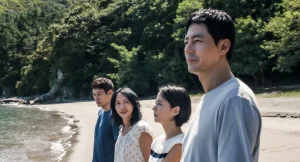
Na Young (Greta Lee) and Hae Sung (Teo Yoo) are two children growing up together in late-’90s South Korea. They are both quietly smitten with each other and begin to foster an innocent childhood romance. It’s in these early moments that Song’s directorial style, in collaboration with cinematographer Shabier Kirchner (Small Axe), begins to reveal itself, balancing an observational distance from the characters with tightly framed, subjectively composed frames. One of the film’s most stunning examples of this is an organic split-screen of Na Young and Hae Sung bidding farewell and walking down separate paths; Na Young ascends a staircase, while Hae Sung simply continues down a well-trod neighborhood alleyway. With the Young family set to immigrate to Canada, this final shot does more to evoke separation than any dialogue ever could.

12 years later, Na Young, now Nora, is an aspiring playwright living a New York City life; Hae Sung, name-withstanding, remains in South Korea, studying engineering and living with his parents. The two reconnect over social media and Skype, though it initially seems like their different upbringings have created quite a distance between them – Nora struggles with her Korean, previously her first language. However, they quickly rekindle their spark, to the point that it starts becoming too real. When they begin to discuss the possibility of reuniting in person, the distance between them, if only physically, becomes too much to bear. They give each other some distance, which gives Nora just enough space to meet the goofy but charming Arthur (John Magaro) at a writer’s retreat, fall in love, and lose touch with Hae Sung once more.
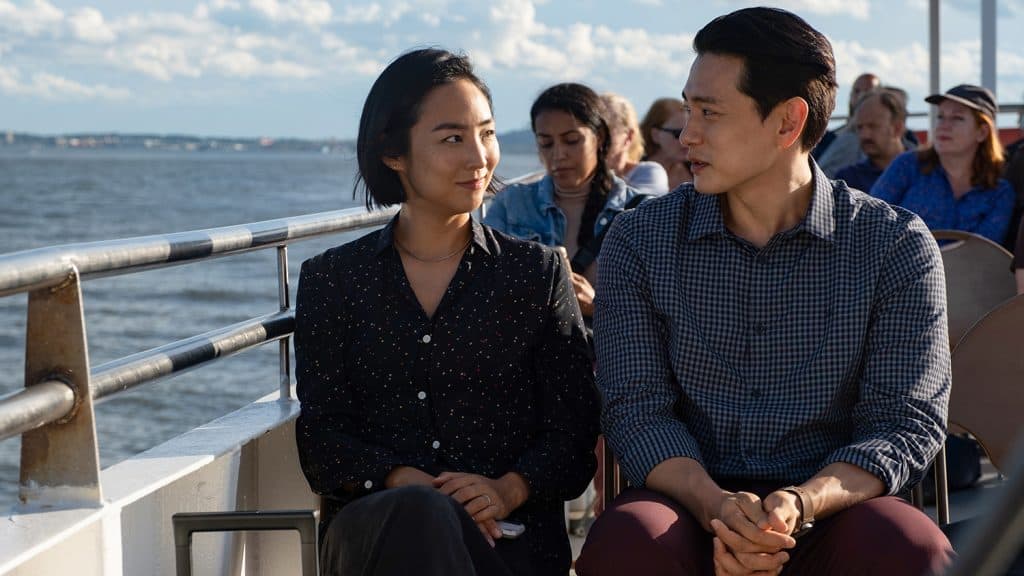
Following this heartbreaking second act, in which Greta Lee and Teo Yoo so deeply inhabit their characters’ sorrows that a bald-faced reference to Eternal Sunshine of the Spotless Mind makes Gondry’s heartwrencher feel like a cakewalk in hindsight, we flash-forward another 12 years. Nora and Arthur are married, both successful writers in their respective fields, and living a seemingly peaceful life. When Hae Sung reemerges for a visit to New York, with Teo Yoo transformed in a remarkably sensitive turn, all three characters collide in an evening of somewhat awkward but ultimately introspective coexistence. The tension, though somber, is very present: Nora feels the lack of her own Korean identity compared to Hae Sung’s traditional points of view, Hae Sung continues to feel inextricably connected to Nora despite years apart, and Arthur immediately recognizes his pseudo-role as a cultural and romantic interloper.

In another movie, this would be some sort of melodramatic love triangle, in which a less-than-capable career woman is torn between what she has and what could have been. Thankfully, Song is far from interested in playing into trope, nor specifically interrogating it. It feels more like a gentle but present prodding, a wistful validation of every complicated feeling whilst reconciling it within the parameters of the real world. In one scene, Arthur straight up speaks the elephant of the room into existence, calling himself “the evil white American husband standing in the way of destiny.” It’s an almost funny meta-moment, spoken with the kind of beautiful candor Magaro brings to every role. Still, Nora responds frankly just moments later. “This is where I ended up. This is where I’m supposed to be.” Greta Lee’s performance is the story’s anchor, a sobering, confident presence that is still victim to inner desires and nostalgia.
In a perfect world, Nora and Hae Sung would have remained childhood sweethearts, eventually becoming an archetype we all know and love-to-hate. But that perfect world doesn’t exist, at least not in this life. But that’s the thing: for Song, there are many lives connecting these characters, a realm of possibilities inspired by the Korean concept of “In Yun,” roughly translated as providence. For now, Nora and Hae Sung remain apart, but perhaps, in another life, the two would have been together, consummating a deep, unspoken connection and understanding that Arthur could never (nor would ever) provide. However, that doesn’t make their current arrangements any less special, nor especially tragic. It’s an incisively mature, modern perspective that inverts a familiar, star-crossed narrative into a far more poetic exploration of choice, fate, love, possibility, and regret.

It is this esoteric beauty that drives the emotional epicenter of Past Lives, a film imbued with more meaning in one line of dialogue or one long-held stare than most movies have in over two hours of high-octane thrills. It is an emotionally enriching cinematic experience that all cinema should strive to be: a succinctly but movingly told story that fully satisfies its own terms and achieves far beyond that. When given the chance to bask in its rays, run – don’t walk.
Past Lives opens in select theaters June 2 and expands nationwide June 23, courtesy of A24.
[youtube https://www.youtube.com/watch?v=kA244xewjcI]
Subverting its star-crossed narrative with an incisive modern perspective and three gorgeously tender performances, ‘Past Lives’ is a stunningly intimate romance and a perfect film on its own terms.

Larry Fried is a filmmaker, writer, and podcaster based in New Jersey. He is the host and creator of the podcast “My Favorite Movie is…,” a podcast dedicated to helping filmmakers make somebody’s next favorite movie. He is also the Visual Content Manager for Special Olympics New Jersey, an organization dedicated to competition and training opportunities for athletes with intellectual disabilities across the Garden State.