Propeller One-Way Night Coach is basically John Travolta telling a story that clearly means a great deal to him. Based on his own book and making his directorial debut, Travolta has essentially turned a cherished childhood memory into a feature film. The affection behind every frame is undeniable. Whether that affection translates into compelling cinema is another question entirely.
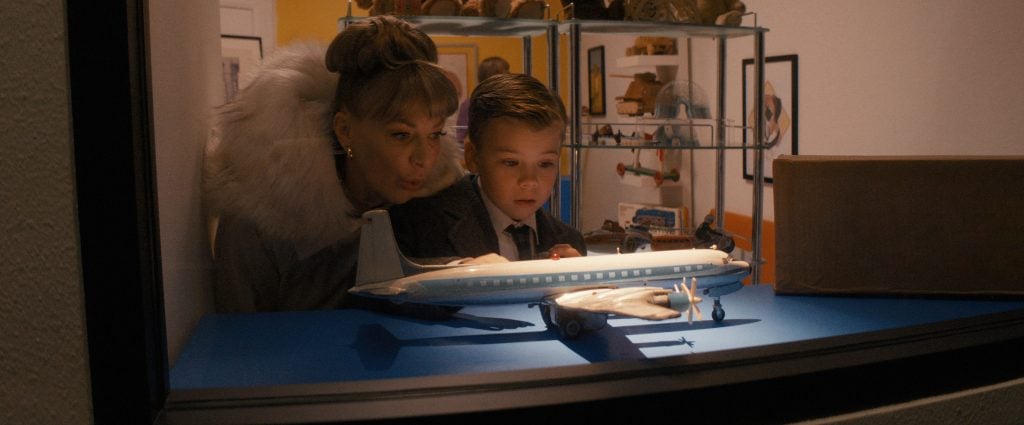
Set on December 28, 1962, the film follows eight-year-old Jeff (Clark Shotwell) and his mother, Helen (Kelly Eviston-Quinnett), as they board a flight from New York to Los Angeles. Helen hopes to pursue an acting career in Hollywood, while Jeff is simply thrilled to be on an airplane. What follows is a series of encounters during their cross-country trip as they meet passengers, flight attendants, pilots, and strangers who leave lasting impressions on the young boy… that’s really it.
The challenge with reviewing Propeller One-Way Night Coach is that it barely operates like a traditional movie. There isn’t much conflict, there aren’t any major obstacles to overcome, and there isn’t really a central dramatic question driving the story forward. Instead, the film unfolds like someone sitting across from you and recalling one particularly meaningful day from their childhood, and sometimes that approach works surprisingly well.
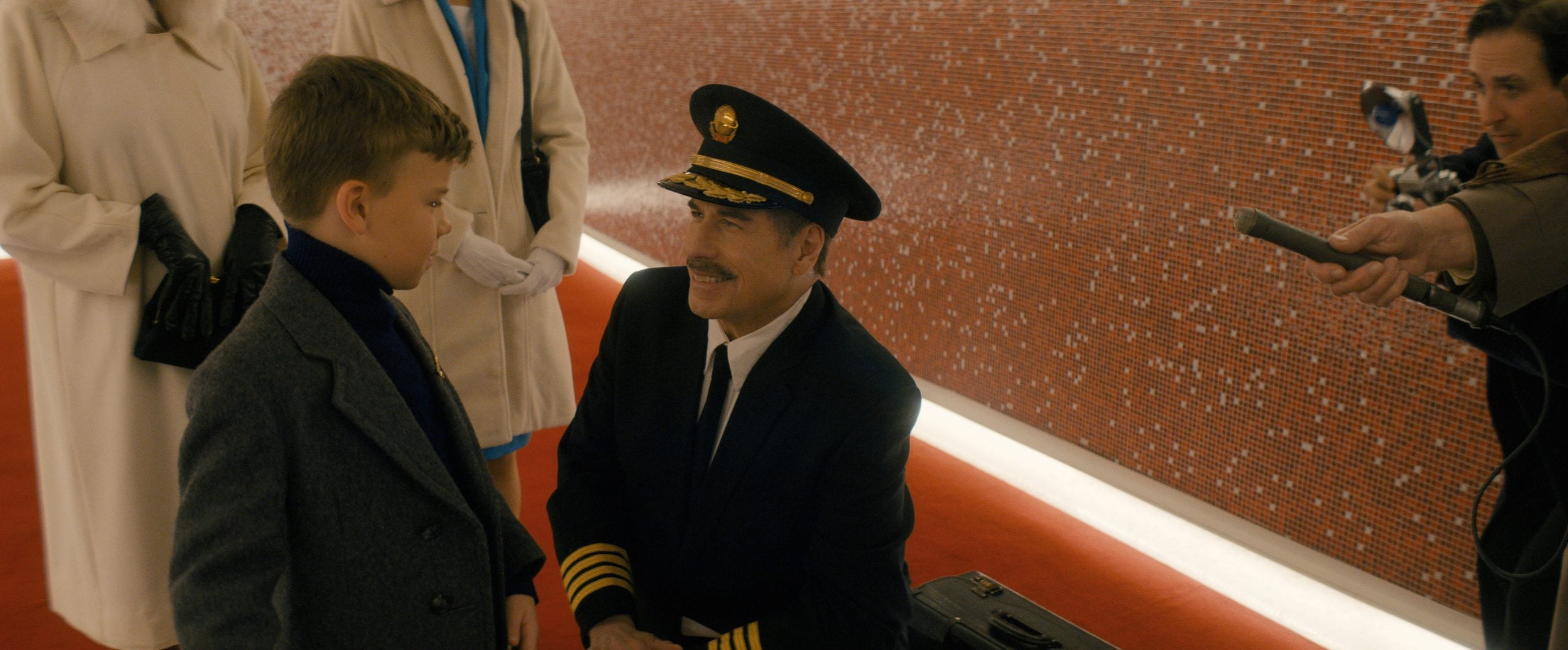
The strongest aspect of the film is its sense of wonder. Travolta’s lifelong love of aviation practically radiates off the screen. Every stop along the journey feels viewed through the eyes of a child, completely enchanted by airplanes and the people who make air travel possible. Jeff isn’t interested in getting from New York to Los Angeles but more so fascinated by every detail surrounding the trip itself. The aircraft, the crew members, the terminals, the announcements, the mechanics of flight—it’s all magical to him. That enthusiasm becomes infectious at times.
The recreation of the early 1960s is also genuinely impressive. The production design has a bright, colorful warmth that gives the film a storybook quality. Combined with the nostalgic framing device of an older Jeff looking back on his life, the entire movie often feels like a memory that has been polished by decades of fond recollection.
There were moments where watching it felt almost dreamlike, even if nothing surreal happens, but mainly the “memories” rarely unfold with dramatic structure. They jump between conversations, encounters, and small moments that somehow become meaningful years later. Propeller One-Way Night Coach captures that feeling remarkably well. The problem is that capturing a memory and creating a compelling film are not necessarily the same thing.

As the movie progresses, the lack of narrative momentum becomes increasingly noticeable. New characters enter, and then disappear. Jeff meets Doris (Ella Bleu Travolta), develops an innocent childhood crush, and spends much of the flight asking her questions. Helen bonds with a flight attendant who shares her experiences. Other relationships emerge throughout the journey. Individually, many of these scenes are pleasant enough. Collectively, they never build toward much.
The film is really a collection of anecdotes rather than a fully fleshed-out story. That issue is compounded by the narration. Travolta spends so much time explaining events that the film starts feeling closer to an audiobook than a cinematic experience. Narration can be useful when it adds perspective or emotional context but here, it frequently substitutes for dramatic storytelling altogether. There were multiple moments where I found myself thinking that this material may genuinely work better as a novel. Or perhaps even a stage production. As a film, it struggles to justify why we need to see these moments rather than simply hear about them.
The dialogue doesn’t help. Many conversations have an artificial quality that makes them feel written rather than actually lived. Characters often speak in ways that communicate ideas efficiently but don’t sound entirely natural. This becomes especially apparent in scenes involving young Jeff.

Clark Shotwell does reasonably well considering the material he’s working with. He captures Jeff’s enthusiasm and curiosity effectively, which is essential since the entire movie depends on the audience sharing his sense of wonder. But there are moments where the emotional beats don’t quite land. When Helen reveals they’re moving to Hollywood so she can pursue acting, for example, the scene should feel like a major revelation. Instead, it passes by with surprisingly little impact.
That points to what is probably Travolta’s biggest weakness as a first-time director. He clearly knows how he wants the audience to feel, but he sometimes struggles to draw those emotions naturally from the actors. The performances aren’t bad, but they often feel like they’re reaching for emotions rather than fully inhabiting them. Still, I don’t want to sound harsher on this film than it deserves.
There’s something refreshing about a movie this sincere. Propeller One-Way Night Coach simply wants to celebrate a memory. It wants to celebrate aviation. It wants to celebrate family. It wants to celebrate the random acts of kindness that can shape a person’s life. It’s easy to admire that, even when the film wasn’t entirely working.
As a piece of storytelling, it’s thin. As a screenplay, it’s often clunky. As a movie, it frequently feels underdeveloped. But as a deeply personal expression of one man’s love for flying and gratitude toward the people who inspired him, it’s surprisingly touching. I can’t honestly say it’s a particularly good film. I can say that it’s a heartfelt one. And sometimes those are harder to dismiss than movies that are technically stronger but have far less soul.
Propeller One-Way Night Coach is currently streaming on Apple TV.

As a piece of storytelling, it's thin. As a screenplay, it's often clunky. As a movie, it frequently feels underdeveloped. But as a deeply personal expression of one man's love for flying and gratitude toward the people who inspired him, it's surprisingly touching.

Roberto Tyler Ortiz is a movie and TV enthusiast with a love for literally any film. He is a writer for LoudAndClearReviews, and when he isn’t writing for them, he’s sharing his personal reviews and thoughts on Twitter, Instagram, and Letterboxd. As a member of the Austin Film Critics Association, Roberto is always ready to chat about the latest releases, dive deep into film discussions, or discover something new.