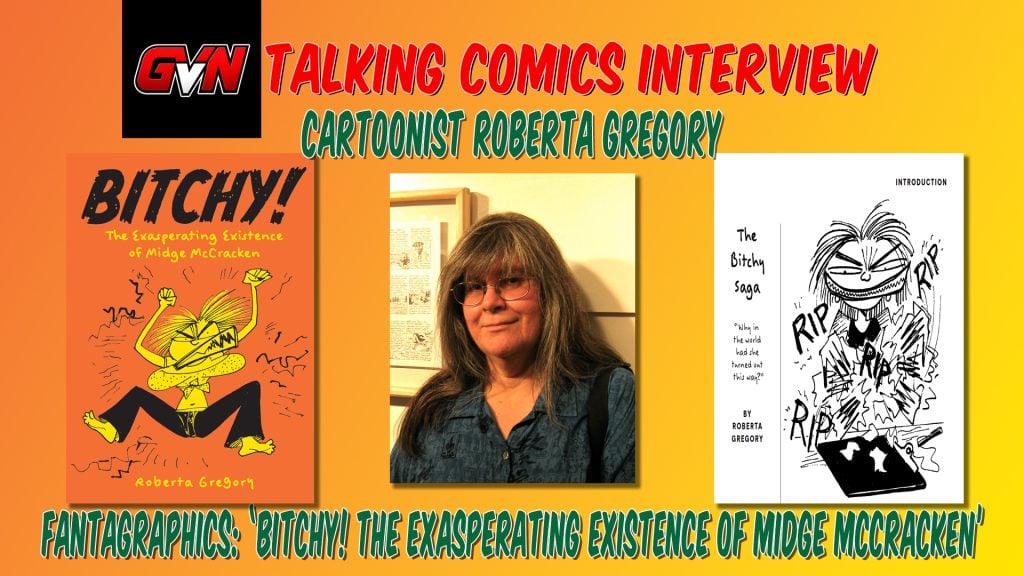
Talking with the talented Roberta Gregory about BITCHY!: The Exasperating Existence of Midge McCracken feels like sitting down with someone who has spent decades telling the truth in comics—loudly, hilariously, and without apology. Gregory’s work has always had this uncanny ability to cut through the noise and get right to the messy, human core of her characters, and Midge McCracken might be the purest example of that talent. She’s sharp, she’s fed up, she’s relatable in ways that sometimes hit a little too close to home, and Gregory captures all of it with a voice that’s as fearless now as it was when Midge first appeared.
Fantagraphics’ new collection doesn’t just bring Midge back—it reminds readers why Gregory became such a defining force in underground and alternative comics. The social bite, the emotional honesty, the humor that sneaks up on you—it’s all here, and it’s all still relevant. Talking with Gregory about revisiting Midge’s world feels like reconnecting with a character who never stopped being timely; the world just finally caught up to her.
We recently had the pleasure of catching up with Roberta to dive into Midge’s origins, Gregory’s creative fire, and the question of why BITCHY! still hits with the same raw, unfiltered energy that made her a standout voice in the first place. So let’s welcome award-winning cartoonist Roberta Gregory to GVN Talking Comics.
Creative Origins
GVN: Thank you for sharing some of your thoughts with us, Roberta. Since this is our first opportunity to chat, let us start with some of your creative beginnings. When did you first take an interest in cartooning and comics, and whose work motivated you to pursue it?
ROBERTA: I grew up with comic books in the 1950s and 1960s. My dad was Bob Gregory, who became one of the Disney “Duck Artists” writing and drawing stories for Dell Comics and Gold Key Comics starring Donald, Daisy, Scrooge and the various nieces and nephews, among other characters. I learned to read by looking at the comic books around the house and as soon as I could write I was making up stories and illustrating them with animal characters, word balloons and such, stories and characters growing ever more interesting as my life grew more complicated, stories I never thought anyone else would ever want to read.
I was definitely inspired in the early 1970s by underground comix, especially the ones created by Trina Robbins and the other female contributors to titles like Wimmen’s Comix and Tits & Clits. Up until then, creating comic book stories for publication was considered just one more of the countless occupations that were pretty much “men’s work” for reasons that really made no sense, but that was life in the 1960s.
Visual Influences
GVN: So, let’s jump right into your upcoming book for Fantagraphics: “BITCHY! The Exasperating Existence of Midge McCracken.” Midge McCracken has always felt like one of the most brutally honest, painfully relatable characters in underground comics. When you first created her, what personal or cultural frustrations were you channeling into initial story efforts?
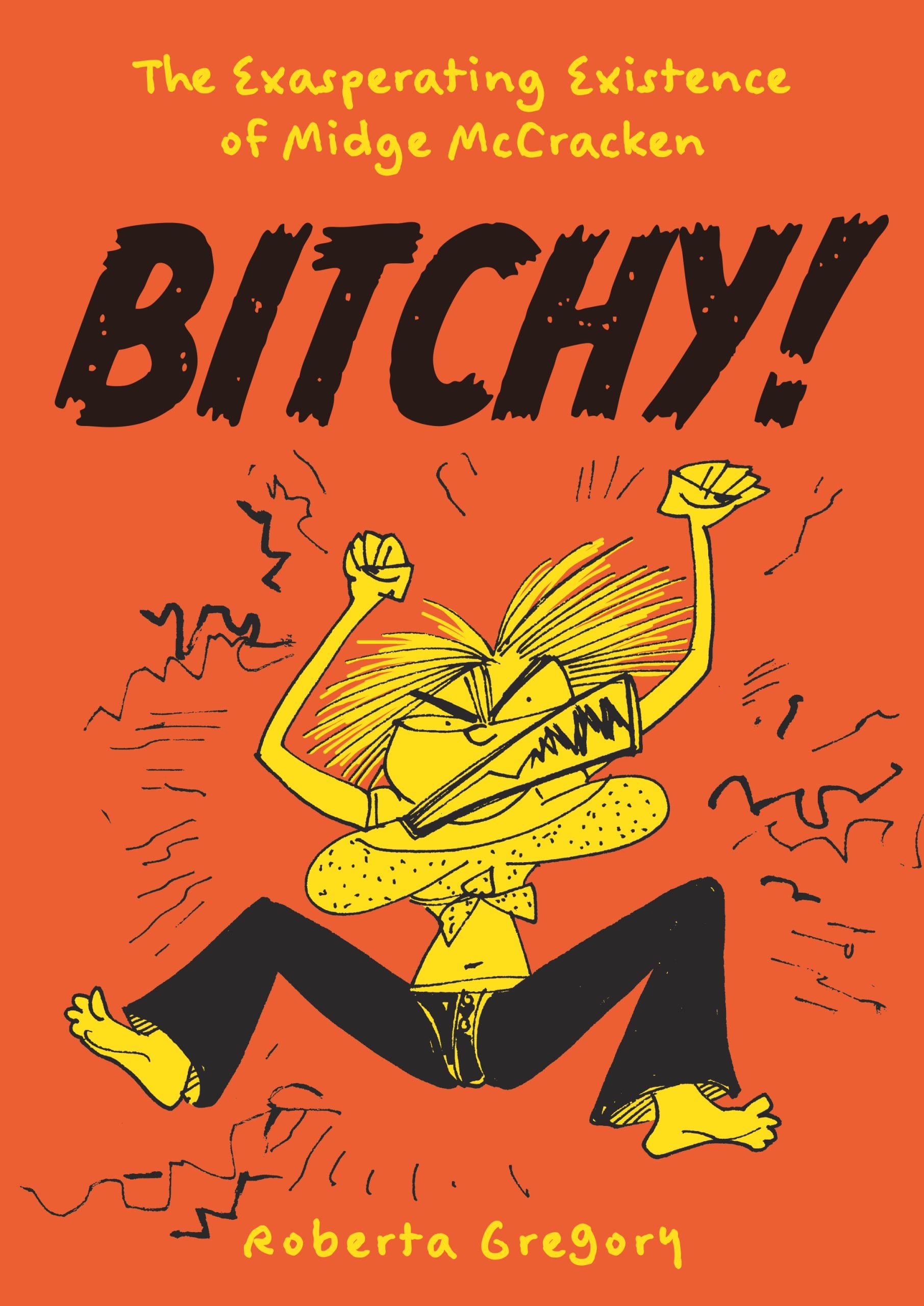
ROBERTA: Midge’s very first appearance was more visual than emotional — my take on the 1980s “ugly art” style of angst-y and often violent comics that were popular at the time, and so utterly unlike the type of comics I was actually having published in places like Gay Comix and some of my self-published books like Sheila and the Unicorn.
In a short story for a 1990 Fantagraphics anthology (Graphic Story Monthly) the “Good” Roberta was drawing kitty cat cartoons while the “Evil” Roberta was drawing the ugly, miserably unhappy Bitchy Bitch. Kim and Gary suggested I should do a comic book for Fantagraphics that I thought would be a one-shot. I imagined a collection of sexy and subversive stories which is why I titled it Naughty Bits, and the perfect place for another Bitchy appearance, but it happened to catch on… for forty more issues.
At first I had absolutely no love for this “Bitchy” character but by the third issue I began to imagine her childhood and family background which made her an increasingly complicated character (as well as the star of the series) and I kinda warmed up to her, although it didn’t keep me from subjecting her to some traumatic life experiences utterly lacking in my own rather uneventful existence.
Cultural Climate
GVN: During its long run, BITCHY! spans decades of shifting social norms, politics, and gender expectations. How did the cultural climate of the times shape the tone, humor, and anger that define the strip, or were there other influences?
ROBERTA: The adult Bitchy storyline takes place in the 1990s and early 2000s, but it all seems so dated since that first issue 35 years ago. When it looked like Naughty Bits would be an ongoing series I was pretty stoked, since before that, not counting my quirky self published stuff, I’d only had stories appear at random in anthology titles like Wimmen’s Comix and Gay Comix.
From 1972 on I pretty much read underground comix (many of which would probably provoke serious backlash in today’s social media-dominated world), to answer where the “tone” of my stories might come from; writing fiction about a topic to figure out what I thought about it, you know. I based the “present day” Bitchy stories on current events and created a comic book series I would most look forward to reading, starring a very challenging protagonist providing no easy answers. Remember, these Bitchy episodes appeared every 4 months or so (whenever readers could find them out in the comics retail world) in a comic book usually filled with other content… lots of my autobiographical stories, commentary from readers, guest pages, and so on.
Creative Evolution
GVN: Your satire is sharp, fearless, and often uncomfortably true. What’s your internal barometer for deciding when a strip should be funny, when it should sting, and when it should outright provoke, or do those decisions evolve as you create?
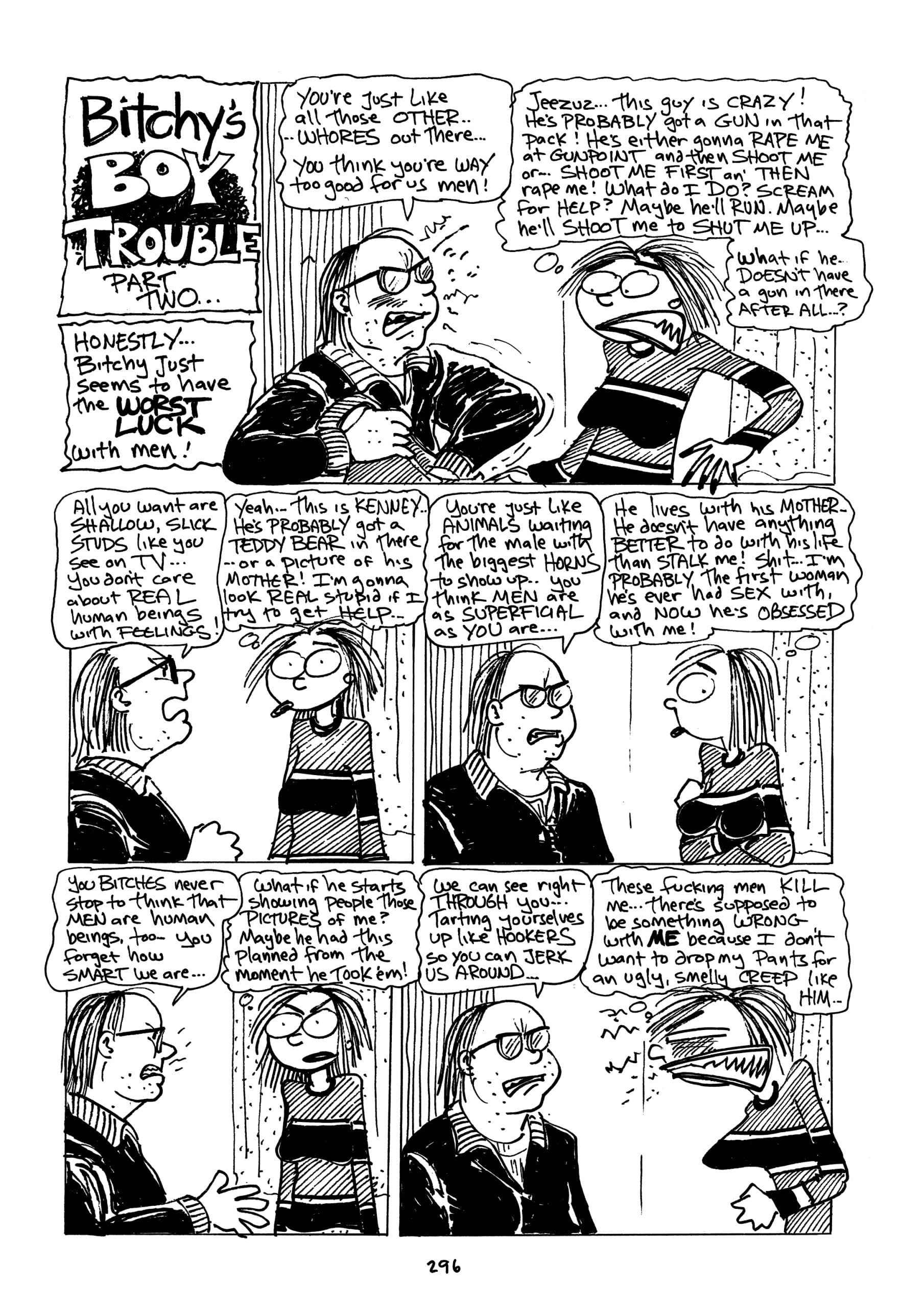
ROBERTA: I don’t think I really put quite so much thought or creative analysis into these stories, to be honest. I had to produce them on a regular basis from 1991 until 2003, (while working on more demanding graphic projects like Winging It and Artistic Licentiousness) and the chronology is spotty: Bitchy returns from her vacation, followed by a three-issue flashback of her college days, then back to vacation-related stories in the next three issues, then a look at her grade-school days, followed by an issue featuring a post-college story, and so on, this sequence over the course of four years.
I’d give Fantagraphics a story idea to promote with a three-month deadline, then work on something else (while keeping Bitchy in mind), then collect whatever story notes I’d scribbled down and churn out the Bitchy story in a few weeks, just in time for publication. I’m still kinda surprised the timeline holds together so consistently with these stories rearranged into Midge’s chronology. I would definitely call this creative process evolution rather than deliberation, and after counterculture life in LA during my young adulthood, hardly anything offends me anymore.
Deciding What Works
GVN: Bitchy is abrasive, cynical, and self-sabotaging; however, more than anything, she is profoundly human. What do you think readers misunderstand the most about her, and what do you see as her most vulnerable trait?
ROBERTA: In the earliest stories, which didn’t make the cut for the BITCHY! collection, Midge was rather a two-dimensional angry woman character, though even in the very first issue (when I thought I’d never have to deal with her ever again) I tossed in some moments of yearning and vulnerability on a whim, briefly thought it seemed out of place but left it in anyway. (So much of my writing seems to consist of shrugging, saying “Hey, that works,” and moving on, only to find out afterwards that it all ties in together in some weird way.)
Midge seemed to be simply an off-putting “angry woman” to a lot of readers, though those who continued through the series did acknowledge there was much more going on. I see her lacking the self-awareness to realize why so many of her woes are self-inflicted (don’t we all!), while retaining some primal realization that things may not have to be this way. Despite the negative conditioning of her upbringing I do let her enjoy a few breakthroughs as her storyline unfolds, a few of which may be likely to last. Let’s hope.
Fantagraphics
GVN: Fantagraphics has been home to so many boundary‑pushing cartoonists. What made this the right moment—and the right publisher—to assemble a definitive collection of Bitchy’s world?
ROBERTA: Since Fantagraphics published the series, it seemed to make sense they should publish the collection. As for the right moment… who knows? I guess we’ll find out when BITCHY! becomes available to the general public.
Inspiration to Underground Comics
GVN: As I have looked at your career, you’ve been a foundational voice in underground and alternative comics. Looking back, what do you feel your work—and Bitchy specifically—contributed to the evolution of women’s voices in comics?
ROBERTA: I began to receive fan mail from younger women, many who sent me their own zines and comics (often appearing somewhat Bitchy-inspired: dealing with women’s anger and frustration, complaints about men, and so forth). Plus, a lot of women’s comics anthologies were published in the mid-1990s, some of them after Naughty Bits became A Thing: Last Gasp published Twisted Sisters, Fantagraphics published Real Girl, Slave Labor published Action Girl, MU Press published On Our Butts, and I’m sure I’ve left some out. It reminded me of the inspiring wave of women’s anthologies twenty years earlier. I don’t know how Bitchy-inspired any of this was, but the energy was certainly there.
Bitchy Dealing with Today’s World
GVN: Thank you so much for sharing a bit of your day, Roberta. Finally, on a more rhetorical note, if Bitchy were navigating today’s world—social media, gig-economy burnout, political polarization—how do you imagine she’d respond, and what would she be furious about first?
ROBERTA: I think Bitchy would be pretty enraged by just about everything in the news these days. And we can all imagine WHO she’d be most furious about. (I’ve drawn a number of minor cartoons over the past several years of Bitchy dealing with current events and public figures in her own, uniquely explosive way.) Maybe the world is ready for another wave of Bitchiness. Goddess help us all.
Fantagraphics BITCHY!: The Exasperating Existence of Midge McCracken isn’t just a return to a cult‑favorite character. It’s a reminder of how sharp, fearless, and emotionally honest Roberta Gregory has always been. Midge’s frustrations, her humor, her unapologetic voice—they still land with the same punch they had decades ago, maybe even harder now. There’s no pretense, no polishing—just a creator who has spent her career telling stories that refuse to look away from the messy parts of being human. And that’s exactly why Midge endures. She’s flawed, she’s loud, she’s relatable, and she’s still saying things people need to hear.

Senior Writer at GeekVibesNation – I am a 60 something child of the 70’s who admits to being a Star Trek/Star Wars/Comic Book junkie who once dove headfirst over a cliff (Ok, it was a small hill) to try to rescue his Fantastic Four comic from a watery grave. I am married to a lovely woman who is as crazy as I am and the proud parent of a 21-year-old young man with autism. My wife and son are my real heroes.