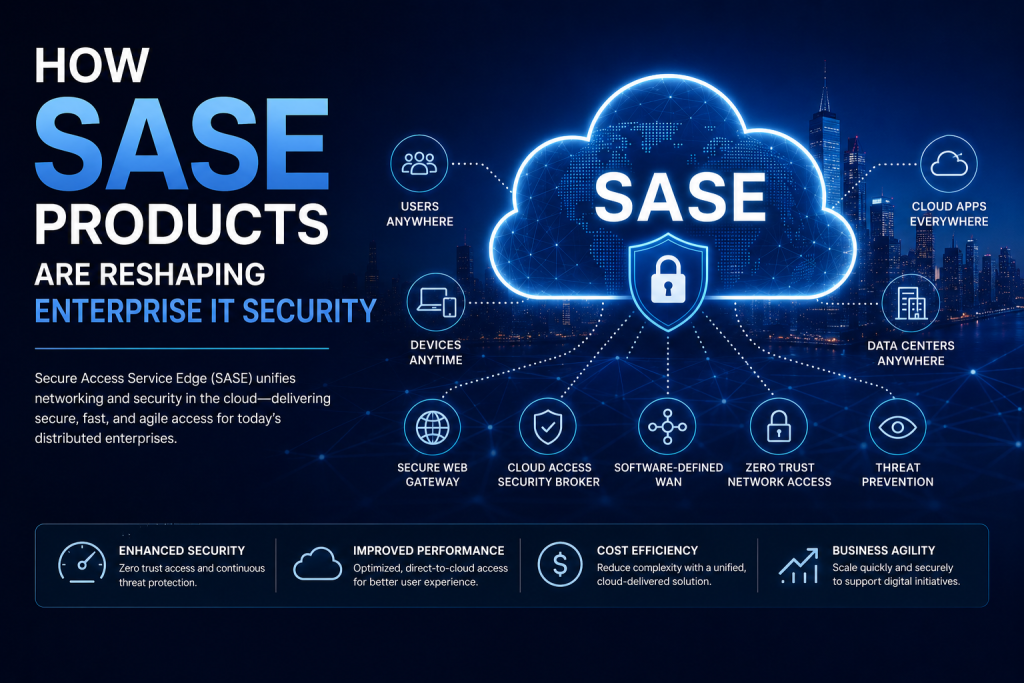
Enterprise networks are not confined to a single building or data center. Your employees connect from homes, coffee shops, airports and branch offices, while applications (and the data they process) increasingly live in the cloud rather than on-prem servers. This change had made security teams reconsider an approach that was created for a world with defined perimeters and generally constant traffic flow. The old guard of enterprise protection — standalone firewalls, site-to-site VPNS, so on — is underperforming in a world populated by users who assume they should be able to work securely from anywhere with low latency.
To meet this gap, a newer breed of tech was developed that converged networking and security functions in a single cloud-delivered service. This convergence extends beyond the way organizations connect users to applications; it also affects how security teams think about risk, visibility and controls across a distributed enterprise.
SASE products for IT security teams are becoming a standard evaluation criterion for organizations planning a phased move away from legacy VPNs and appliance-based firewalls, since the depth of integration between networking and security functions varies widely from one platform to the next.
We no longer live inside the traditional security perimeter
Enterprise security used to depend on a hard shell of what was inside the network and outside it. Firewalls perched at the edge, VPNs tunneled remote users back into that perimeter and a pass of all traffic occurred past one or more central data center(s) to be inspected. The implication of that model made sense when applications lived in place — think a couple of controlled locations — and remote access was the exception rather than the expected.
This assumption has been shattered with the take-off of cloud applications, distributed workforces and branch offices connected straight to the Internet. Backhauling all traffic through a central hub increases latency, annoys the users, and puts a single point of failure. And yet, security teams require policy enforcement to be uniform regardless of where a user connects from or which application they are seeking access to. The shift to converged networking and security architectures is a major force driven by this tension between performance and protection.
What This Convergence Actually Combines
In essence, this category of tech essentially integrates SD-WAN with a suite of security capabilities consisting of secure web gateways, cloud access security brokers, next-gen firewall functions and zero trust network access. Instead of deploying and managing these as different products from multiple vendors, organizations can consume them as an integrated service out of the cloud with policies enforced consistently regardless of the user’s physical location.
Why does this convergence matter? Well, it matters on several levels. This simplifies operations,as security teams that previously had to contend with disparate management consoles, each having its own policy language and reporting format can work out of a single pane of glass. It enhances the experience for users: traffic can be inspected and routed closer to where users actually sit rather than taking an indirect path through a remote data center. It also enables a more uniform security posture: the same policies are in place no matter whether a user is working from headquarters, at a branch office or remotely.
Zero Trust as the New Default
At the heart of this shift are zero-trust principles. Instead of just trusting anything inside the corporate network, this model validates each access request based on user identification, device posture and contextual signals before letting an application. This is a welcome change to legacy VPN access that has, historically speaking, presented users with very broad network-level access once they are authenticated.
Security teams building their own roadmaps often turn to published zero trust maturity guidance from government agencies when deciding how quickly to phase out legacy perimeter-based controls in favor of identity-centric access.
Real Customer Benefits for Enterprise IT Teams
The practical benefits for enterprise IT security teams emerge in several different areas. Cloud simplifies branch-office connectivity, replacing the need for expensive, complex networking hardware with cloud-based security policy enforcement, eliminating the need for a rack full of appliances. From a corporate laptop at the kitchen table to a mobile device on public Wi-Fi, you deliver continuous protection for your remote and hybrid employees. Instead of correlating logs from disparate tools, security teams have centralized visibility into traffic and threats across the entire organization.
Planning a Realistic Migration
Transitioning to this model is seldom a matter of flicking a switch. Many organizations have a phased approach to move, often beginning with remote access or a portion of branch locations then extending coverage. For any IT leaders assessing vendors in this area, one of the key areas to consider is how truly integrated networking and security functions are within a single solution versus joint marketing efforts while actually being managed and licensed separately. The most cohesive practices in the industry provide more consistent policy enforcement and a much simpler operational model than any staggered set of acquired technologies.
None of this replaces the fundamentals covered by solid network security policy basics, which remain the foundation of any security program regardless of which platform sits on top of it.
Looking Ahead
Enterprise IT security strategy will probably continue to evolve toward this converged, cloud-delivered model as hybrid work and distributed applications become part of the new normal instead of short-term adaptations. Companies that focus on how these platforms mesh with their unique voice of branch, remote worker, and cloud application balance will be poised to simplify everything they do while maximizing their security benefit.
Frequently Asked Questions
What is SASE, and what problem does it solve
SASE: Secure Access Service Edge It brings networking capabilities (e.g., SD-WAN) together with security functionality (such as secure web gateways and zero trust network access) in a single cloud-delivered service, eliminating the limitations of plug-and-play point solutions.
What distinguishes this from a conventional VPN?
Most VPNs offer wide network access upon successful authentication and backhaul traffic through a centralized data center. With a converged platform, you can enforce fine-grained, identity-based access policies directly on the device and examine traffic closer to the user, providing both security and performance benefits.
Does this apply only to big enterprises?
No. Large enterprises with multiple branch offices gain substantial operational benefits from it, but mid-sized organizations with remote or hybrid employees can benefit from simple management and uniform security policy enforcement across a distributed workforce.

Caroline is doing her graduation in IT from the University of South California but keens to work as a freelance blogger. She loves to write on the latest information about IoT, technology, and business. She has innovative ideas and shares her experience with her readers.