Every critic, no matter how hard they try to avoid them, has biases. Personally, I do my best to remove those, but sometimes, it is just plain impossible. I will lay that all out here. For about a decade, I worked in the substance abuse counseling industry. Many in mental health professions may squirm at the choice of the word industry, but…more on that later. To make a long story short, I eventually came to understand that, even if I was personally doing good work, I felt that being in that particular system was doing more harm than good for the people I wanted to help. Much of this was due to finding that these patients were seen as a paycheck by predatory corporations that ran treatment centers. And this is to say nothing of my own mental health. With that in mind, I was given the opportunity to watch Shuffle, a documentary about this exact topic.
The director, Benjamin Flaherty, is a person in recovery and, as such, he has a deeply personal experience with treatment, which is essentially the film’s starting point. He wonders, as many do, if his experience (a successful one) is common. Many in recovery are told that there is hope, but also that there are many places one can fall and struggle. So, what makes the successful person in recovery special? Is it mere chance? Drug of choice? Family support? As his own personal exploration continues, the film smartly branches to others in recovery alongside Flaherty, who have their own stories. It introduces Nicole, Daniel, and Cory, who all become important, not only in showing their histories, but also in indicting the health care system in the United States.

This topic would be quite an easy one to become dry and bogged down in health care data and talking heads. But Shuffle quickly shows both sides of an overall damaging coin. On one hand, it is a good and correct thing that addiction was finally being seen as a disease, something that medical professionals need to treat. But the dark side of this is, and stop me if you have heard this before, the health care system in the United States is absolutely a for-profit business. And there is no system that cannot be easily corrupted by good, old-fashioned greed.
Due to the fact that the processes that enable this profit are deeply complex, Flaherty has a difficult job in detailing this information in an easily understandable way. Luckily, he is more than up to the task and utilizes simple animation to show the flow of money and how it funnels to all the wrong people in the end. This simplicity only reinforces the rage he knows that the viewer will feel. It is as if he has been able to push his own emotion into the frames of the film without ever raising his voice.
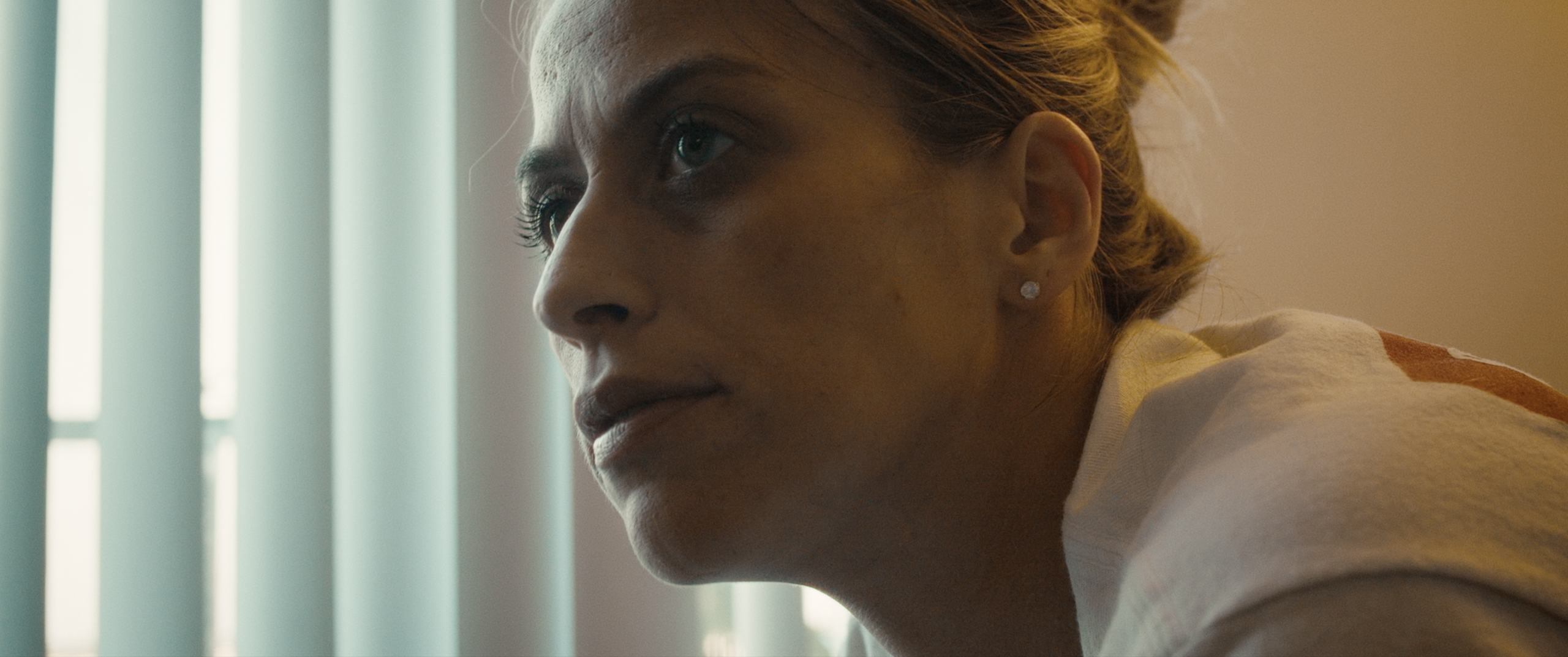
But what matters is the people affected. And, to Flaherty’s credit, he never forgets this important fact. Speaking from ancillary experiences, it would be easy for him to attempt to forget the people who struggle and to simply focus on his own recovery. But I dare anyone to look at and listen to Nicole, Daniel, and Cory and not feel their struggle. They all have friends, families, hopes, and dreams. This may seem obvious, but people forget this about those in recovery, simply because it is easier to write them off due to certain behaviors. Shuffle forces the audience to remember this and hold on to it. The emotional heft that these lives unload on us is one that will stick with me for quite a long time.
This is where Shuffle truly shines. As the title implies, these are people who never get their stories told, people who are lost in the labyrinthine maze that is health care. And more than that, despite knowing that addiction is a disease, there are still vast generalizations and judgments made about people struggling with this illness. As the film winds its way through these stories, it never judges them. The use of individual interviews, paired with discussions with family members, allows us to see them as whole people. This is in direct contrast to those in control of these systems, which only serve to make the rich richer and give those struggling both a number and a distinct dollar value. The sickness in the system is much, much deeper than addiction.
Addiction robs us of many wonderful human beings. It is a sad state of affairs when the system designed to help them refuses to value them beyond how much money they can charge insurance companies. If that system sees them as replaceable, it is, by definition, inhumane. Something must change, and Benjamin Flaherty has done admirable work bringing that humanity to the forefront in Shuffle.
Shuffle will debut exclusively in select theaters on January 16, 2026, courtesy of Abramorama. The film will expand in the following weeks.

Addiction robs us of many wonderful human beings. Something must change, and Benjamin Flaherty has done admirable work bringing that humanity to the forefront in Shuffle.

Dave is a lifelong film fan who really got his start in the independent film heyday of the 90’s. Since then, he has tried to branch out into arthouse, international, and avant garde film. Despite that, he still enjoys a good romcom or action movie. His goal is to always expand his horizons, through writing and watching new movies.