The global energy transition is no longer defined solely by advances in hardware such as photovoltaic panels or inverters. Instead, the industry is rapidly shifting toward more intelligent, integrated energy ecosystems—where software, data, and system-level coordination play a decisive role. As distributed energy resources become more widespread and energy demands grow increasingly complex, the ability to orchestrate generation, storage, and consumption in various applications at real time has become a key differentiator.
Against this backdrop, Sigenergy marked a significant milestone in a comprehensive full-scenario energy portfolio in March 2026 at the inauguration of its Nantong Smart Energy Center in Jiangsu Province, China. This is a unifying thread running through its entire product ecosystem—spanning residential, commercial & industrial (C&I), and utility-scale applications.
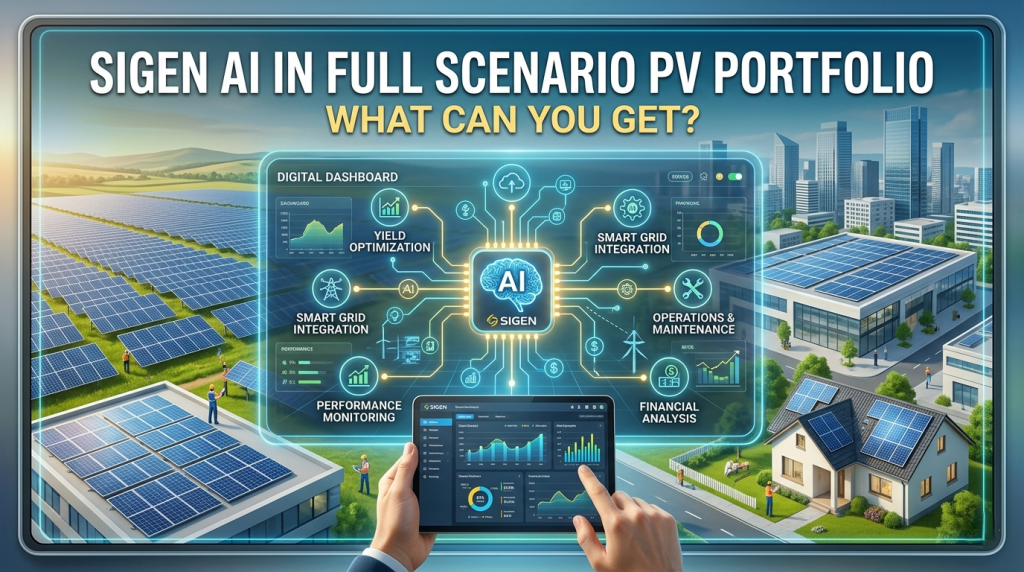
And during this event, Sigenergy officially introduced its “AI in All” strategy alongside, embedding AI across every layer of energy management, transforming how systems are designed, deployed, and optimized in three various applications.
What is “AI in All”?
Before diving into how it applies across residential, commercial, and utility-scale scenarios, it is essential to first understand the core philosophy behind Sigenergy’s “AI in All” strategy.
At its core, “AI in All” positions AI as a foundational capability rather than a standalone function. In traditional energy systems, components such as PV modules, inverters, battery storage, EV chargers, and energy management platforms often operate in silos. Even when connected, they rely on predefined logic or limited optimization rules, which restricts their ability to adapt to dynamic conditions.
“AI in All” takes a different approach. By embedding AI at the system level, Sigenergy enables the integration of fragmented devices, complex energy flows, and diverse application scenarios into a highly coordinated ecosystem. Instead of isolated operations, every component becomes part of an intelligent network that can communicate, learn, and respond in real time.
From Hardware to Intelligent Platform: How “AI in All” Transforms Residential Energy
In the residential scenario, Sigenergy’s “AI in All” strategy is most clearly reflected in how it redefines the role of SigenStor. Rather than functioning as a conventional combination of PV inverter, battery, and EV charging hardware, SigenStor evolves into a fully integrated, AI-driven home energy platform—capable of perception, decision-making, and continuous optimization.
Traditionally, a home energy setup comprising PV generation, battery storage, EV charging, and household loads, functions as a loosely connected assembly of hardware. Each component may perform well individually, but coordination across the system is often limited, resulting in suboptimal energy utilization and a heavy reliance on manual configuration.
With SigenStor at home, this fragmented structure is re-architected into a highly coordinated whole.
-
AI as the System Backbone: From Fragmentation to Integration
At the core of the residential solution, SigenStor is no longer defined by its hardware composition, but by the intelligence that connects and orchestrates it. AI acts as the system backbone, integrating:
-
Distributed devices (PV, battery, EV charger, smart loads)
-
Complex energy flows (generation, storage, consumption, grid interaction)
-
Diverse usage scenarios (self-consumption, backup power, tariff optimization)
Instead of operating in isolation, every element becomes part of a synchronized network. Energy is no longer managed at the device level, but at the system level—where decisions are made holistically rather than sequentially.
-
Unified Orchestration: One System, One Logic
This integration enables unified scheduling across the entire household energy ecosystem. Through platform, the mySigen App, AI continuously coordinates when to generate, store, consume, or export energy based on real-time conditions and predictive inputs.
For example, rather than separately configuring battery charging or EV charging schedules, the system evaluates all variables simultaneously—household demand, solar availability, electricity pricing, and grid signals—and executes a single, optimized strategy.
This is a critical distinction: the home operates as one energy system, not multiple devices.
-
Continuous Evolution: From Static Rules to Adaptive Intelligence
Equally important is the system’s ability to evolve. In conventional setups, optimization is constrained by fixed rules or user-defined settings. Under “AI in All,” SigenStor continuously learns from:
-
Historical consumption patterns
-
Environmental changes such as weather and seasonality
-
User behavior and preferences
Over time, this enables increasingly refined energy strategies—improving self-consumption rates, reducing electricity costs, and enhancing energy resilience without requiring constant user intervention.
As a result of this architecture of “AI in All”, SigenStor transitions from a hardware-centric solution into a bridge of intelligent home energy. Its value no longer lies solely in conversion efficiency or storage capacity, but in its ability to:
-
Coordinate all energy assets in real time
-
Adapt to changing conditions autonomously
-
Deliver system-wide optimization rather than isolated performance gains
At the same launch event, Sigenergy also introduced the SigenStor Neo, further extending this concept. Built on the same “AI in All” foundation, SigenStor Neo is designed to harness AI as a unifying layer as well—connecting devices, synchronizing energy flows, and enabling seamless coordination across the entire home energy ecosystem.
Driving Measurable Value: “AI in All” in Commercial & Industrial Scenarios
In commercial and industrial (C&I) applications, the value of Sigenergy’s “AI in All” strategy becomes even more tangible: it directly translates into higher operational efficiency, lower system complexity, and quantifiable business returns. At the March 2026 launch event, alongside its broader “AI in All” strategy, Sigenergy officially introduced the Sigen PV Inverter 166 kW—a product purpose-built to bring AI-native capabilities into complex C&I environments.
-
From External Control to Native Intelligence
In conventional architectures, multi-inverter systems typically rely on external data loggers and centralized controllers to coordinate operations. While functional, this approach introduces:
-
Additional upfront investment
-
More points of failure
-
Greater system integration complexity
Under the “AI in All” framework, this paradigm is fundamentally restructured.
The Sigen PV Inverter 166 kW embeds an Energy Management System (EMS) directly within each unit. This design enables hundred-unit-level parallel operation without the need for external data acquisition or centralized control devices. Any inverter within the network can dynamically assume the role of a master controller, orchestrating system-wide operations.
-
Decentralized Coordination: A More Resilient Architecture
By distributing control capabilities across all inverters, the system achieves true decentralized collaborative control. This architecture delivers several critical advantages:
-
Elimination of single points of failure: No reliance on a central controller improves system robustness
-
Higher scalability: Expanding the system does not require redesigning the control architecture
-
Simplified deployment: Reduced hardware components streamline installation and commissioning
As control capabilities become intrinsic to each device, previously “essential” auxiliary equipment naturally disappears. The result is a leaner system with improved reliability and long-term maintainability.
Maximizing Intelligence at Scale: “AI in All” in Utility-Scale Power Plants
In utility-scale scenarios, where solar plants operate across vast geographies and interact directly with grid-level dispatch systems, the value of Sigenergy’s “AI in All” strategy reaches its highest level. At the March 2026 launch event, Sigenergy introduced the Sigen PV Inverter 500 kW, purpose-built for utility-scale solar plants. More than a high-capacity inverter, it is designed as an AI-native node within a larger intelligent network—where every device contributes to system-wide coordination and optimization.
From Reactive to Predictive Operation
A key manifestation of this AI foundation is the ability to perform ultra-short-term and short-term power generation forecasting.
By combining equipment data, site-level performance metrics, and weather information, the system can accurately predict future output and adjust strategies in advance. This predictive capability transforms plant operation from reactive to proactive.
More importantly, it enables continuous evolution:
-
Forecasting models improve over time with more data
-
Dispatch strategies are refined based on historical performance
-
The system adapts to seasonal, environmental, and grid-side changes
From Segmented Control to System-Level Orchestration
This integration enables unified scheduling and dispatch across the entire power plant.
With AI embedded at the inverter and system level, the plant can coordinate output not just based on instantaneous conditions, but through a holistic evaluation of grid requirements, generation capacity, and environmental forecasts. The result is a shift from segmented, reactive control to system-level orchestration.
In practical terms, this means:
-
Power generation is aligned more precisely with grid dispatch signals
-
Energy flows are optimized across the entire site rather than individual units
-
Operational decisions are executed cohesively, not independently
From Power Plant to Intelligent Energy Network
With AI embedded as the core capability, the Sigen PV Inverter 500 kW is no longer just a conversion device—it becomes part of an intelligent, adaptive energy network. Its role extends to:
-
Participating in system-wide decision-making
-
Enabling coordinated grid interaction
-
Supporting revenue optimization through smarter dispatch and reduced inefficiencies
As a result, the entire utility-scale plant transitions from static infrastructure into a dynamic, self-optimizing system.
Conclusion
Through this cross-scenario integration, Sigenergy is defining a new benchmark for AI-driven energy infrastructure. No longer is AI an isolated tool for a single application; it becomes the standard architecture for future energy systems, emphasizing:
-
Unified control and coordination across scales and sectors
-
Continuous learning and evolution of system behavior
-
Seamless integration of devices, sites, and environmental data
By establishing AI as the central connective tissue, “AI in All” is Sigenergy’s blueprint for the next generation of intelligent, resilient, and sustainable energy ecosystems.

Caroline is doing her graduation in IT from the University of South California but keens to work as a freelance blogger. She loves to write on the latest information about IoT, technology, and business. She has innovative ideas and shares her experience with her readers.