
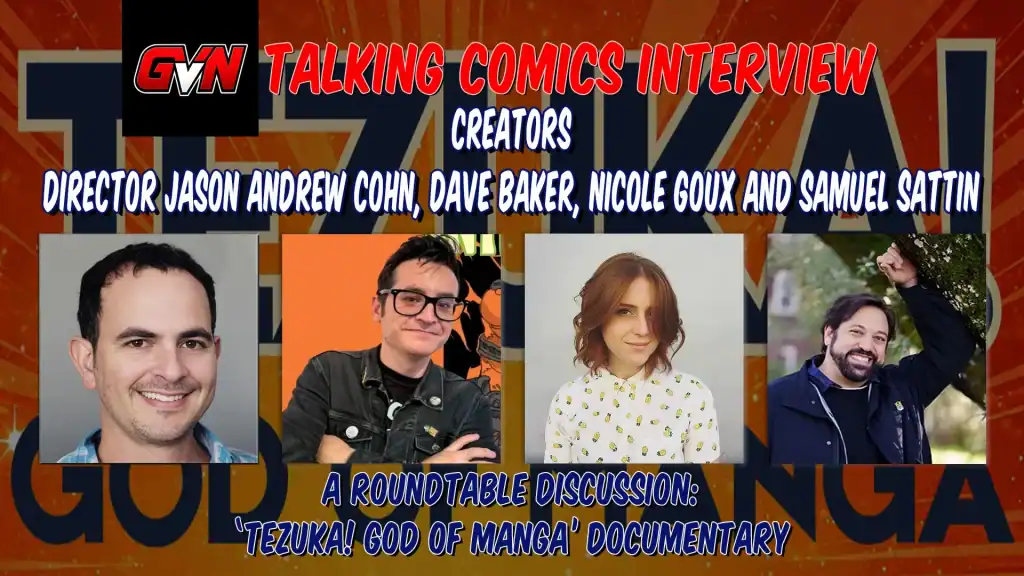
Few creators in comics have had an impact as profound and far-reaching as Osamu Tezuka. Often referred to as the “God of Manga,” Tezuka’s groundbreaking storytelling and artistic innovations helped shape the modern manga industry and influenced generations of creators across the globe. Now, a new documentary aims to celebrate that extraordinary legacy while exploring the man behind the legend.
We recently had the chance to host a roundtable discussion about this remarkable man and his exciting, important project. Participating were documentary director Jason Andrew Cohn and renowned comic creators Dave Baker, Nicole Goux, and Samuel Sattin. Their work mirrors the global creative landscape that Tezuka helped shape. Together, we explored Tezuka’s lasting influence, the challenges of portraying such an iconic figure on film, and why his stories continue to captivate readers and creators decades after their original publication.
So, settle in as we explore the life, legacy, and lasting impact of one of the most important storytellers in comic book history and learn why TEZUKA! God of Manga is a project that deserves the attention of comics fans everywhere.
Tezuka’s Influence
GVN: Thank you all for sharing your thoughts on this exciting new documentary about the iconic work of Osamu Tezuka. Throughout his remarkable career, Tezuka helped lay the foundation for modern comics and animation. How has his work personally influenced each of you in storytelling, design, pacing, or world-building?
Cohn: I’m a documentary filmmaker so the influence isn’t direct the way it might be for these esteemed artists! But I will say that I don’t think I’d be a big fan of Japanese pop culture if I didn’t discover Tezuka early on. I was a Japanese history major as an undergrad and I was very interested in modern Japanese novels, the movies of Kurosawa and Ozu, sort of highbrow stuff like that. But I always loved comic books and graphic novels. I was really into some American alternative comic book artists like Peter Bagge, Rooberta Gregory and Daniel Clowes. And I was under the impression that Japanese comic books and animation didn’t go to those places. So discovering Tezuka changed all that and it led me to start reading other great ‘Golden Era’ manga artists, not to mention the anime of people like Satoshi Kon. So it opened my eyes to a whole world of Japanese creativity.
Baker: Osamu Tezuka’s work is a towering achievement. It’s almost hard to know where to begin when describing his work. I guess, I’ll start with his fashion sense. Who doesn’t want to wake up and immediately reach for a beret? The man’s sartorial instincts aside, I love the density and the movement of his work. The simplicity of the anatomy of his drawings. I also Love the idea that he was just a fountain of ideas, and was always creating new genre and boundary pushing stories. He wasn’t defined by the previous work he made, and I think that’s something that every artist can learn a lot from.
Goux: I have the utmost respect for Tezuka’s work. The fact that he was able to simultaneously put out the quality and quantity of his output is shocking to me. I do my best to get a page a day, and he’s out here cranking it out. And it’s all so good! Definitely something to aspire to.
Sattin: Tezuka was brilliant in a lot of ways. From the way treated cartooning like a mad scientist’s laboratory to his ability to run the gamut in terms of artwork and tone, he expanded and often defined the medium within which he worked in ways that would be impossible for future generations to ignore. But for me, what I love most about Tezuka is his ideas. He was an endless wellspring of incredible ideas, and what appeared to be an unlimited fount of characters to bring those ideas to life. It is perhaps in the way that he encouraged such incredible departures from convention that I am inspired most.
The “Tezuka” Effect on Creators
GVN: Tezuka’s work spans various genres, mediums, and decades. Each of you has experienced this work affecting you in different ways. Why do you think his storytelling continues to resonate so strongly with contemporary creators and readers?
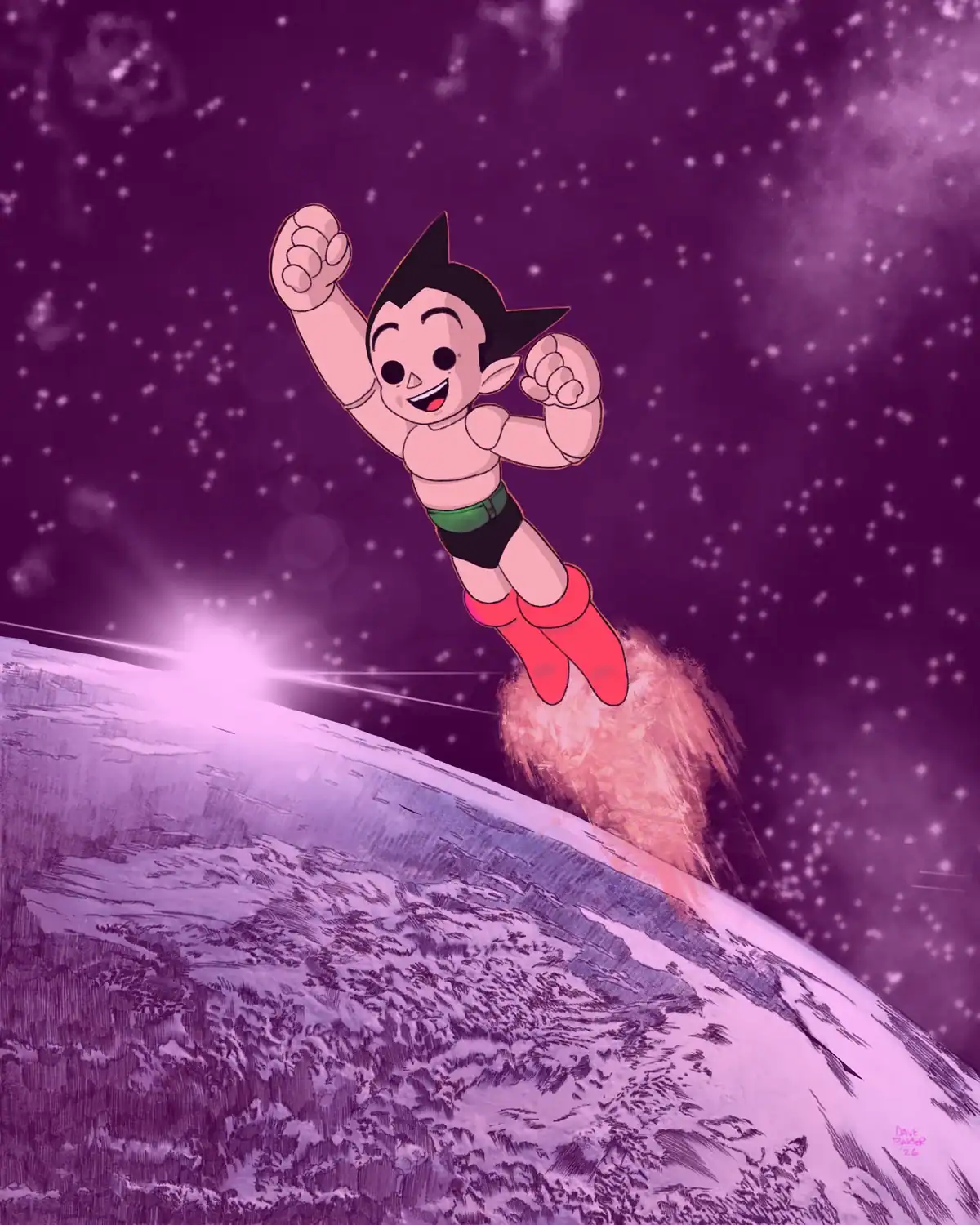
Cohn: I agree with that. The willingness to constantly reinvent yourself as an artist is totally inspirational. He could have kept remaking Astro Boy forever and he probably would have made more money doing that but he was never satisfied with repeating himself. Part of the challenge of introducing Tezuka to audiences is just this question of where do you start? I mean, he had a whole career making G-rated adventure stories for young boys…and then at some point he starts creating stories like MW or Ayako, which get into crazy dark territory like genocide and incest. I can’t really think of anyone equivalent in the West. Can you imagine Charles Schultz writing a story about a girl held as a sex captive by her own family?
Baker: The fact that Tezuka continually found new ways to approach the idea of making comics and manga, says a lot about his outlook on the act of creation. I love the idea of having the ability to take a step back, look at your body of work, and then re-design an approach to your legacy as an artist.
Goux: For me, it’s the flow of clarity in his work. Tezuka always had a perfect sense of where to put the camera, and that’s something I’m very interested in as well. What’s the best place to view the events of a story from. What’s the best way to clue the audience into what’s happening? What’s the best vantage point to see this scene from, and how does it change things if I move the camera somewhere else? Clarity in storytelling is the most important aspect of making narrative work, to me.
Sattin: Of course Tezuka is responsible for an immense cultural shift, as he laid the foundation for modern Japanese comics and anime. But what often goes undiscussed is that Tezuka was also a one-of-a-kind storyteller who always thought outside the box. He didn’t just have big ambitions… He’s a profound soul. He takes fables and myths that at one time looked like they could originate in the same garden as classic Disney films, and gave them complex themes, moral uncertainties, and a sense of folkloric tragedy that didn’t allow for fairy tale endings. For instance, Astro Boy isn’t just a force for good in an aspiring techno-utopia. He’s a mechanical Pinocchio created by a cold and selfish Gapetto to replace his dead son. That Gapetto, Dr. Tenma then sells Astro Boy off into servitude once he discovers that he will never grow up and replace what he lost. So yes, you have heroism and excitement and action and adventure. But you also have discomfort and emotion and a cauldron of often opposing ideas. This is what I find so amazing about Tezuka. There is always another layer to unfurl.
Reflections of Tezuka’s Work
GVN: Creators who are inspired by his work often unknowingly carry forward elements of Tezuka’s artistry. What aspects of his craft—such as visual rhythm, emotional clarity, and thematic ambition—do you see reflected in your work or hope to emulate?
Baker: Honestly, for me, it’s more his creative impact on Shotaro Ishinomori and then Ishinomori’s approach to iterative design, costume creation, and clarity of silhouette. I also love the way he used assistants. I love seeing Ishinomori’s transparent use of assistants vs Tezuka’s more blended approach. It’s deeply funny and also fascinating, to me.
Goux: In my own work, I focus on the emotion of a scene a lot. The characters expression, the way the scene feels. I don’t know that it’s exactly fro Tezuka, honestly, but I think we have similar interests in that respect.
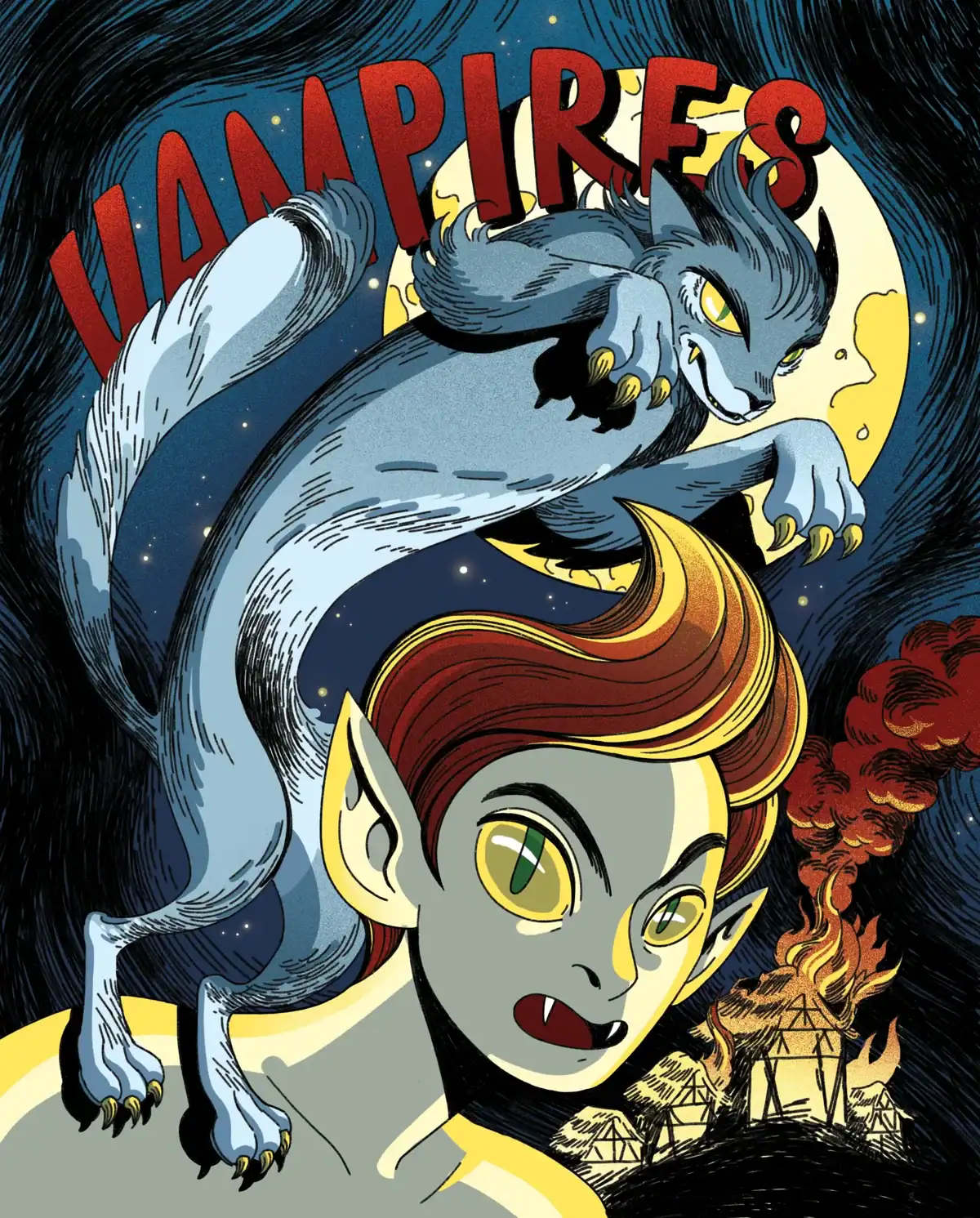
Sattin: Emotional and thematic complexity. Also, the fact that Tezuka will follow a story to wildly bizarre heights. I love that. One of the greatest parts of Tezuka’s work as well is the notion of transformation. Something can always become something else in Tezuka-world. That transformation can be positive, negative, or neutral, but it always occurs, and I like to try and apply that sensibility to my own stories as well.
Tezuka’s Global Reach
GVN: This roundtable brings together your four unique perspectives. As you’ve likely heard your peers discussing Tezuka’s impact, what insights did you gain from their conversations? Did your perspectives change as the discussions progressed?
Baker: I really like the idea that Tezuka’s impact extends well beyond his death and now reverberates amongst a cadre of creative people that live literally on the other side of the globe. That’s both a truly fascinating level of impact and also I’ve really loved hearing the various ways that idea has manifested within the other people in this roundtable.
Goux: What Dave said, haha.
Sattin: I’m just happy to have been able to contribute a few thoughts.
The Impact of the Documentary
GVN: Once fans see this film, what do you hope viewers—especially those new to Tezuka—will take away from this documentary, and how might it reshape Western understanding of manga’s origins?
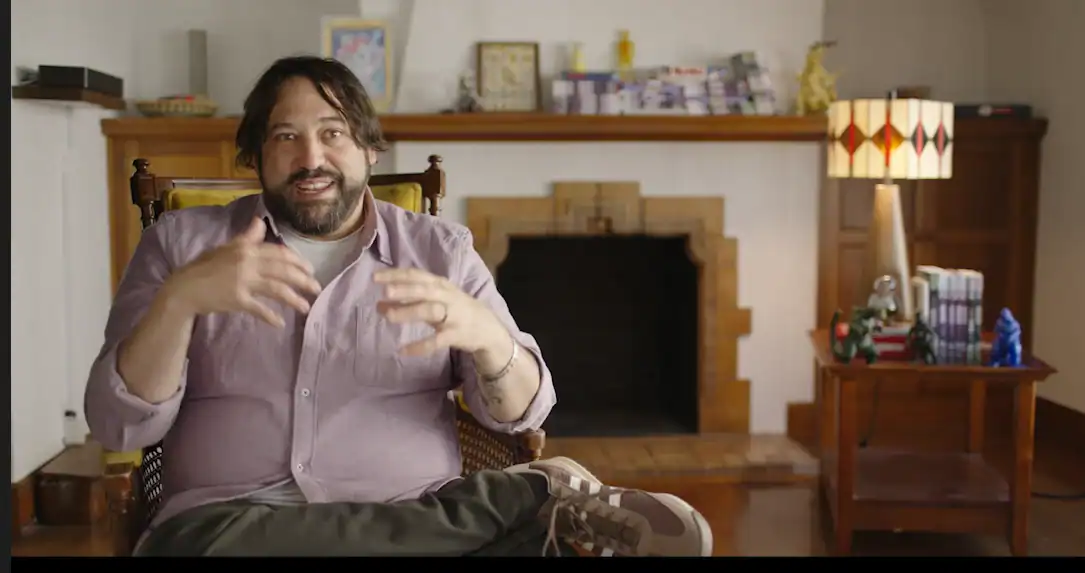
Cohn: Yeah, I’m really fascinated by the postwar era in Japan that Tezuka was active during. It was incredibly dynamic and fertile, and that was the context in which modern manga developed. So I hope people kind of move the needle backward on where they start paying attention to manga, if that makes sense. Because I think for a lot of people it starts maybe with Otomo’s Akira or something like that, so the 1980s, basically. I’d love more people to discover not just Tezuka, but also his contemporaries like Shirato Sanpei, Shigeru Mizuki and Yoshihiro Tatsumi. I think it helps to be grounded a little bit in the history and the culture, so that’s part of what we hope to accomplish with this film – not just profiling Tezuka, but placing him in his world historical context.
Baker: I hope it makes them want to read more manga.
Goux: I hope that they appreciate that these things are made by people. And what one person can do, anyone can do. So, I hope it serves as an inspiration, in that respect.
Sattin: I hope people will start spending more time looking towards the past. We’re in a time of forgetting. In that time it’s hard to recall what came before us, what shaped the things we love not just today, but ten years ago, twenty years ago, thirty years ago. I’m not saying we all need to become historians, but reading Tezuka is like reading at the dawn of an era. He provides a unique window into the world that made our current one possible.
The Importance of Crowdfunding for Documentaries as a Whole
GVN: Thank you all once again for sharing your thoughts. Finally, as “TEZUKA! God of Manga” continues its Kickstarter campaign, what makes this project a perfect fit for the platform, and why is community-driven support essential for a documentary of this scope?
Baker: This is a project that needs to be seen. And what better way to ensure that these vital stories, that the traditional pipeline doesn’t always support, get told than by directly taking it to the fans and broader comics community.
Cohn: To be honest, it’s a pretty grim time for documentary filmmakers. The normal sources of funding are drying up – we actually had a $600,000 grant for this project from the National Endowment for the Humanities canceled by the Trump Administration last year. We got caught up in the whole Elon Musk DOGE shit show. There’s a war on culture in the U.S. and doc filmmakers are feeling the pain from that. So we feel incredibly lucky that this project is so well suited to crowdfunding through a platform like Kickstarter. That’s because the audience for our film is already on Kickstarter. It’s the way that so much independent comic book art and animation gets seed-funded these days.
We made another film with our friend Arwen Curry about the fantasy author Ursula K LeGuin (The Worlds of Ursula K. LeGuin) that was partially funded through Kickstarter and that’s when we first realized that the SF/Fantasy/Comic Book/Animation audience has largely given up on market capitalism, so they’ve become the backbone of Kickstarter. Fans of these art forms are committed to keeping the thing they love alive in the culture and they don’t wait for the movie studios and publishing houses to deliver it to them. I just have so much respect for that.
Goux: Making anything is hard. Making things outside the system is even harder. So, supporting those efforts is important.
Sattin: Sometimes, a project needs to be seen to be believed. I thought similarly when we launched our Unico: Awakening Kickstarter in 2022. I just felt like traditional publishing wouldn’t necessarily know what they were looking at unless there was a groundswell of public support behind it. I see the same kind of urgency and excitement in TEZUKA! God of Manga, and I think Kickstarter is the best place to realize that excitement.
A big thank you to Jason, Dave, Nicole, and Samuel for offering their insights on this incredible project and the lasting influence of the man dubbed the “God of Manga.” Their love for the art form and admiration for Tezuka’s work show why his creations continue to resonate and stay meaningful today.
For more from the participants, be sure to check out our previous conversation with Cohn about TEZUKA! God of Manga, our interview with Sattin about UNICO: Awakening, and our exclusive Dave Baker feature on Mary Tyler MooreHawk.
Whether you’re into comics, love manga, or are simply curious about the history of visual storytelling, TEZUKA! God of Manga offers an exciting look at one of the most influential creative minds of the twentieth century.
The documentary’s Kickstarter campaign is now live and has already surpassed its initial funding goal. The campaign runs through November 13, giving fans additional time to support the project and help bring Tezuka’s life and legacy to audiences around the world.

Senior Writer at GeekVibesNation – I am a 60 something child of the 70’s who admits to being a Star Trek/Star Wars/Comic Book junkie who once dove headfirst over a cliff (Ok, it was a small hill) to try to rescue his Fantastic Four comic from a watery grave. I am married to a lovely woman who is as crazy as I am and the proud parent of a 21-year-old young man with autism. My wife and son are my real heroes.